Background: Exploring New Interactions Between Heat and Electricity
The interconversion of thermal and electrical energy is widely known through phenomena like thermoelectric generation (Seebeck effect) and Peltier cooling (Peltier effect). While these effects primarily stem from electron behavior, the possibility of heat and electricity interacting via mechanical strain in materials has also been suggested. Piezoelectric materials, in particular, generate electric charges under mechanical stress, but the ‘thermomechanical pathway’ where a thermal gradient couples with this mechanical stress to induce charge generation has not been fully explored. Understanding such new conversion pathways could lead to advancements in energy harvesting and the development of novel types of sensors.
On-Chip Detection of Anisotropic Thermopolarization in Quartz
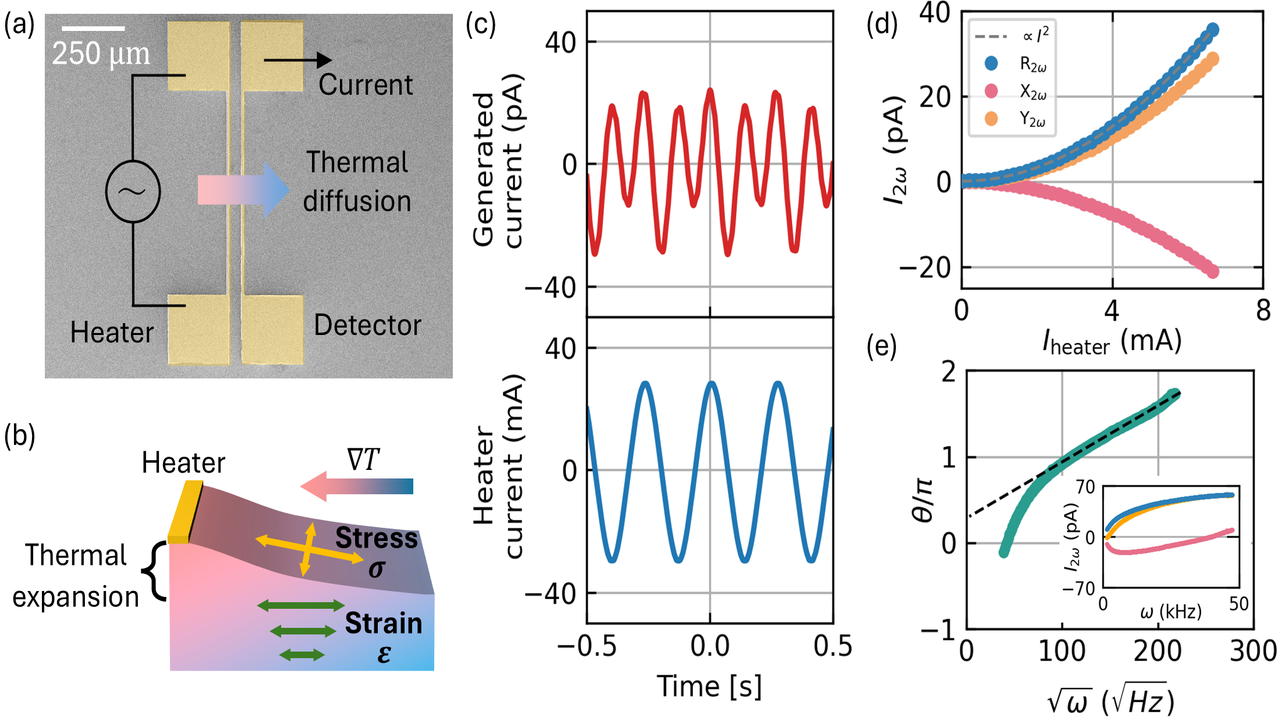
This preprint, published on arXiv, reports groundbreaking research that demonstrates how heat can be converted into electrical energy using quartz, a piezoelectric material, as a model system. The research team developed a microfabricated on-chip device, which was applied to quartz. This device allows for the highly sensitive detection of electrical responses induced by applying a localized temperature gradient to the quartz sample.
- Thermally Induced Stress and Charge Generation: Experimental results indicate that when a thermal gradient is applied along specific crystallographic axes of quartz, its anisotropic thermal expansion generates stress within the material. This stress, in turn, produces electric charges (current) through the piezoelectric effect. This phenomenon, termed ‘thermopolarization,’ was confirmed to manifest strongly in specific directions (anisotropically).
- On-Chip Detection Platform: The researchers designed an innovative on-chip device to directly detect this thermopolarization phenomenon on minute quartz samples. This platform enables precise control of the thermal gradient and measurement of minute currents, successfully revealing phenomena that were previously undetectable with conventional macroscopic measurements.
This discovery clearly demonstrates the existence of a ‘thermomechanical pathway’ for heat-to-charge conversion that was not fully appreciated before. It offers a new perspective, suggesting that phonons (thermal vibrations) and lattice strain contribute to charge generation, in addition to electronic mechanisms.
Technical Significance and Future Outlook
This research opens new frontiers in fundamental physics and materials science, with the following technical significance and future outlook:
- Innovation in Energy Harvesting: It could lead to the development of new types of energy harvesting devices that convert minute temperature differences and thermal fluctuations present in the environment into electrical energy. Applications are particularly expected in waste heat recovery, and as autonomous power sources for wearable sensors and IoT devices.
- Development of Novel Sensors: Since temperature and stress changes can be directly detected as electrical signals, it will contribute to the development of highly sensitive thermal and stress sensors, or multi-functional sensors that detect both changes simultaneously. This is particularly relevant for applications challenging for existing technologies, such as non-contact temperature measurement in harsh environments or internal stress monitoring in materials.
- Thermomechanical Characterization of Insulating Materials: This on-chip detection platform serves as a powerful tool for detailed investigation of thermomechanical responses in various insulating materials beyond quartz. This could lead to the advancement in the design and optimization of new functional insulating materials.
- Contribution to Basic Science: A deeper understanding of the complex interplay between heat, stress, and electricity could uncover unexplored areas in physics and lead to the discovery of new material design principles.
These research findings are expected to be an important step towards improving thermal energy conversion efficiency and realizing more diverse, autonomous devices.









Comments