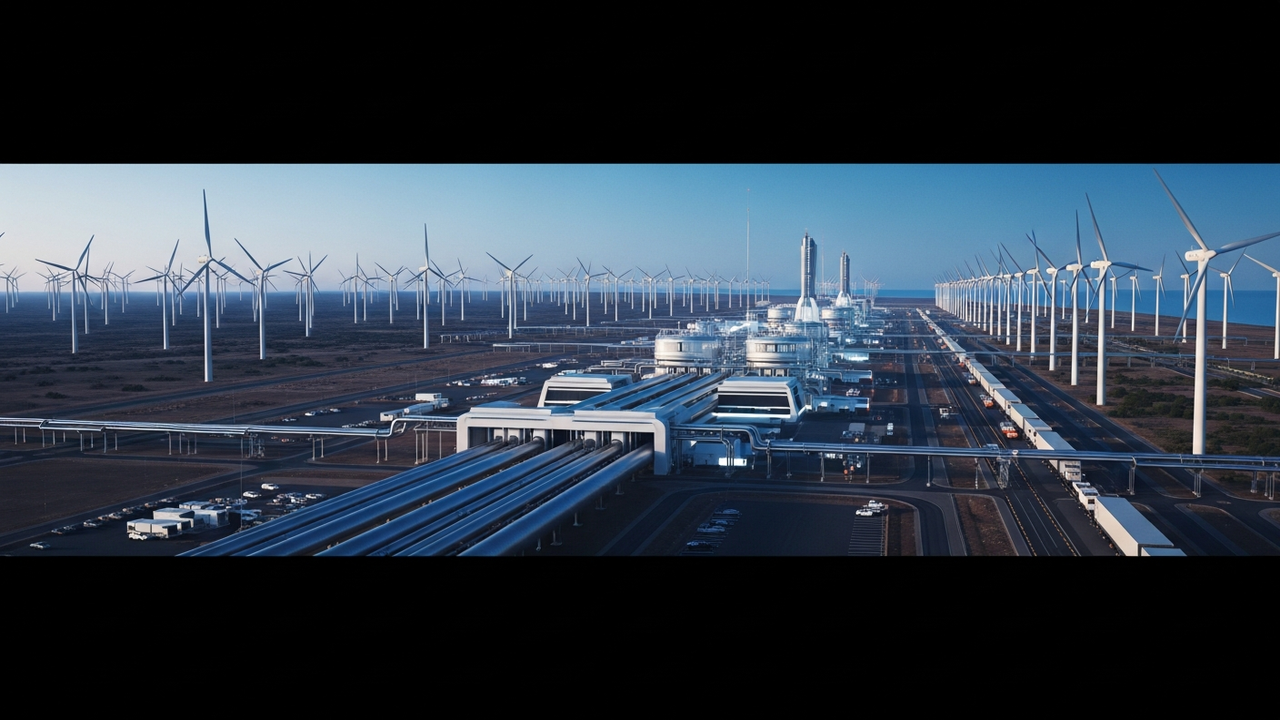
Background: Australia’s Green Hydrogen Export Strategy
Australia possesses immense potential to become a global superpower in renewable energy, thanks to its vast land area and abundant solar and wind resources. The government has strategically committed to leveraging these advantages to become a major exporter of green hydrogen and its derivatives, such as green ammonia. As countries across the Asia-Pacific region intensify their efforts to meet decarbonization targets, the demand for reliable and cost-competitive clean energy sources is rapidly escalating. Against this backdrop, large-scale integrated projects are deemed essential to solidify Australia’s international role as a clean energy provider.
Key Project Overview: The Murchison Green Hydrogen Project
The Murchison Hydrogen Renewables Project, planned near Geraldton in Western Australia, stands as a cornerstone of Australia’s green hydrogen strategy. This ambitious undertaking involves the construction of a hybrid wind and solar power facility totaling 6 GW, which will generate clean electricity. This power will then feed 3 GW of electrolyzers to produce green hydrogen. Subsequently, the hydrogen will be converted into 2 million tons of renewable ammonia annually, primarily destined for export to key Asian markets like Japan, South Korea, and Singapore. The project has received substantial financial backing, securing A$814 million in the first round of the Australian government’s Hydrogen Headstart program, and has been shortlisted for the second round.
Technical Significance and Future Outlook
The technical significance of the Murchison Project lies in its demonstration of an entire green hydrogen value chain, from large-scale renewable energy integration and electrolysis-based hydrogen production to ammonia conversion and international shipping. The 6 GW renewable energy capacity ensures both the sustainability and the massive scale of the project’s output. With a target Final Investment Decision (FID) in late 2027 and initial production slated for 2030, its successful realization is crucial for establishing Australia as a global clean energy hub. Providing stable supply to Asia will bolster regional energy security and serve as a model for international cooperation toward achieving global decarbonization goals. Challenges include managing the inherent construction and operational risks of such a large-scale project, securing firm international off-take agreements, and diligently assessing and managing local ecological impacts.
Source: https://research.csiro.au/hyresource/murchison-hydrogen-renewables-project/






Comments