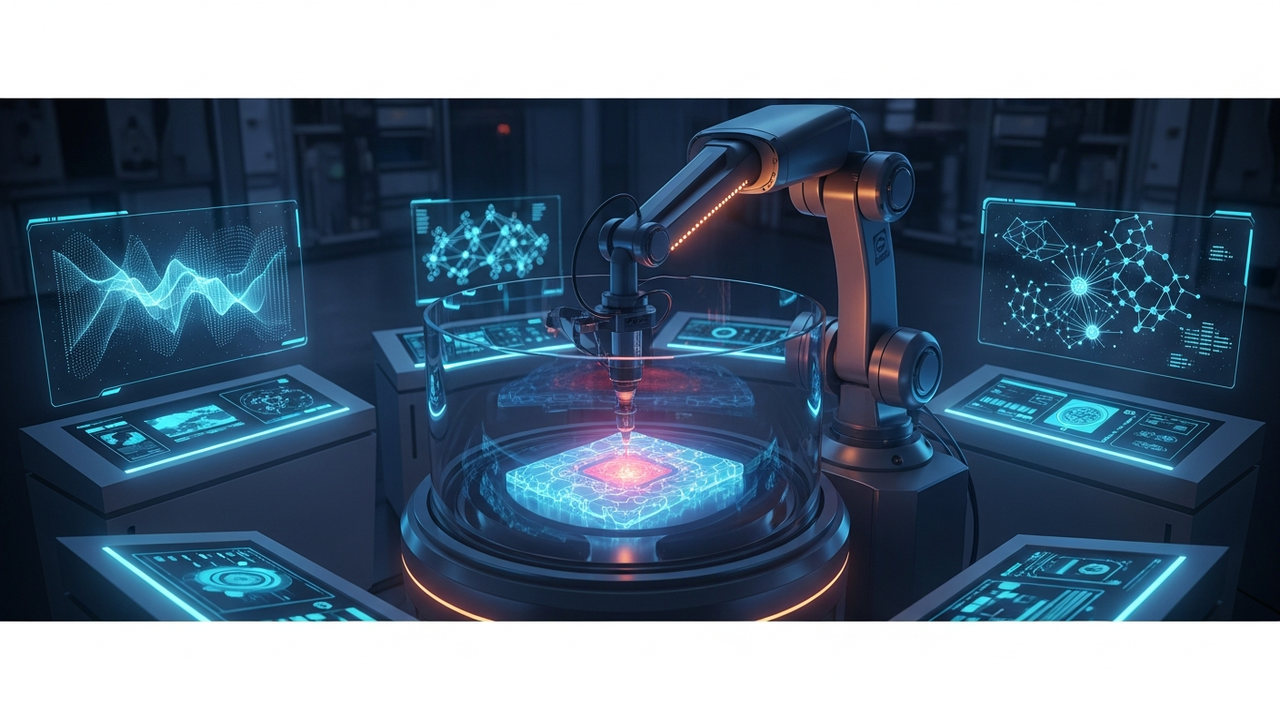
Background
In modern industrial machinery and high-performance components, tribological properties—which encompass friction, lubrication, and wear—are critical factors directly influencing equipment lifespan, efficiency, and reliability. Epoxy resins are widely used due to their excellent mechanical strength, adhesion, and chemical resistance. However, their intrinsic tribological properties are often insufficient for demanding applications. Attempts to enhance these properties by incorporating nanoparticles into epoxy matrices have been made, but designing optimal composite materials requires considering complex interactions among numerous parameters (e.g., nanoparticle type, size, concentration, dispersion method). Traditional trial-and-error approaches are time-consuming and costly.
Key Findings / Results
This research introduces an AI-driven multiparameter optimization methodology to accelerate the design and development of high-performance epoxy composites for tribological applications. This approach allows for a more rapid and efficient identification of optimal material compositions and structures compared to conventional experimental methods. Various types of nanoparticles have been utilized to enhance the properties of epoxy matrix composites:
- Diverse Nanoparticle Fillers: Metal oxide nanoparticles such as Al2O3 (aluminum oxide), SiO2 (silicon dioxide), and TiO2 (titanium dioxide), alongside carbon-based nanomaterials like carbon nanotubes (CNTs) and graphene nanoplatelets (GNPs), are incorporated into the epoxy matrix. Each type of nanoparticle contributes to composite performance through different mechanisms, including reinforcement, lubricating effects, and enhanced thermal conductivity.
- Mechanical and Thermal Property Enhancement: These nanoparticles significantly improve mechanical properties such such as tensile strength, compressive strength, hardness, and wear resistance. They also enhance thermal properties like thermal conductivity and thermal stability, enabling the composites to perform reliably under high load and elevated temperature conditions.
- Optimal Al2O3 Nanoparticle Effects: The study particularly highlights the efficacy of Al2O3 nanoparticles within the 40–50 nm size range. Nanoparticles of this size exhibit excellent dispersion characteristics throughout the epoxy matrix. Homogeneous dispersion is crucial for maximizing interfacial adhesion, which in turn enhances the composite’s hardness, resistance to surface damage, and load-bearing capacity, leading to superior friction and wear performance.
- Role of AI Optimization: Artificial intelligence (AI) technologies are employed to analyze the complex interactions between numerous parameters (e.g., nanoparticle type and loading, curing conditions) and predict optimal formulations to achieve desired tribological properties (e.g., low coefficient of friction, high wear resistance). This significantly reduces the number of experimental iterations and shortens development timelines.
Technical Significance & Outlook
The development of AI-driven optimized high-performance epoxy composites holds substantial technical significance for various tribological applications. This technology can dramatically enhance the performance and lifespan of materials used in aerospace components, automotive engine parts, industrial machinery bearings and gears, and medical devices—all fields where friction and wear are critical concerns. Expected benefits include reduced equipment maintenance costs, improved energy efficiency, and enhanced system reliability.
The outlook for this field involves further advancements in AI models and their application to more complex, multifunctional composite systems. For instance, the development of smart tribological materials with self-healing capabilities or integrated sensor functions is a promising direction. Additionally, predicting and optimizing friction and wear behavior under different environmental conditions (e.g., corrosive environments, cryogenic temperatures) remains an important research area. This technology is poised to transform the paradigm of material design from ‘trial and error’ to ‘data-driven design,’ enabling the rapid development of sustainable, high-performance next-generation materials.
Source: https://www.astrj.com/pdf-218557-140261?filename=AI-driven-multi-parameter.pdf





Comments