Key Findings
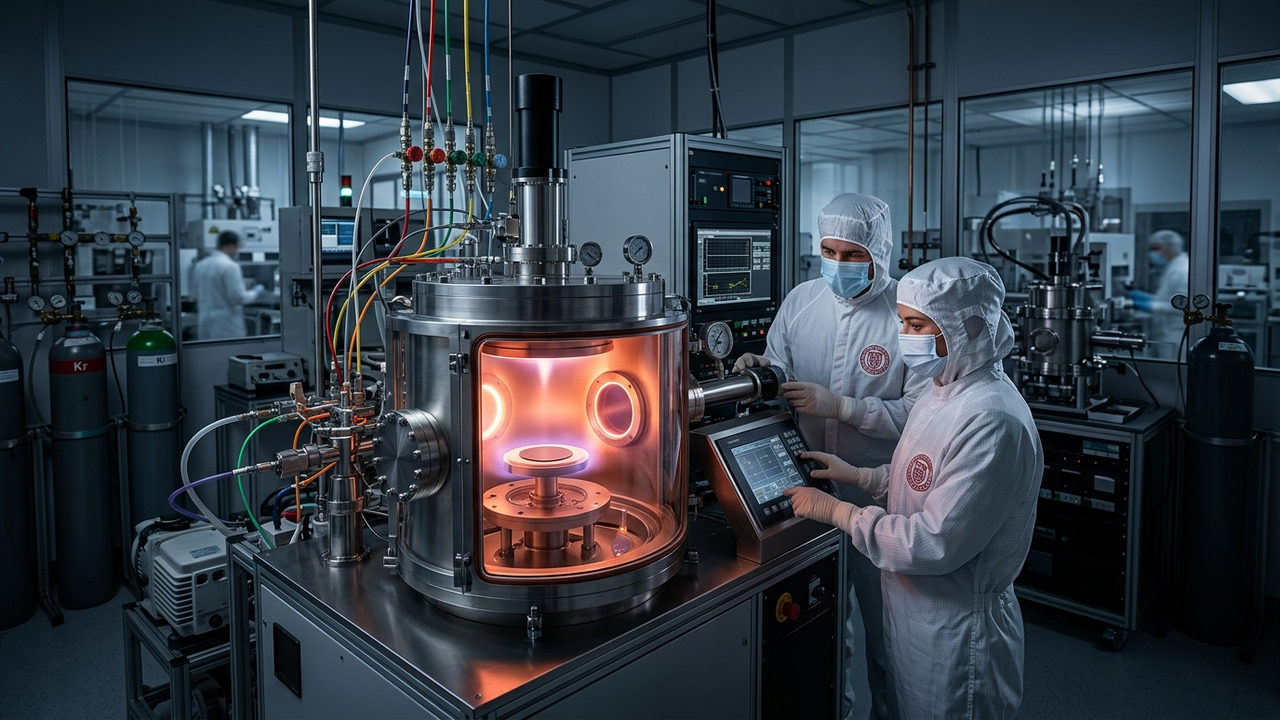
Researchers at Cornell University have developed a groundbreaking low-temperature fabrication technique for tantalum-based superconducting qubits. By replacing the conventionally used argon gas with krypton gas during magnetron sputtering, they achieved a remarkable reduction in the necessary substrate deposition temperature from over 400°C to a mere 200°C, cutting it by more than 200°C.
Technical / Clinical Details
Superconducting qubits are highly sensitive devices that operate at cryogenic temperatures, and temperature control during their fabrication directly impacts performance and scalability. Traditional tantalum film deposition techniques often require high temperatures to ensure crystal quality and superconducting properties, which hinders compatibility with existing silicon-based semiconductor manufacturing equipment. The Cornell team discovered that heavier krypton atoms more efficiently dislodge atoms from the target material, enabling the formation of high-quality tantalum thin films even at lower temperatures. This low-temperature deposition process has the potential to reduce qubit decoherence, lower manufacturing costs, and significantly facilitate the mass production of fault-tolerant quantum computers, which require thousands to millions of qubits. Furthermore, this technology can foster heterogeneous integration of quantum chips with conventional semiconductor circuits.
Background & Context
The scaling of quantum computing heavily relies on advancements in materials science and manufacturing technologies. Superconducting qubits, in particular, are considered a leading qubit modality due to their maturity and high-speed operation, but manufacturing challenges, especially high-temperature requirements, have impeded their large-scale production. The classical semiconductor industry, through decades of R&D, has established precise, low-temperature manufacturing techniques. Cornell’s discovery has the potential to significantly lower the barrier to mass production by bringing quantum chip fabrication closer to existing semiconductor foundry processes. This holds critical importance for quantum computing’s transition from the research stage to an industrial phase.
Strategic Significance & Outlook
The low-temperature tantalum film deposition technique using krypton gas has the potential to dramatically improve the scalability and cost-efficiency of quantum computing hardware. Widespread adoption of this technology would enable faster and more economical production of a greater number of qubits, thereby accelerating the realization of fault-tolerant quantum computers. Moreover, easier integration with conventional CMOS technology will allow for more intimate coupling between quantum processors and control electronics, enhancing system performance and efficiency. This breakthrough is expected to bring closer a future where quantum computing becomes a practical tool for solving complex real-world problems.
Source: https://quantumzeitgeist.com/quantum-tantalum-chip-cornells-cuts/
Get our weekly technology intelligence — free
Receive an infographic that lets you judge at a glance whether each field’s analysis report is worth reading.
Subscribe Free — Weekly Tech Intelligence
By subscribing, you’ll receive Troy-Technical’s weekly technology intelligence newsletter.
- Your email and selected fields are used only to deliver the newsletter.
- We never share your information with third parties.
- You can unsubscribe anytime via the link in each email.
See our Privacy Policy for details.
Takes about a minute · Unsubscribe anytime