Addressing Challenges in High-Temperature Lithium Metal Batteries
Lithium metal batteries (LMBs) are heralded as a next-generation power source due to their theoretically highest energy density. However, their practical implementation is hindered by critical issues such as lithium dendrite growth, electrolyte instability, and a narrow electrochemical window, especially under elevated temperatures. These problems severely compromise battery safety and cycle life, making the development of stable solid electrolytes imperative for the commercialization of high-performance LMBs. Against this backdrop, the development of new electrolytes inspired by natural materials represents a groundbreaking step forward.
Technical Details of the Bone-Inspired Solid Solution Electrolyte (CFSSE)
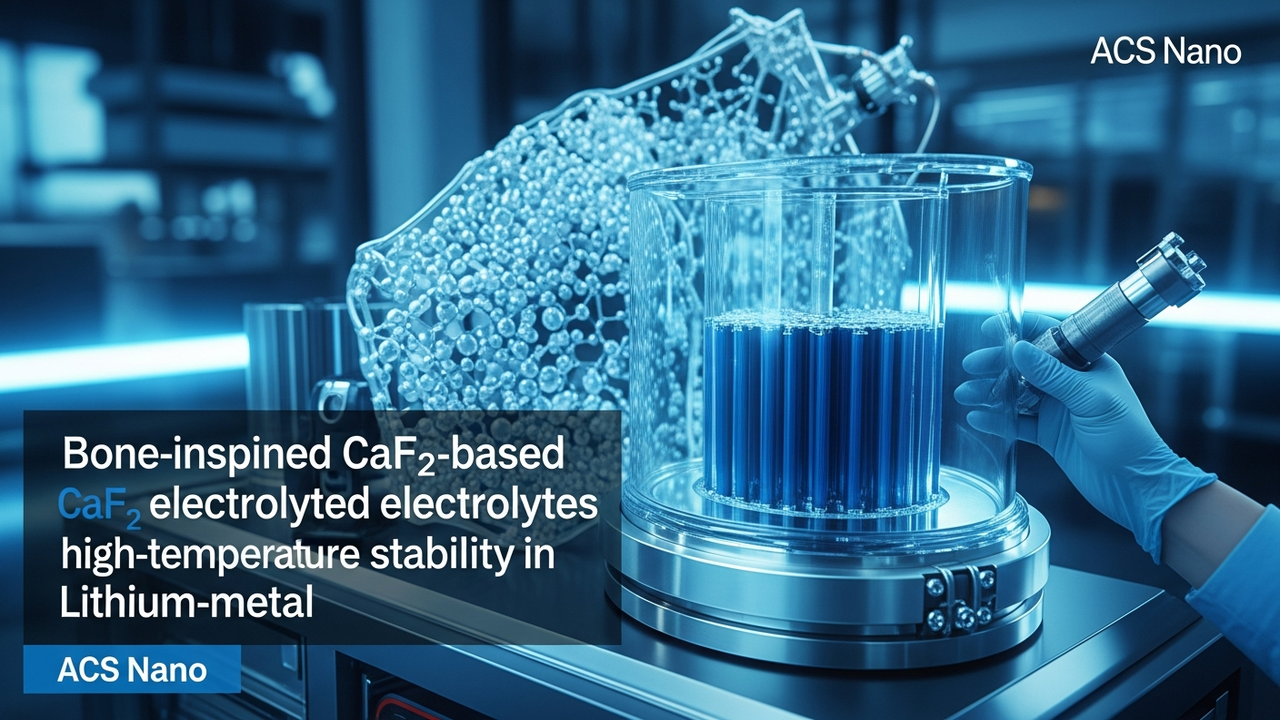
Recent research published in ACS Nano introduces a novel “bone-inspired solid solution electrolyte (CFSSE)” derived from naturally occurring calcium fluoride (CaF2). This innovative solid electrolyte demonstrates properties that substantially enhance the performance of lithium metal batteries. Specifically, the CFSSE exhibits an exceptionally wide electrochemical window of 5.26 V, broadening its applicability for high-voltage systems. Furthermore, its high lithium ion transference number (Li+ transference number) of 0.77 signifies efficient lithium ion migration, contributing directly to the effective suppression of dendrite growth. This is a crucial advancement, as it mitigates the short-circuiting and performance degradation commonly associated with dendrite formation in conventional electrolytes.
Exceptional High-Temperature Performance and Future Prospects
Lithium metal cells incorporating this CFSSE, when paired with a LiFePO4 (LFP) cathode, demonstrated remarkable stability and performance under demanding high-temperature conditions. The cells successfully maintained 81.7% of their initial capacity after 200 charge-discharge cycles at an elevated temperature of 100°C. This robust performance is highly significant for applications requiring extreme environmental tolerance, such as automotive batteries operating in diverse climates or stationary energy storage systems exposed to thermal fluctuations. This “bone-inspired” design paradigm highlights the burgeoning potential of biomimetics in battery material science, offering a new directional pathway for the development of future-generation lithium metal batteries that can operate reliably and safely in harsh environments.



Comments