Background: The Imperative of Automated Fruit Harvesting and End-Effector Challenges
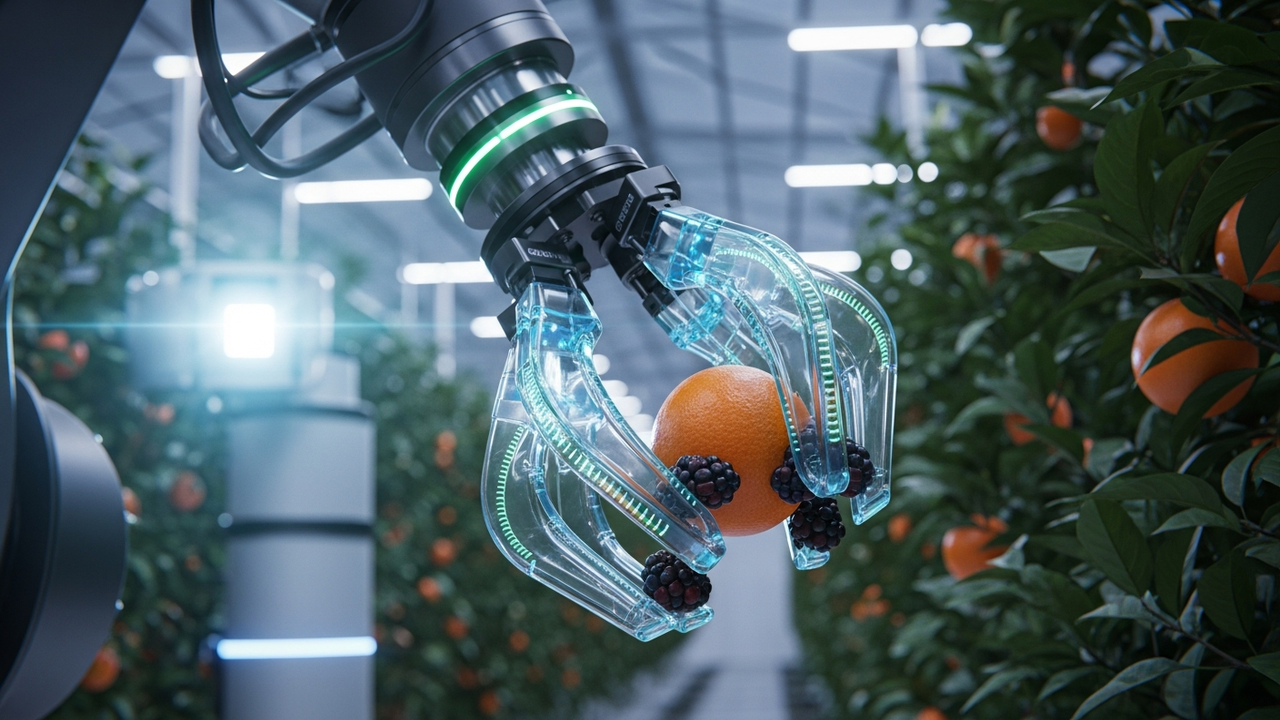
Driven by labor shortages and the pressing need for increased agricultural efficiency, automated fruit harvesting has become a critical global challenge. A key component determining the performance of harvesting robots is the “end-effector,” which is responsible for gripping and harvesting fruit without causing damage. End-effectors must meet several demanding requirements: delicate force control for handling soft fruits, flexibility to accommodate various fruit shapes and sizes, and rapid operation. Traditional rigid robotic hands have struggled to fulfill all these requirements, prompting the search for more advanced materials and designs to achieve precision and gentleness.
Key Findings: Smart Materials Revolutionizing End-Effector Design
A review article published by MDPI provides a detailed analysis of the application of smart materials in end-effector technologies for fruit harvesting robots. The review highlights several types of smart materials:
- Shape Memory Alloys (SMAs): These alloys offer structural simplicity, high power density, and silent operation, holding promise for biomimetic movements. However, their thermal activation leads to relatively slow response times, posing a challenge for meeting the speed requirements of commercial harvesting.
- Electroactive Polymers (EAPs): Often called “artificial muscles,” EAPs can undergo significant deformation when an electric voltage is applied. They contribute to flexible and lightweight end-effector designs, but high driving voltages and durability can be limiting factors.
- Ionic Polymer-Metal Composites (IPMCs): IPMCs can deform substantially under low voltages and are also promising for underwater operation. Nevertheless, performance degradation in dry environments and manufacturing costs remain challenges.
The review concludes that these materials enable the miniaturization, lightweighting, and increased flexibility of end-effectors, facilitating the development of more delicate and intelligent harvesting operations.
Technical Significance and Outlook
This review clearly delineates the potential and limitations of smart materials in the design of fruit harvesting robot end-effectors. The integration of smart materials is essential for enhancing the “dexterity” of robots, allowing them to sense the softness and shape of fruit and adjust gripping force accordingly. Moving forward, crucial research and development efforts will focus on improving response speed, ensuring durability, and establishing low-cost mass production techniques for smart material-based end-effectors. Furthermore, the combination of multiple smart materials in hybrid end-effectors and the optimization of gripping strategies through AI will be key to dramatically improving harvesting efficiency and quality in future agricultural robotics.








Comments