Key Findings
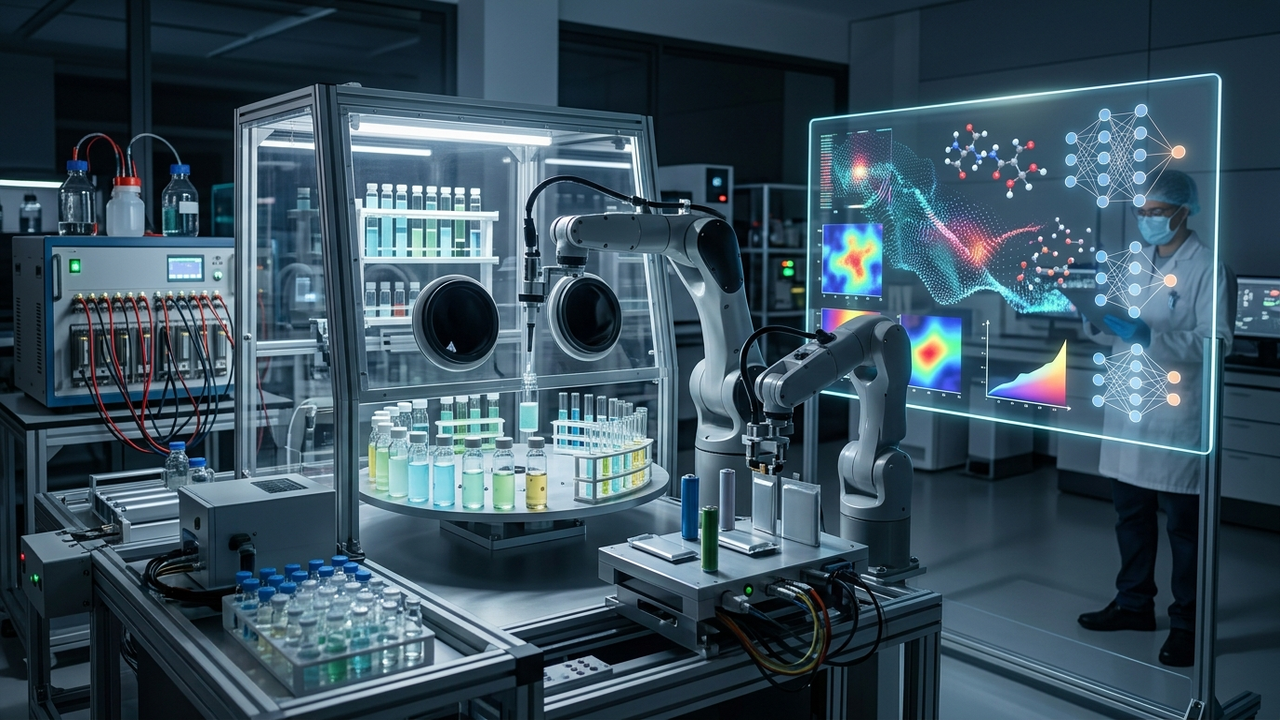
This comprehensive review underscores the profound impact of artificial intelligence (AI) on lithium-ion battery (LIB) electrolyte research. The integration of AI technologies is fundamentally transforming electrolyte development from a historically empirical, trial-and-error process into one driven by sophisticated data-driven predictions, in-depth mechanistic analysis, and highly efficient compositional optimization. This paradigm shift, leveraging the synergy of machine learning algorithms, multiscale simulations, and autonomous experimental platforms, is a critical accelerator for discovering novel solvents, lithium salts, additives, and solid electrolytes.
Technical / Clinical Details
AI’s core strength lies in its ability to analyze vast quantities of experimental and computational simulation data, extracting complex structure-property relationships that are often opaque to human researchers. This capability provides deeper insights into electrolyte ion transport characteristics, electrochemical stability, and electrode-interface reaction mechanisms. For instance, AI can accurately predict the influence of specific molecular structures on electrolyte viscosity or lithium-ion diffusivity, guiding the rational design of molecules with desired performance profiles. Furthermore, AI’s integration with ‘autonomous laboratories’ (self-driving labs) enables the automated design and execution of high-throughput screening experiments. These systems efficiently navigate vast chemical spaces, rapidly identifying optimal electrolyte compositions from tens of thousands of potential candidates, leading to significant reductions in development timelines and costs.
Background & Context
Lithium-ion batteries are indispensable for modern energy storage, yet they face persistent challenges regarding safety, energy density, and cycle life. Electrolytes are a pivotal component dictating these performance metrics. Traditional electrolyte development, heavily reliant on expert intuition and laborious experimentation, has been a significant bottleneck. AI addresses this challenge by automating and streamlining the discovery process, thereby accelerating the commercialization of next-generation LIBs with superior performance and safety characteristics. The implications extend across numerous industries, including automotive, renewable energy storage, and portable electronics, where enhanced battery technology is a critical enabler.
Strategic Significance & Outlook
The AI-driven electrolyte chemistry field is poised for further advancements, with applications expected to expand to designing more complex electrolyte systems and evaluating performance under extreme environmental conditions. In the future, it is anticipated that a holistic AI design approach will emerge, integrating not only electrolytes but also electrode materials and separators. This ‘digital twin’ concept for entire battery systems aims to optimize overall battery performance. Such breakthroughs in energy storage technology are vital for advancing sustainable development globally and maintaining competitive advantage in key technological sectors.
Source: https://pubs.rsc.org/ee/article/19/17/5564/1287116/Artificial-intelligence-driven-electrolyte
Get our weekly technology intelligence — free
Receive an infographic that lets you judge at a glance whether each field’s analysis report is worth reading.
Subscribe Free — Weekly Tech Intelligence
By subscribing, you’ll receive Troy-Technical’s weekly technology intelligence newsletter.
- Your email and selected fields are used only to deliver the newsletter.
- We never share your information with third parties.
- You can unsubscribe anytime via the link in each email.
See our Privacy Policy for details.
Takes about a minute · Unsubscribe anytime









Comments