Key Findings
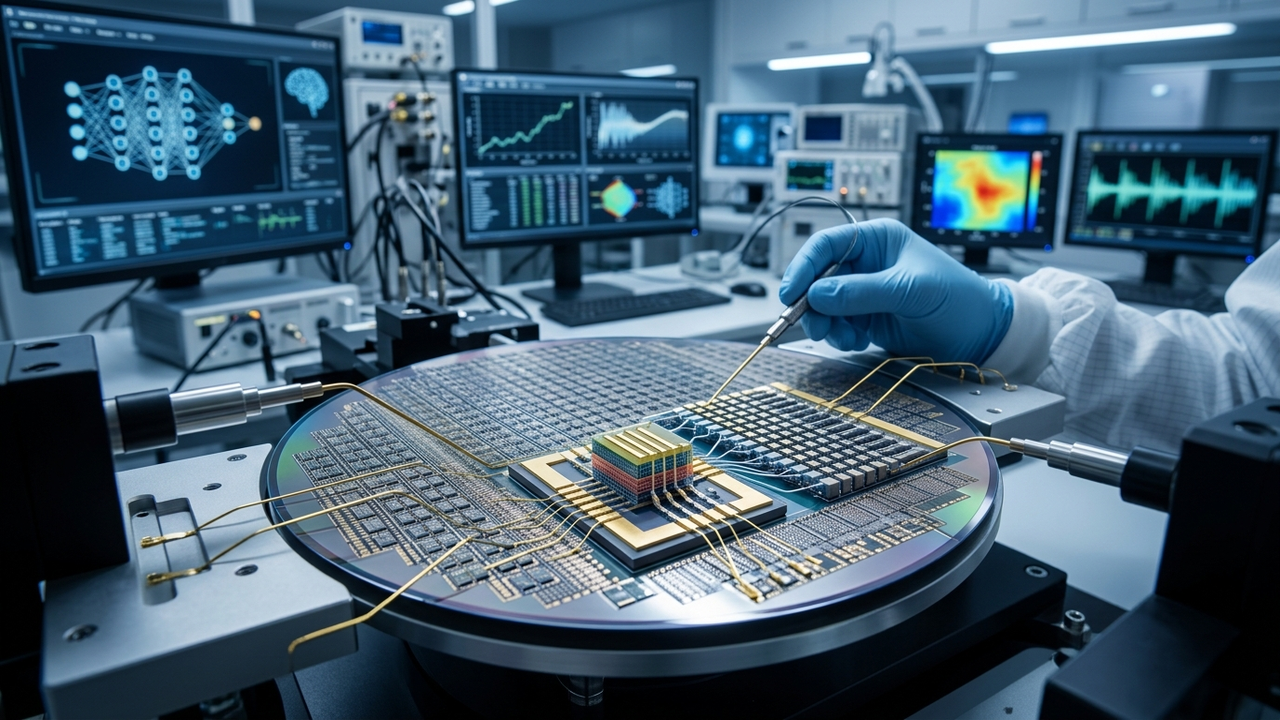
A novel ETCRAM (Electrochemical Transistor based on Resistive Switching and Active Memory) device has successfully demonstrated an operational principle that integrates both analog memory, akin to brain synapses, and neuron-like switching capabilities into a single, compact element. This remarkable achievement, utilizing vanadium oxide (VOx) and a solid electrolyte, opens new avenues for developing ultra-efficient neuromorphic AI hardware that could potentially overcome the limitations of current computing architectures.
Technical Details
The ETCRAM device leverages a combination of a VOx layer and a solid electrolyte layer to achieve an impressive 9-digit conductivity adjustment range, maintaining over 3,000 programmable states (resistance values). A key innovation is its ability to realize uniform phase coexistence without relying on filament formation, coupled with non-volatility at room temperature. This ensures stable analog memory and switching operations. According to a preprint (arXiv:2505.15936) by the researchers, this technology holds the potential to achieve an astounding computational efficiency exceeding 1,000 TOPS/W (Tera Operations Per Second per Watt) specifically for matrix-vector multiplication (MVM) operations. This represents a breakthrough in power efficiency, orders of magnitude beyond current high-performance AI accelerators, promising dramatic reductions in energy consumption for training and inference of large-scale AI models.
Background & Context
Despite rapid advancements in AI technology, its progress is increasingly bottlenecked by the immense computational resources and energy consumption it demands. The energy expenditure primarily associated with data movement, often referred to as the von Neumann bottleneck, is a major limiting factor for AI hardware efficiency. Brain-inspired computing, or neuromorphic computing, is a promising approach to circumvent these challenges. The ETCRAM device embodies the principles of “in-memory computing,” where memory and computation occur at the same physical location. By mimicking the structure and function of the brain, it aims to minimize energy losses incurred by data transfer, offering a path toward more sustainable and powerful AI systems.
Strategic Significance & Outlook
The successful demonstration of the ETCRAM device is poised to significantly influence the design of next-generation AI hardware. It promises dramatic improvements in power efficiency across a wide range of applications, including smartphones, edge AI devices, and large-scale AI systems in data centers, thereby accelerating the widespread adoption and evolution of AI. Achieving over 1,000 TOPS/W for MVM operations could break current AI chip performance barriers, enabling more complex and sophisticated AI models to run with substantially less power. This, in turn, is expected to make AI more accessible and foster the creation of novel services and applications. Future work will focus on establishing robust manufacturing techniques and verifying the scalability of these devices for large-scale integrated circuits.
Source: https://xenospectrum.com/sandia-etcram-vanadium-oxide-analog-memory/
Get our weekly technology intelligence — free
Receive an infographic that lets you judge at a glance whether each field’s analysis report is worth reading.
Subscribe Free — Weekly Tech Intelligence
By subscribing, you’ll receive Troy-Technical’s weekly technology intelligence newsletter.
- Your email and selected fields are used only to deliver the newsletter.
- We never share your information with third parties.
- You can unsubscribe anytime via the link in each email.
See our Privacy Policy for details.
Takes about a minute · Unsubscribe anytime









Comments