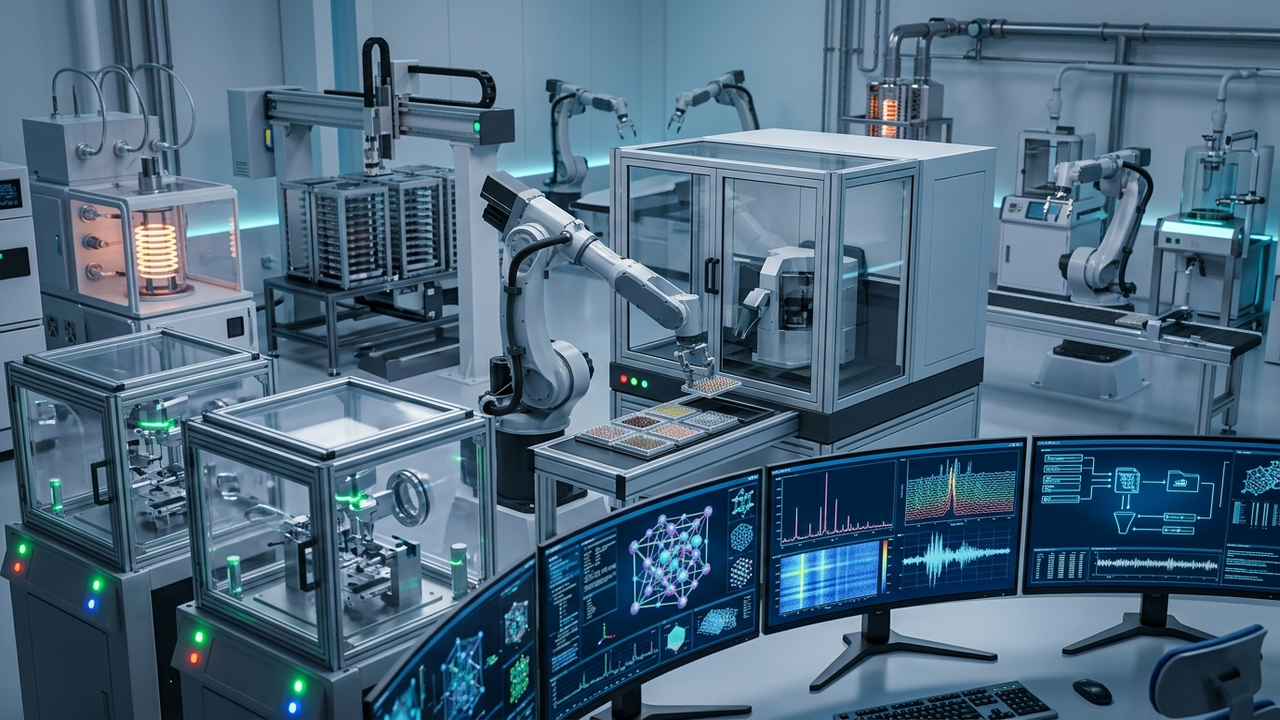
In materials science, powder X-ray diffraction (XRD) analysis is a critical process for characterizing material properties, but it traditionally demands significant expertise and time. A preprint by Yuetong Wu and Maojun Sun, titled ‘AutoXRD: Autonomous LLM Agents and Comprehensive Evaluation for Powder Diffraction Analysis,’ published on arXiv, proposes a groundbreaking system called ‘AutoXRD’ that leverages autonomous LLM agents to address this challenge.
Key Findings
- Developed ‘AutoXRD,’ an autonomous LLM agent for powder diffraction analysis.
- Enables automatic analysis of complex diffraction patterns and rapid identification of structural and phase compositions.
- Presents the potential for significantly improving the efficiency and accuracy of data analysis in materials science.
- A comprehensive evaluation framework validates the performance and reliability of the LLM agent.
Technical Details
AutoXRD automates the analysis of powder X-ray diffraction data by integrating the reasoning capabilities of Large Language Models (LLMs) with materials science expertise. Specifically, it takes raw XRD data as input, and the LLM agent autonomously performs a series of analysis tasks such as peak identification, phase quantification, lattice parameter calculation, and crystallite size estimation, based on known crystal structure databases and physical laws. The LLM is expected to leverage not only text-based knowledge but also image recognition and pattern matching capabilities to identify complex overlapping peaks and background noise, producing results comparable to or even surpassing human analysts in accuracy. The research demonstrated through a comprehensive evaluation using standard material datasets that AutoXRD significantly reduces analysis time and improves robustness, especially for multiphase mixtures and low-quality data, compared to conventional semi-automated methods.
Background & Context
In materials discovery and development, quickly and accurately identifying the structure of new materials after synthesis is paramount. XRD analysis is one of the most powerful tools for obtaining structural information of crystalline materials, but its data analysis is time-consuming and often ambiguous, even for experienced researchers. Especially with the acceleration of AI-driven materials design, automating high-throughput experimental data analysis is essential to resolve bottlenecks in new material development. The introduction of autonomous AI systems like AutoXRD means that researchers can be freed from routine data analysis, allowing them to focus on more creative research activities.
Strategic Significance & Outlook
The advent of AutoXRD has the potential to transform the research workflow in materials science. Further development of this technology could significantly enhance research efficiency and discovery rates in a wide range of fields where XRD is used, including chemistry, physics, and geology, not just materials science. In the future, integrating AutoXRD into autonomous experimental lab systems (known as ‘self-driving labs’) could make the creation of ‘AI-driven materials discovery’ platforms a reality, automating everything from material synthesis to characterization, data analysis, and even suggesting next synthesis strategies. This would dramatically shorten the discovery cycle for new functional materials, accelerating innovation.
Source: https://arxiv.org/abs/2609.00070
Get our weekly technology intelligence — free
Receive an infographic that lets you judge at a glance whether each field’s analysis report is worth reading.
Subscribe Free — Weekly Tech Intelligence
By subscribing, you’ll receive Troy-Technical’s weekly technology intelligence newsletter.
- Your email and selected fields are used only to deliver the newsletter.
- We never share your information with third parties.
- You can unsubscribe anytime via the link in each email.
See our Privacy Policy for details.
Takes about a minute · Unsubscribe anytime



Comments