Background
Blue light-emitting devices are fundamental to modern photonics, serving as one of the primary colors for white LED lighting and full-color displays. Traditional organic light-emitting diodes (OLEDs) and quantum dot LEDs (QLEDs) have consistently faced challenges in achieving high emission efficiency and stability for blue light, particularly when compared to their red and green counterparts. The global research race to develop high-performance blue emissive materials is intense, directly impacting display color gamut expansion and energy efficiency improvements. Perovskite quantum dots (PQDs) have emerged as highly promising candidates due to their exceptional photoluminescence quantum efficiency and color purity, yet their practical application has been hindered by inherent instability and variability in device performance, especially for blue emissions.
Key Findings
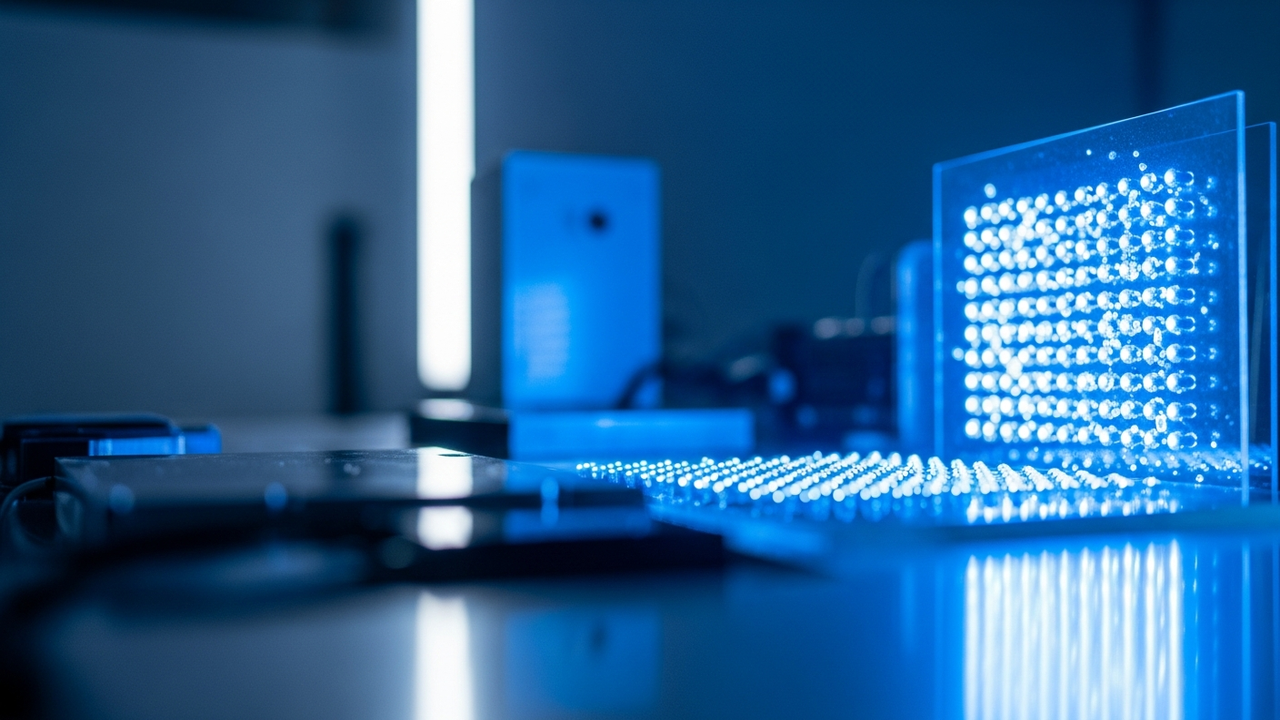
Researchers at Zhengzhou University have successfully achieved a breakthrough in the power efficiency of blue perovskite quantum dot light-emitting diodes (PQD-LEDs) by applying polymer dipole engineering. Specifically, they integrated poly(1,1-difluoroethylene) (PVDF) into the emissive layer, resulting in a record-breaking power efficiency of 43.91 mW−1. This marks a significant step towards the commercial viability of blue PQD-LEDs.
The team adopted a novel “polymer dipole engineering” approach by introducing PVDF, a fluorinated polymer with a high electrical dipole moment, into the PQD emission layer. This integration yielded multiple synergistic benefits. Firstly, the dipole moments of PVDF optimize the energy levels between the charge transport layer and the emissive layer, thereby facilitating electron injection and transport. This leads to improved current-voltage characteristics, enabling higher luminance at lower operating voltages. Secondly, PVDF effectively passivates surface defects on the PQDs. Surface defects are a primary cause of non-radiative recombination (energy loss without light emission), which degrades efficiency. By blocking these defect sites, PVDF enhances the efficiency of radiative recombination, consequently boosting the overall luminous efficiency.
These combined effects collectively contributed to achieving an unprecedented power efficiency of 43.91 mW−1 for blue PQD-LEDs, setting a new benchmark for reported performance in the field.
Future Outlook
This polymer dipole engineering strategy represents a crucial breakthrough for the commercialization of blue PQD-LEDs. Future work will focus on evaluating the long-term stability of this technology, scaling up manufacturing processes, and exploring its applicability across various device architectures. Crucially, highly efficient blue emission directly contributes to the advancement of high-definition QLED displays, flexible displays, micro-LED technology, and next-generation lighting solutions. This development is expected to deliver more vivid and energy-efficient visual experiences to consumers and profoundly impact the broader optoelectronic device industry.