Key Findings
Google DeepMind’s GNoME (Graph Networks for Materials Exploration) project has achieved a landmark breakthrough, predicting over 2 million new stable crystal structures using graph neural networks (GNNs), exceeding the entire catalog of known materials discovered over the last century. Concurrently, AI-powered autonomous laboratories (A-Labs) are integrating AI with robotics to automate the design, synthesis, and analysis of novel materials, significantly accelerating the material development process within chemical engineering. This synergistic approach drastically reduces the time required for discovering and developing new materials.
Technical / Clinical Details
- GNoME’s Contribution: GNoME is a specialized GNN model for materials science that predicts material properties and stability directly from atomic structures. This capability enables the high-throughput generation of theoretically stable new material candidates without the need for physical synthesis. The materials predicted by GNoME exhibit high structural diversity and hold immense value as starting points for future materials research.
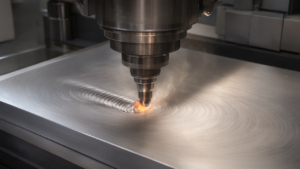
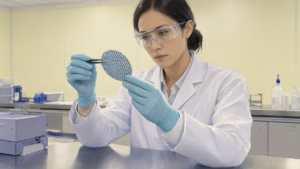
- Autonomous Labs (A-Labs): A-Labs represent systems that integrate AI, robotics, and advanced sensor technologies. The AI formulates experimental plans, robots execute material synthesis and characterization, and the results are fed back to the AI in a ‘closed-loop’ process for optimization of subsequent experimental cycles. This reduces manual intervention, allowing researchers to focus on more complex and creative challenges.
- Accelerated Discovery: The combination of AI and A-Labs has the potential to compress material development timelines from years to mere weeks or months. This enables efficient exploration of vast chemical spaces, particularly for materials with specific functionalities that were previously challenging to identify.
Background & Context
In chemical engineering, there is a growing demand for high-performance and sustainable materials, yet their development remains a bottleneck. Traditional material development heavily relies on costly and time-consuming experimentation. In this context, AI and automation technologies are seen as transformative tools to overcome these bottlenecks and enable faster, more efficient material discovery. AI models like GNoME are positioned as the ‘fifth paradigm’ in materials science, pioneering the frontier of data-driven scientific discovery.
Strategic Significance & Outlook
The integration of AI and autonomous laboratories is expected to accelerate new material development across a wide range of industrial sectors, including batteries, catalysts, pharmaceuticals, and polymers. This will lead to reduced R&D costs and shorter time-to-market, with significant economic implications. Furthermore, with AI functioning as a co-scientist, the discovery of unprecedented, breakthrough materials is anticipated, contributing to the realization of a more sustainable and advanced society globally.
Source: https://chemenggcalc.com/ai-is-transforming-chemical-engineering/