Key Findings
North Carolina State University (NC State) is leading the development of Self-Driving Lab (SDL) technology that intelligently plans and executes experiments to discover optimal ‘recipes’ for new molecules and materials using artificial intelligence (AI) and machine learning. This groundbreaking work accelerates scientific discovery up to 100 times faster compared to traditional chemistry and materials science research processes. Notably, PoLARIS, one of the SDLs developed by the university, discovered brighter, environmentally friendly lead-free nanoplatelets (semiconductor nanomaterials) in an astonishing 12 hours from billions of potential synthesis candidates. This dramatically reduces material development lead times and costs.
Technical / Clinical Details
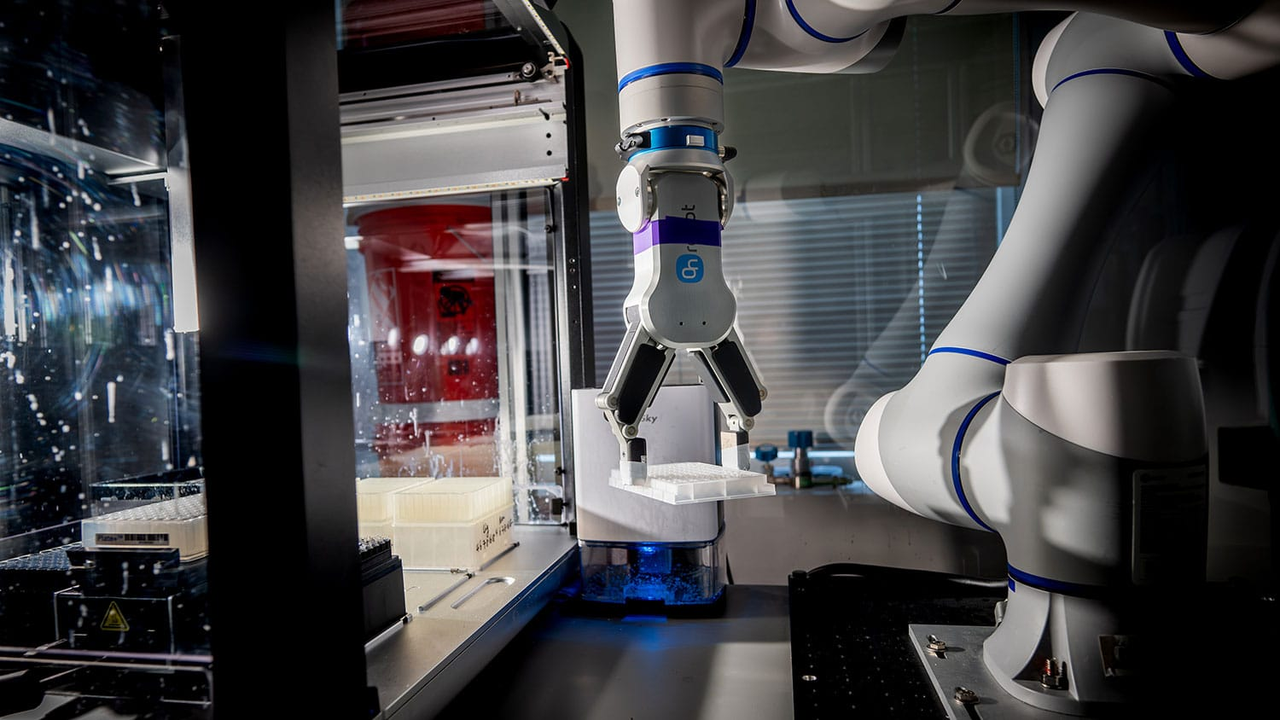
- Self-Driving Lab (SDL) Operating Principle: NC State’s SDLs employ a ‘closed-loop learning system’ where AI analyzes experimental data, generates hypotheses, instructs robotic systems to perform physical experiments, and collects/evaluates results in real-time. Through this feedback loop, the AI rapidly converges on optimal material compositions or synthesis conditions.
- Up to 100x Faster Discovery Rate: While traditional human-led trial-and-error experimental cycles could take months to years, SDLs can complete these processes in days or hours, leading to an exponential increase in discovery speed. This allows researchers to explore more possibilities and solve complex problems quickly.
- PoLARIS Discovery of Lead-Free Nanoplatelets: PoLARIS is an SDL specifically focused on semiconductor nanomaterials like quantum dots. It explored billions of synthesis conditions and, in just 12 hours, discovered higher-performance nanoplatelets that are lead-free, addressing the challenge of toxicity in conventional materials. This marks a significant step in the development of eco-friendly electronic materials.
- Other SDL Projects: NC State is also developing multiple other SDLs, such as Rainbow (for polymer materials) and Fast-Cat (for catalysts), each addressing different research challenges in diverse material systems.
Background & Context
The discovery of new materials is fundamental to innovation in many key industries of modern society, including energy, electronics, medicine, and environment. However, this process has long been a bottleneck due to challenges like vast exploration spaces, complex synthesis, and time-consuming characterization. The advent of SDLs, integrating AI and robotics, provides a powerful means to overcome these bottlenecks and rapidly develop more sustainable and high-performance materials. NC State’s efforts strengthen U.S. leadership in science and technology and play a crucial role in shaping future industries.
Strategic Significance & Outlook
NC State’s SDL technology holds the potential to revolutionize not only materials science but also a wide range of scientific and engineering fields, including drug discovery, chemical process optimization, and environmental monitoring. Specifically, the role of “AI co-scientists,” where AI collaborates with human scientists to discover previously overlooked material correlations and properties, is expected to expand. This will lead to the rapid market introduction of new technologies, such as improved performance for electric vehicle batteries, enhanced efficiency for renewable energy systems, and the creation of breakthrough pharmaceuticals, contributing to global challenge resolution. SDLs are redefining the future of scientific discovery.
Source: https://news.ncsu.edu/2026/06/speeding-up-scientific-discovery/