Key Findings
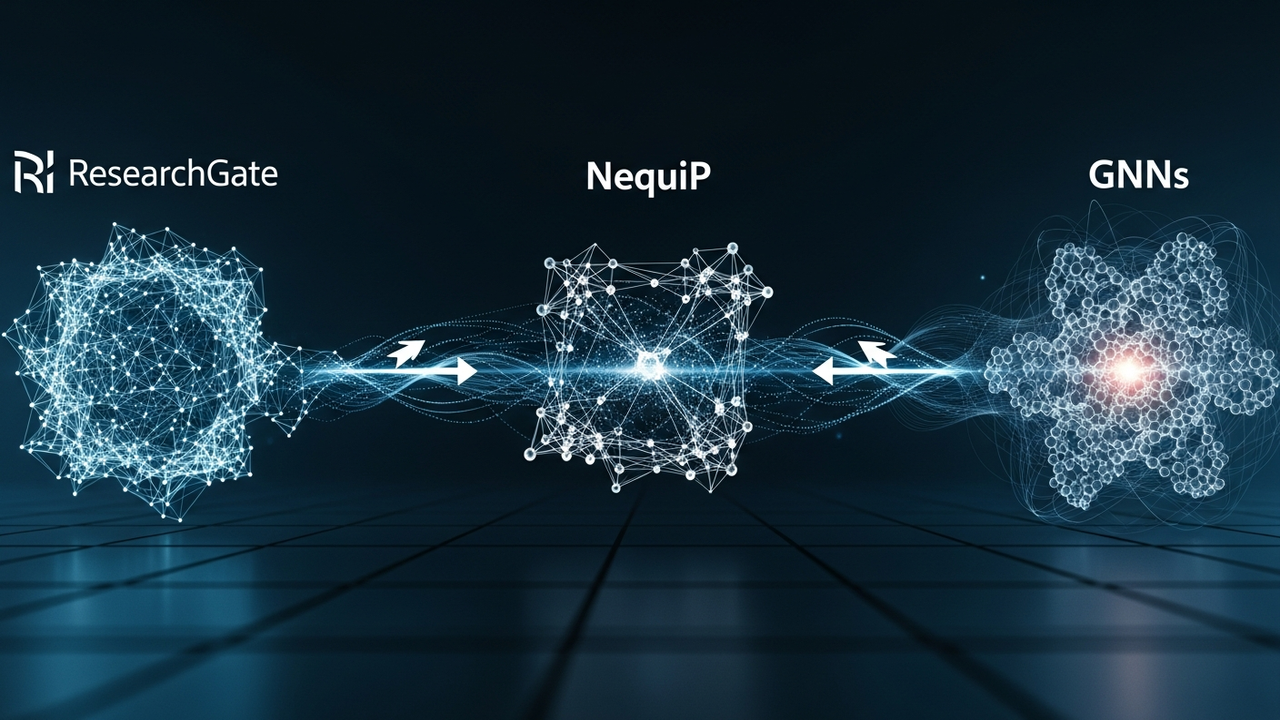
A recent research paper demonstrates the groundbreaking capability of Graph Neural Networks (GNNs) for predicting many-body interactions in amorphous materials. Specifically, by applying NequIP, an equivariant message-passing GNN, to model soft glasses of solvent-free polymer-grafted nanoparticles (PGNs), NequIP learned the high-dimensional, rugged potential energy surface of the system with exceptional accuracy. The most significant aspect of this achievement is NequIP’s success in reproducing energies with computational costs four orders of magnitude lower than traditional Density Functional Theory (DFT). This opens new avenues for simulating the complex dynamics and thermodynamics of amorphous materials with unprecedented efficiency.
Technical / Clinical Details
- NequIP GNN Principle: NequIP is a type of Machine Learning Interatomic Potential (MLP) that learns the nature of forces acting between atoms. Crucially, this model is designed with equivariance to rotations and translations, enabling predictions consistent with physical laws. This ensures that forces are predicted consistently regardless of atomic configuration changes, maintaining physical integrity.
- Application to Amorphous Materials: Amorphous materials (like glass) lack long-range order, making their many-body interactions and energy surfaces extremely challenging to model. NequIP effectively learns the complex interactions between atoms, accurately describing local structural changes and dynamics in these materials.
- Dramatic Reduction in Computational Cost: While DFT provides high-accuracy electronic structure calculations, its computational cost is immense, making it unsuitable for large-scale or long-timescale simulations. NequIP demonstrated a 10,000-fold reduction in computation time compared to DFT, while nearly retaining DFT’s accuracy. This enables molecular dynamics simulations at scales previously impossible.
- Learning High-Dimensional Potential Energy Surfaces: Soft glasses like PGNs possess many degrees of freedom and complex interactions, resulting in highly rugged potential energy surfaces. NequIP demonstrates the ability to efficiently learn this complex surface and accurately identify stable structures, transition states, and reaction pathways.
Background & Context
Amorphous materials are indispensable in our daily lives and industries, including window glass, plastics, rubbers, and advanced functional materials (e.g., bulk metallic glasses). However, their disordered atomic structure makes understanding and controlling their properties extremely challenging. Accurate atomic-level simulations are crucial for designing new amorphous materials or improving existing ones, but conventional computational methods had limitations. MLPs, particularly GNN-based models like NequIP, are emerging as powerful tools to solve this long-standing problem and expand the frontier of amorphous materials science.
Strategic Significance & Outlook
Advances in NequIP and similar GNN-based MLPs will revolutionize the design and understanding of amorphous materials. This could lead to the development of higher-performance glasses, more durable polymers, innovative rubber materials, and new soft matter materials. The reduction in computational cost will enable large-scale material screening and process optimization in industry, accelerating the market introduction of new products. In the future, it is expected that these MLPs will be integrated into closed-loop autonomous laboratories, further streamlining the discovery and development of amorphous materials. This will further enhance the importance of data-driven approaches in materials science.