Key Findings
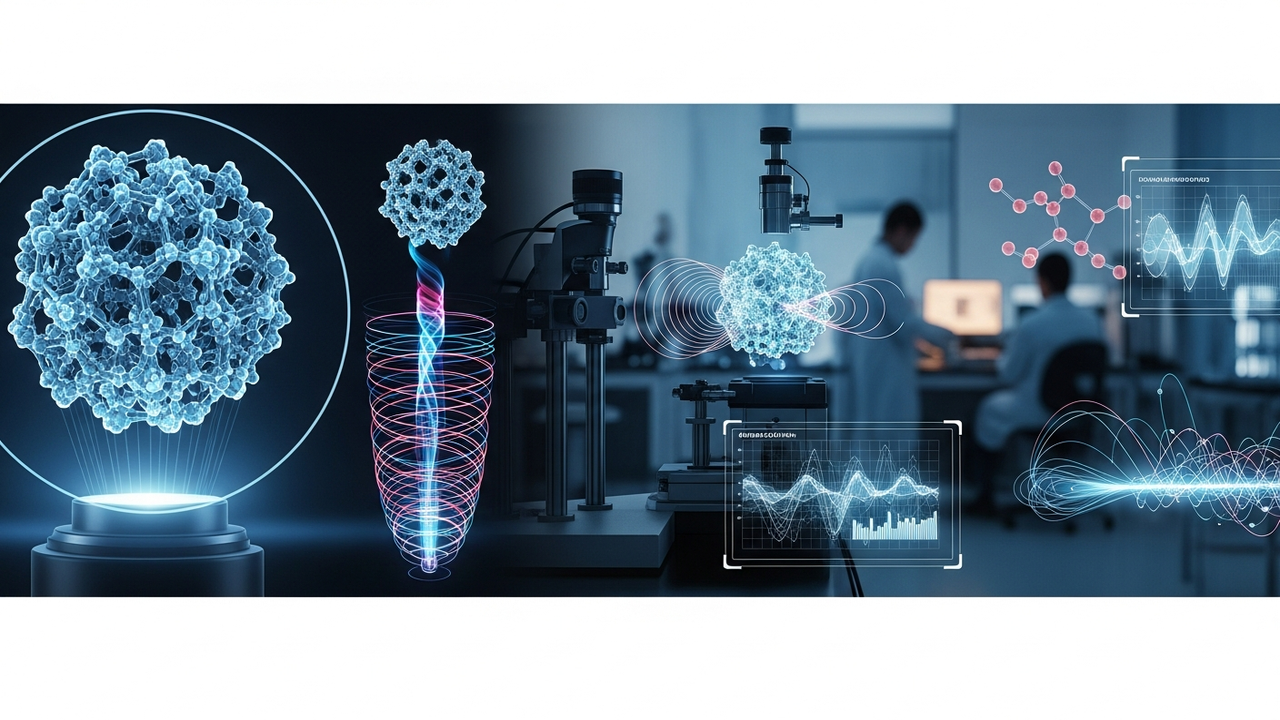
A research team led by the University of Utah has identified organic-inorganic hybrid perovskites as a “miracle material” for the burgeoning field of spintronics, a technology that utilizes electron spin for data processing. This landmark study, published in Nature Physics, marks the first demonstration of these perovskites possessing an exceptionally long spin lifetime, extending up to nanoseconds—a critical parameter for stable information storage and manipulation.
Technical / Clinical Details
- Spintronics Fundamentals: Spintronics leverages the intrinsic angular momentum (spin) of electrons, in addition to their charge, to encode and process information. This promises devices with higher speed, lower power consumption, and greater data density compared to conventional charge-based electronics.
- The Spin Lifetime Challenge: A major bottleneck in spintronics development has been identifying materials capable of maintaining electron spin coherence for sufficiently long durations, especially at room temperature. Long spin lifetimes are essential for reliable information propagation and operation within spintronic devices.
- Perovskite Breakthrough: The study experimentally confirmed that organic-inorganic hybrid perovskites exhibit spin lifetimes in the nanosecond range at room temperature. This prolonged spin coherence is attributed to the material’s unique crystal and electronic band structures, which effectively suppress spin-scattering mechanisms.
- Quantum Property Exploitation: The material’s ability to maintain a stable spin state for an extended period positions it as a robust platform for developing spin-based memory, logic gates, and other quantum information processing components.
Background & Context
As traditional silicon-based electronics approach their physical limits imposed by Moore’s Law, the quest for alternative computing paradigms has intensified. Spintronics offers a compelling path forward by tapping into a fundamental quantum property of electrons. However, the lack of suitable materials with sufficiently long spin lifetimes at ambient conditions has historically hampered its progression. The discovery of these perovskites as highly efficient spin conductors represents a significant advancement in overcoming this fundamental material science challenge.
Strategic Significance & Outlook
This “miracle material” discovery is poised to dramatically accelerate research and development in spintronics, with far-reaching implications:
- Next-Generation Memory: Materials with long spin lifetimes are crucial for non-volatile magnetic random-access memory (MRAM), which combines the speed of SRAM with the non-volatility of flash memory, potentially replacing conventional memory technologies.
- Quantum Computing: Stable and controllable spin states are the bedrock of quantum bits (qubits). This finding could contribute to the development of more robust qubits, advancing the field of quantum computing.
- High-Performance Processors: Spin-based logic devices could offer significantly higher processing speeds and energy efficiency than current semiconductor processors, enabling new frontiers in computing power.
The research redefines the potential of hybrid perovskites and establishes a new direction for materials engineering in quantum and information technologies. This is a critical step towards unlocking computing capabilities that were previously considered aspirational, fostering intense interdisciplinary collaboration in materials science, physics, and computer engineering.
Source: https://www.labmanager.com/study-discovers-a-miracle-material-for-field-of-spintronics-7244





Comments