Key Findings
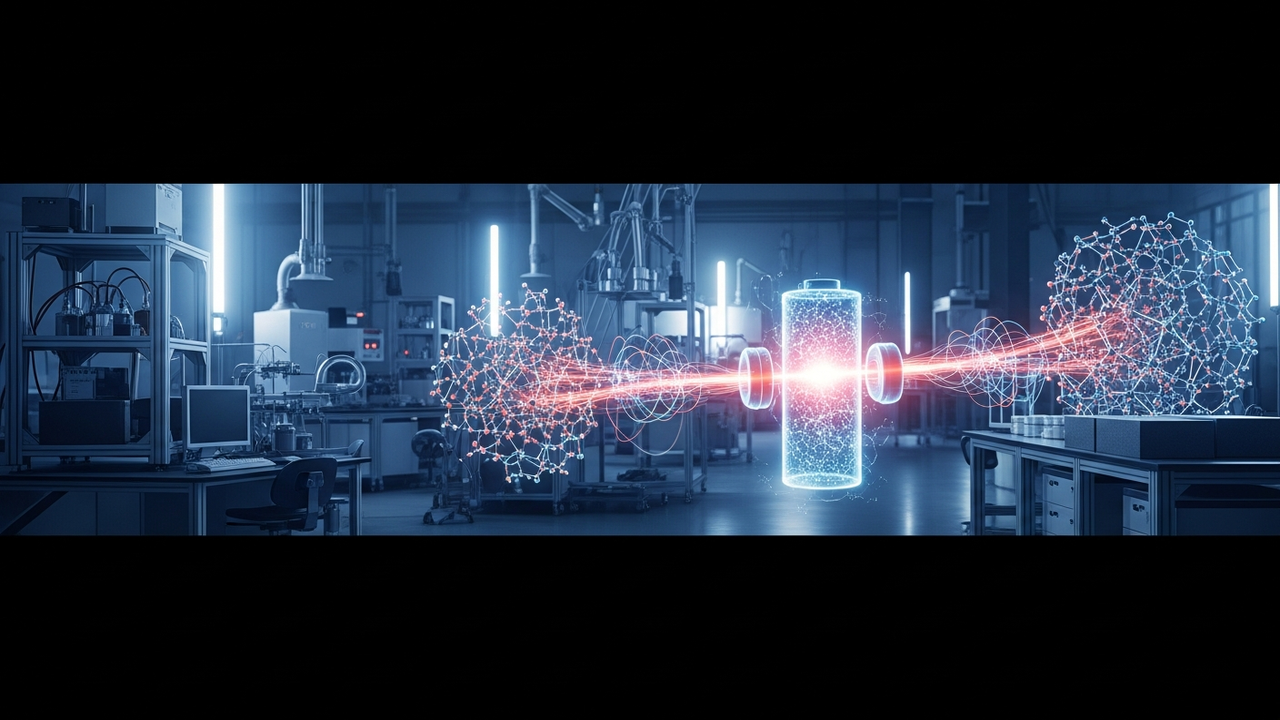
A breakthrough academic study has demonstrated that the incorporation of a rare-earth triflate (Nd(OTf)3) as an electrolyte additive substantially enhances the performance of anode-free lithium–sulfur (Li-S) batteries. The Nd(OTf)3 compound was found to exert a dual function: it facilitates the adsorption of polysulfides, thereby aiding conversion reactions, and simultaneously protects the lithium metal anode by stabilizing its stripping and deposition processes. This innovative electrolyte modification led to an impressive areal capacity of 5.5 mAh cm^-2 in both Li ǁ Li2S half-cells and Ni ǁ Li2S anode-free full-cells, representing a significant advance for this high-energy-density battery chemistry.
Technical Details
Lithium-sulfur batteries are highly attractive for their theoretical energy density of 2500 Wh/kg, far exceeding conventional lithium-ion chemistries. However, their practical application has been hampered by issues such as poor cycle life, primarily due to the polysulfide shuttle effect and the instability of the lithium metal anode. The Nd(OTf)3 additive addresses these fundamental challenges comprehensively:
- Enhanced Polysulfide Adsorption: The rare-earth ions within Nd(OTf)3 form strong coordination bonds with polysulfides, preventing their dissolution into the electrolyte. This prolonged retention of polysulfides at the cathode surface promotes their complete conversion, which is crucial for maintaining capacity, especially under high sulfur loading conditions.
- Stabilization of Lithium Metal Anode: Nd(OTf)3 actively promotes the formation of a stable solid electrolyte interphase (SEI) layer on the surface of the lithium metal anode. This robust SEI layer effectively suppresses the growth of lithium dendrites and ensures uniform lithium stripping and deposition. By mitigating anode degradation, the additive significantly improves the battery’s cycle stability.
- Achievement of High Areal Capacity: The modified electrolyte enabled an exceptionally high areal capacity of 5.5 mAh cm^-2 in both tested cell configurations. This figure substantially surpasses the performance typically observed in anode-free Li-S batteries, marking a critical step toward their commercial viability. This level of areal capacity is vital for practical energy storage devices, where high energy density per unit area is as important as gravimetric energy density.
Background & Context
Anode-free batteries represent an ultimate goal in battery design, aiming to maximize overall energy density by eliminating or minimizing the anode material. However, anode-free Li-S batteries, which rely on direct lithium metal as the anode, have faced considerable challenges due to the high reactivity of lithium metal and the intrinsic issues of Li-S chemistry. This research offers a promising pathway to overcome these hurdles through sophisticated electrolyte engineering. The ability to enhance both energy density and cycle life positions Li-S batteries as a strong contender for applications demanding high gravimetric energy density, such as aerospace, drones, and long-range electric vehicles (EVs). The lithium-sulfur cathode market is currently targeting energy densities exceeding 400 Wh/kg and cycle lives of 500 cycles by 2035, with companies like NexTech Batteries, Theion, and Zeta Energy actively advancing their development efforts.
Strategic Significance & Outlook
The findings from this study represent a significant advancement toward the practical deployment of anode-free Li-S batteries. The use of rare-earth triflate as an electrolyte additive provides a potent strategy to simultaneously improve both the energy density and cycle life of Li-S cells. Future work will focus on reducing the manufacturing cost of this additive, demonstrating its scalability, and validating long-term stability in larger-format cells. If successfully deployed at a commercial scale, this technology has the potential to break through the performance limitations of current lithium-ion batteries, offering an innovative solution for applications where high energy density is paramount, such as advanced aerospace platforms and next-generation electric mobility.








Comments