Key Findings
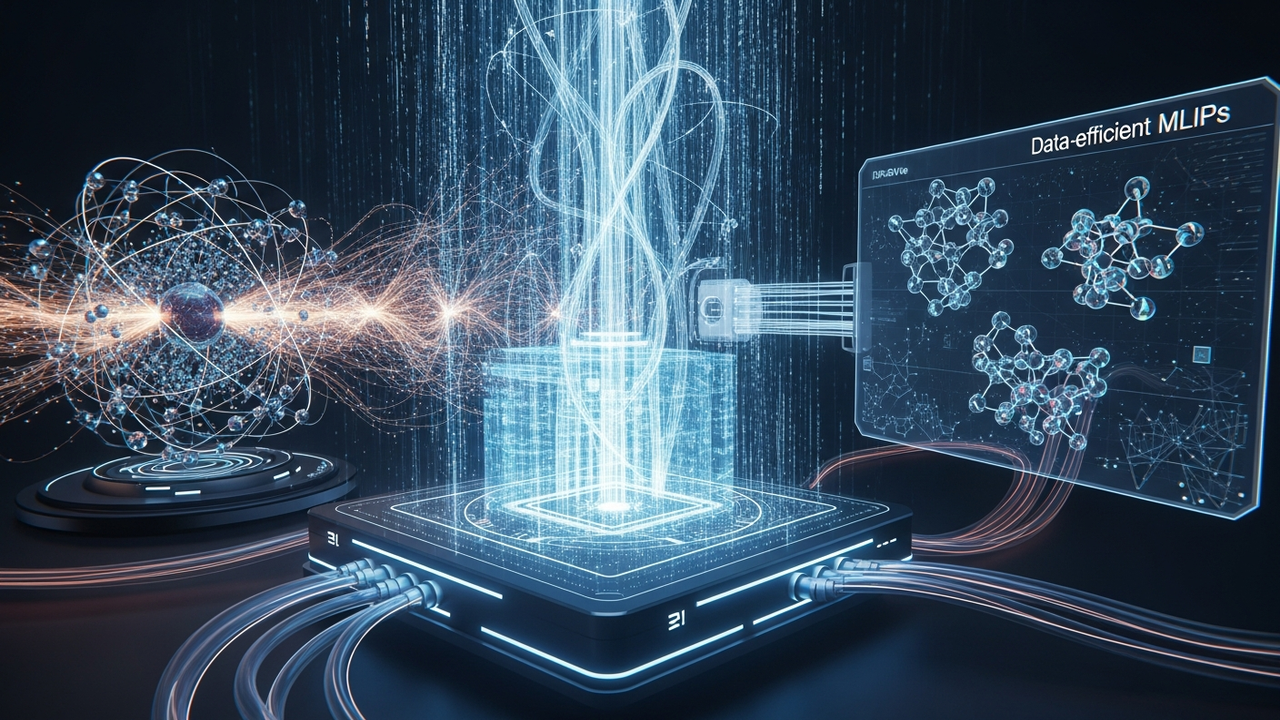
A data-efficient fine-tuning framework, ‘DP-EVA,’ has been introduced for the development of Machine Learning Interatomic Potentials (MLIPs), designed to maximize the utilization of pre-trained knowledge from large atomistic models. DP-EVA enables the rapid construction of high-performance MLIPs even from limited domain-specific data, thereby significantly extending the temporal and spatial scales of atomic simulations.
Technical / Clinical Details
DP-EVA (Data-Efficient Fine-Tuning framework via Maximizing Pre-trained Knowledge of Large Atomistic Models) is based on the principles of transfer learning. First, a large atomistic model (foundation model) is prepared, trained on vast datasets of atomic configurations, energies, and forces (e.g., Materials Project, OpenKIM) to learn universal physical laws and chemical bonding patterns. Next, a small amount of domain-specific ab initio computational or experimental data is collected for a particular domain (e.g., specific alloy systems, interfacial phenomena, particular reactions). DP-EVA efficiently ‘fine-tunes’ the foundation model using this small dataset to generate MLIPs capable of reproducing domain-specific behavior with high accuracy. This process requires significantly fewer computational resources and less time than training an MLIP from scratch. For instance, it becomes possible to analyze complex phenomena at the atomic level, such as the behavior of active sites in specific catalytic reactions or ion transport mechanisms in battery materials, through large-scale and long-duration simulations.
Background & Context
Interatomic potentials are indispensable tools for describing atomic interactions in molecular dynamics (MD) simulations. However, traditional empirical potentials have limitations in accuracy, while first-principles calculations (DFT), though highly accurate, are computationally expensive and unsuitable for large systems or long simulations. Machine Learning Interatomic Potentials (MLIPs) are gaining attention for their ability to combine the accuracy of DFT with the computational efficiency of empirical potentials. Yet, training high-quality MLIPs still requires large DFT datasets, which has been a bottleneck. Data-efficient fine-tuning methods like DP-EVA solve this challenge, significantly enhancing the versatility and practicality of MLIPs. MLIPs are becoming an indispensable tool, especially in the development of clean energy technologies (fuel cells, batteries, solar cells) and high-performance materials.
Strategic Significance & Outlook
The advent of the DP-EVA framework will dramatically broaden the scope of MLIP applications, ushering in a new era for atomic simulations. In the future, this method is expected to be deployed across various application fields, including more complex multi-component materials, materials under high-temperature and high-pressure conditions, and even biological molecular systems. Data-efficient approaches will play a central role in AI-driven materials discovery platforms, enabling researchers to design and optimize innovative materials more rapidly. This is projected to accelerate technological innovations aimed at solving society’s most pressing challenges, such as improving energy conversion efficiency, extending battery life, and developing new catalysts. It will prove to be a critically important technology in breaking through the ‘time and cost’ barriers of scientific discovery.
Source: https://academic.oup.com/ce/advance-article-abstract/doi/10.1093/ce/zkag029/8706613
Get our weekly technology intelligence — free
Receive an infographic that lets you judge at a glance whether each field’s analysis report is worth reading.
Subscribe Free — Weekly Tech Intelligence
By subscribing, you’ll receive Troy-Technical’s weekly technology intelligence newsletter.
- Your email and selected fields are used only to deliver the newsletter.
- We never share your information with third parties.
- You can unsubscribe anytime via the link in each email.
See our Privacy Policy for details.
Takes about a minute · Unsubscribe anytime