Key Findings
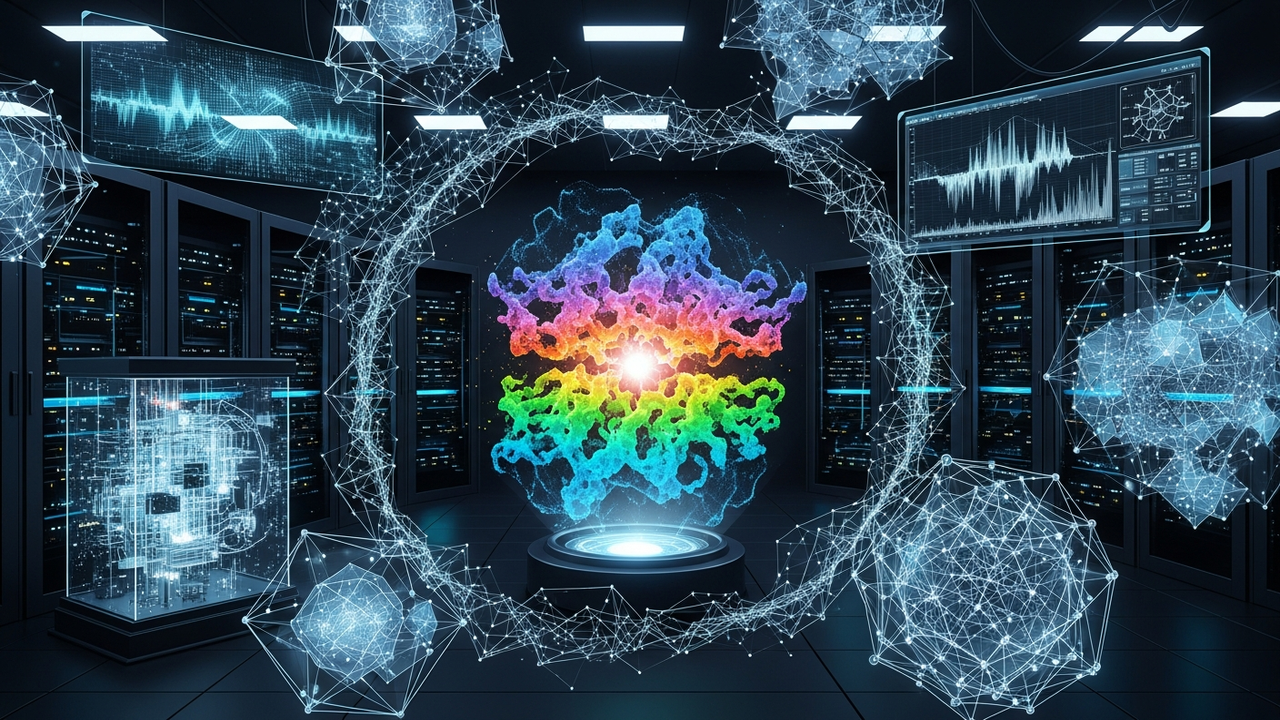
In a collection of papers from Hugging Face, an innovative generative framework has been introduced for learning the generative latent space dynamics of electronic density. This framework combines a 3D convolutional autoencoder (3D-CAE) with a latent diffusion model, enabling it to accurately learn and reproduce stable, long-term electronic density trajectories obtained from ab initio molecular dynamics (AIMD) simulations.
Technical / Clinical Details
Electronic density is the fundamental quantity that determines all physical and chemical properties of atoms and molecules. AIMD simulations are high-precision methods that simultaneously describe electronic states and nuclear motion at a first-principles level, but their computational cost is very high, limiting their application to large systems or long-duration simulations. This new generative framework first uses a 3D-CAE to compress complex electronic density distributions from high-dimensional data into a lower-dimensional ‘latent space.’ In this latent space, the temporal evolution of electronic density is represented as simpler dynamics. Next, a latent diffusion model learns these latent space dynamics, becoming capable of generating new and physically plausible electronic density trajectories. This allows for the compression of vast computational data from AIMD simulations, enabling the extraction and prediction of essential dynamic behaviors of electronic density at significantly higher speeds and efficiency than traditional AIMD. For example, changes in electronic density during bond formation and breakage in chemical reactions, or charge transport mechanisms in materials, can now be analyzed much more efficiently.
Background & Context
In many fields such as materials science, quantum chemistry, and molecular biology, understanding and controlling electronic density is indispensable for designing new materials, elucidating molecular functions, and exploring chemical reaction mechanisms. Capturing dynamic changes in electronic density is particularly crucial for systems whose states evolve over time, such as catalytic reactions, photochemical reactions, and battery charge-discharge processes. However, electronic density complexity grows exponentially with the number of atoms, making its direct simulation and modeling extremely challenging. The advent of AI, especially generative models, is gaining attention as a powerful means to solve this problem. The approach of learning latent spaces and generating electronic densities from them offers a new paradigm for efficiently capturing complex dynamics of electronic states while reducing computational costs.Strategic Significance & Outlook
This electronic density generative framework holds the potential to profoundly transform the future of quantum chemistry simulations and materials design. Moving forward, this method is expected to be applied to a wide range of fields, including more complex molecular systems (e.g., protein-ligand interactions), interfacial phenomena, and electronic structures of materials with defects. Furthermore, with advances in integration with experimental data (e.g., electronic density maps from X-ray diffraction data), more data-driven and high-accuracy electronic density models will be built. This is projected to accelerate technological innovations aimed at solving society’s most pressing challenges, such as the design of new high-efficiency catalysts, optimization of high-performance battery materials, and improvement of solar cell light absorption properties. Accurate understanding and control of electronic states are indispensable elements for breakthroughs in science and technology.
Source: https://huggingface.co/papers?q=neural%20field%20theory
Get our weekly technology intelligence — free
Receive an infographic that lets you judge at a glance whether each field’s analysis report is worth reading.
Subscribe Free — Weekly Tech Intelligence
By subscribing, you’ll receive Troy-Technical’s weekly technology intelligence newsletter.
- Your email and selected fields are used only to deliver the newsletter.
- We never share your information with third parties.
- You can unsubscribe anytime via the link in each email.
See our Privacy Policy for details.
Takes about a minute · Unsubscribe anytime