Key Finding: VR-Based Bioreactor Dramatically Enhances Student Equipment Proficiency and Operational Procedure Understanding
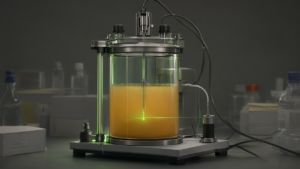
Research published in Frontiers demonstrates the effectiveness of a virtual reality (VR)-based bioreactor developed for biomanufacturing and environmental engineering laboratories. This innovative VR system faithfully replicates a detailed 3D model of a 30L stainless steel bioreactor, enabling students to safely and effectively experience complex practical activities, such as component identification and Steam-In-Place (SIP) operations, through simulation both before and after operating physical equipment. This approach is expected to significantly improve students’ equipment proficiency and comprehension of operational procedures, dramatically enhancing the quality of practical education.
Technical & Clinical Details: VR System Design and Educational Applications
- High-Fidelity 3D Model: The developed VR bioreactor features a high-precision 3D model of all major components of a 30L stainless steel bioreactor, including impellers, sensors, piping, and valves. This allows students to intuitively learn the names, functions, and placement of each part in a virtual environment.
- Practical Simulation Activities: The system goes beyond mere visual representation by supporting specific operational simulations. For example, the ‘Component Identification’ module allows students to experience disassembling and reassembling a virtual bioreactor, leading to a deeper understanding of each part’s role. The ‘SIP Operation’ module enables step-by-step practice of complex steam sterilization procedures, helping students master safety protocols.
- Interactive Learning Environment: The VR environment provides an interactive learning space where students can freely experiment without fear of error and visually observe the impact of different operations. This fosters a deeper understanding and practical skills that are difficult to acquire through traditional textbooks or video learning.
- Evaluation of Educational Effectiveness: The study reported that the VR group showed significantly higher scores in understanding equipment structure, recalling operational procedures, and self-confidence compared to a control group receiving traditional instruction.
Background & Industry Context: Challenges in Biomanufacturing Education
In biomanufacturing and environmental engineering education, a major challenge has been limited student access to expensive and complex physical bioreactor equipment. Risks of equipment damage, maintenance costs, and time constraints often make it difficult for students to gain sufficient practical experience. VR technology is emerging as a solution to overcome these limitations, providing realistic learning experiences safely and cost-effectively.
Future Outlook: Revolutionizing Bioprocess Workforce Development
VR-based bioreactors hold the potential to become transformative tools in training the next generation of bioprocess engineers and researchers. This technology can be applied not only in universities and vocational schools but also in corporate training programs, contributing to more efficient onboarding of new hires and continuous skill development for experienced technicians. In the future, it is expected to further enhance educational content through integration with more complex process control, troubleshooting scenarios, and even digital twins, thereby strengthening workforce development vital for the advancement of the bioindustry.
Source: https://www.frontiersin.org/journals/education/articles/10.3389/feduc.2026.1834044/full
Get our weekly technology intelligence — free
Receive an infographic that lets you judge at a glance whether each field’s analysis report is worth reading.
Subscribe Free — Weekly Tech Intelligence
By subscribing, you’ll receive Troy-Technical’s weekly technology intelligence newsletter.
- Your email and selected fields are used only to deliver the newsletter.
- We never share your information with third parties.
- You can unsubscribe anytime via the link in each email.
See our Privacy Policy for details.
Takes about a minute · Unsubscribe anytime