Key Findings
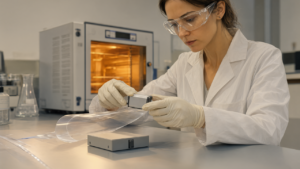
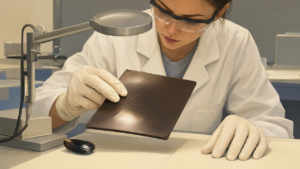
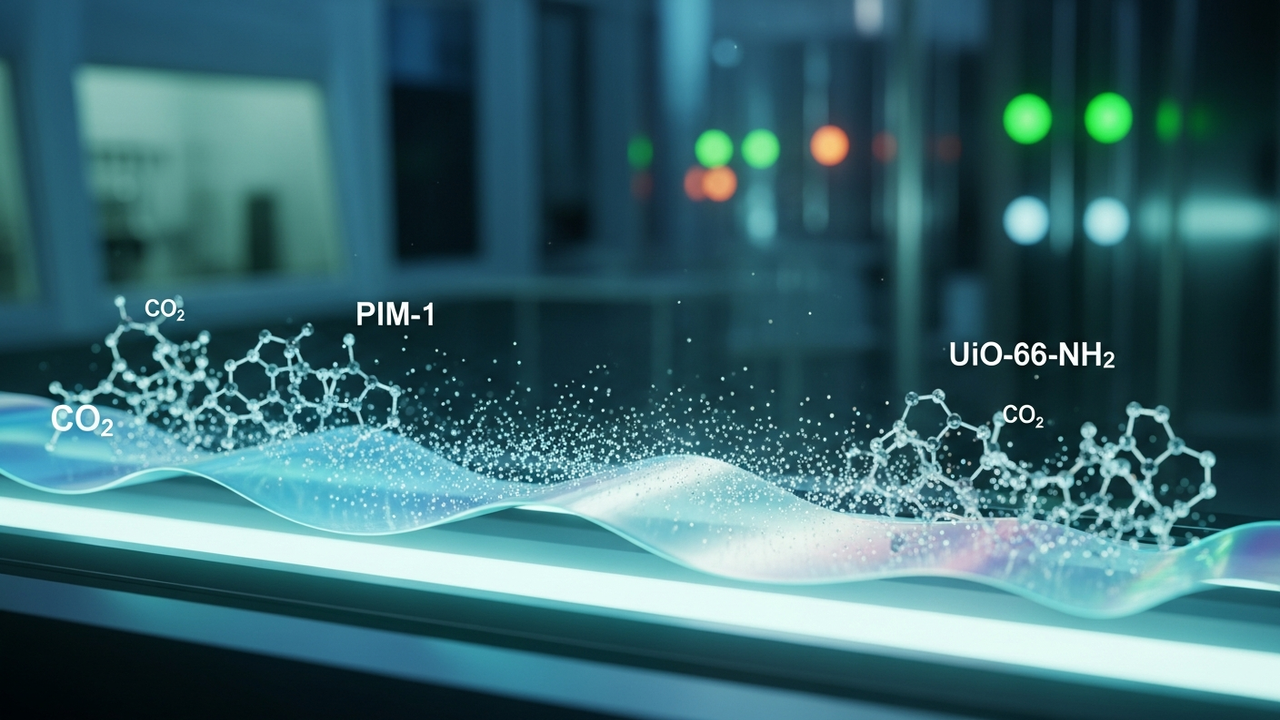
A research team has fabricated novel mixed-matrix membranes (MMMs) by integrating CO2-molecularly imprinted UiO-66-NH2 (metal-organic framework) fillers into an amidoxime-functionalized PIM-1 (polymer of intrinsic microporosity) matrix. This innovative combination, coupled with thermal treatment, achieved a significant breakthrough in CO2/N2 separation, demonstrating both high CO2 permeability and superior selectivity, with stable performance across a range of pressures.
Technical / Clinical Details
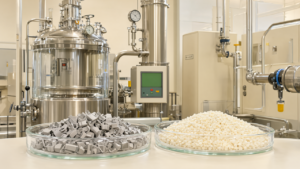
The developed MMMs leverage a sophisticated dual-strategy. First, PIM-1, known for its high free volume and gas permeability, was functionalized with amidoxime groups to enhance its affinity for CO2. Second, UiO-66-NH2 fillers were precisely engineered using CO2 molecular imprinting techniques, thereby improving CO2 selectivity by creating specific recognition sites. The uniform dispersion of these imprinted MOF fillers within the polymer matrix establishes selective pathways for CO2 transport. A subsequent thermal treatment step plays a crucial role in stabilizing the membrane structure and fine-tuning pore sizes, resulting in a membrane that exhibits both high CO2 permeance and excellent selectivity against N2.
Background & Context
Mitigating CO2 emissions is an urgent global challenge, necessitating the development of highly efficient CO2 separation and capture technologies from industrial sources like power plants. Membrane separation stands out as a promising alternative to energy-intensive conventional methods such as absorption and adsorption, offering lower energy consumption and a smaller environmental footprint. However, a long-standing trade-off between permeability and selectivity has limited the practical application of many polymeric membranes. This research directly confronts this challenge, providing a viable pathway to overcome this performance barrier and develop highly efficient, practical CO2 separation membranes.
Strategic Significance & Outlook
These novel MMMs, combining amidoxime-functionalized PIM-1 with CO2-imprinted UiO-66-NH2, hold immense potential for large-scale CO2 capture applications. Their demonstrated high permeability, selectivity, and stability under operational conditions suggest they could significantly contribute to industrial CO2 emission reduction efforts. Future work will focus on scaling up manufacturing processes, evaluating long-term operational stability, and conducting pilot-scale demonstrations under real-world conditions. This innovative membrane technology represents a critical tool in the global transition towards a more sustainable, low-carbon future, offering a path to cleaner industrial processes and enhanced environmental protection.
Source: https://pubs.acs.org/doi/abs/10.1021/acsapm.6c01048
Get our weekly technology intelligence — free
Receive an infographic that lets you judge at a glance whether each field’s analysis report is worth reading.
Subscribe Free — Weekly Tech Intelligence
By subscribing, you’ll receive Troy-Technical’s weekly technology intelligence newsletter.
- Your email and selected fields are used only to deliver the newsletter.
- We never share your information with third parties.
- You can unsubscribe anytime via the link in each email.
See our Privacy Policy for details.
Takes about a minute · Unsubscribe anytime