Key Findings
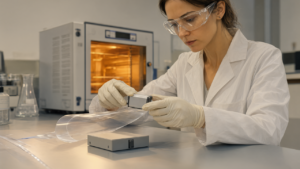
This research demonstrates that extreme nanoconfinement dramatically enhances the solubility of small molecules within nonpolar polymers in mixed matrix membranes (MMMs). Specifically, by integrating imidazole zeolite nanoparticles (ZIF-8) into a polymethylpentene (PMP) polymer matrix, researchers achieved a significant improvement in both CO2 permeability and selectivity, yielding performance that surpasses current trade-off limits in gas separation.
Technical / Clinical Details
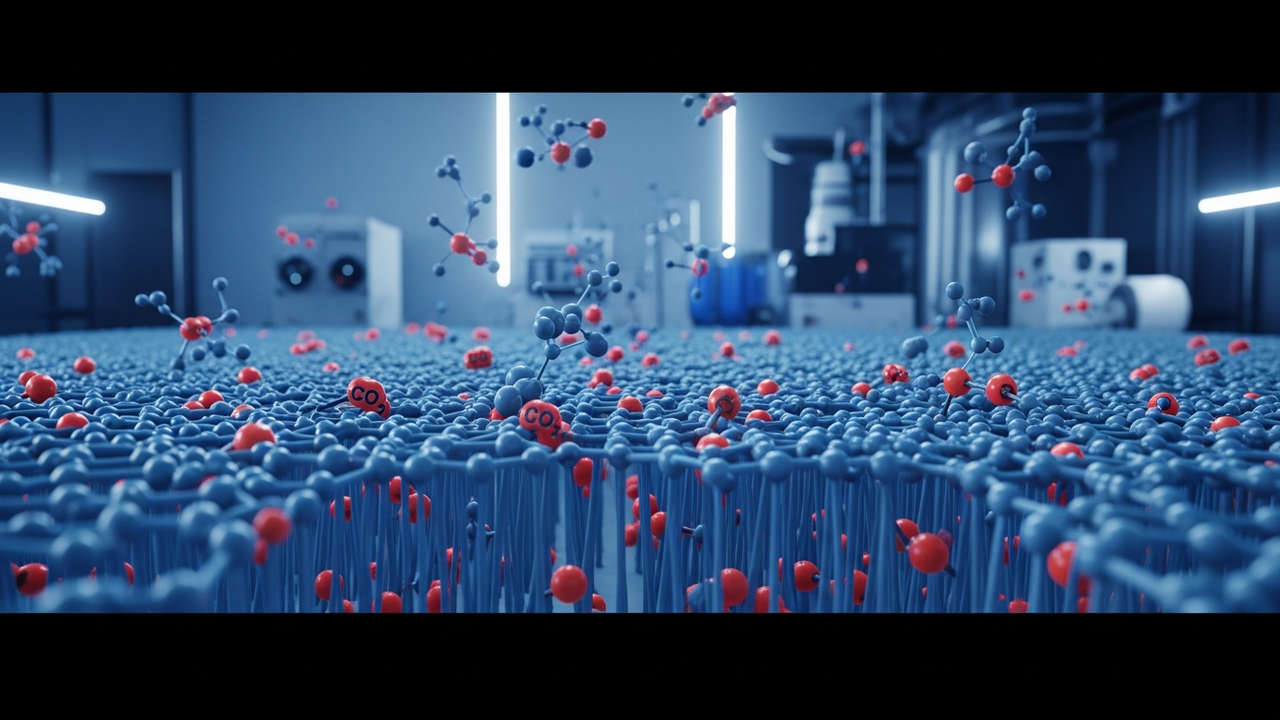
The researchers engineered a hydrophobic PMP polymer matrix to uniformly disperse amphiphilic ZIF-8 nanoparticles, which possess both hydrophilic and CO2-philicity properties. This setup creates a unique “nanoconfined space” within the membrane. Within this nanoscale environment, amphiphilic interactions between the polymer and ZIF-8 were observed to efficiently enhance the dissolution and adsorption of CO2 molecules. This mechanism not only boosts CO2 permeation flux but also maintains selectivity against other gases like N2. This solubility-enhancement mechanism offers new design principles for improving MMM gas separation performance and shows potential to overcome the conventional trade-off between solubility and diffusivity selectivity.
Background & Context
Gas separation membrane technology is garnering significant attention as an energy-efficient alternative for various industrial processes, including carbon capture, hydrogen purification, and natural gas processing. However, a persistent challenge in CO2 separation has been the difficulty in achieving both high permeability and high selectivity simultaneously, with many membrane materials confronting a fundamental “trade-off limit.” Nonpolar polymers typically offer high permeability but suffer from low affinity for CO2, leading to poor selectivity. This research addresses this trade-off directly by judiciously incorporating MOF (metal-organic framework) nanoparticles, thereby accelerating the development of high-performance CO2 separation membranes.
Strategic Significance & Outlook
This strategy of dramatically enhancing small molecule solubility through extreme nanoconfinement holds broad applicability beyond CO2 separation membranes, extending to other gas separations, water treatment, and even catalytic reactions. It is expected to significantly contribute to the efficiency of industrial-scale carbon capture technologies. Future work will focus on assessing the long-term stability of these membranes, scaling up manufacturing processes, and evaluating performance under real-world conditions. This research, integrating nanomaterials and polymer science, is poised to drive advancements in high-efficiency separation technologies vital for achieving a sustainable society and robust industrial processes globally.
Get our weekly technology intelligence — free
Receive an infographic that lets you judge at a glance whether each field’s analysis report is worth reading.
Subscribe Free — Weekly Tech Intelligence
By subscribing, you’ll receive Troy-Technical’s weekly technology intelligence newsletter.
- Your email and selected fields are used only to deliver the newsletter.
- We never share your information with third parties.
- You can unsubscribe anytime via the link in each email.
See our Privacy Policy for details.
Takes about a minute · Unsubscribe anytime