Key Findings
The Japan Times highlighted Japan’s national initiative to develop ‘Physical AI,’ leveraging its strengths in manufacturing and vast datasets. This vision aims to create AI systems where robots can autonomously assist human workers with high precision. This endeavor is propelled by government research calls and strong industry focus, aiming to regain Japan’s competitiveness in the global AI race, particularly in fields like autonomous driving, through the fusion of software and hardware.
Technical / Clinical Details
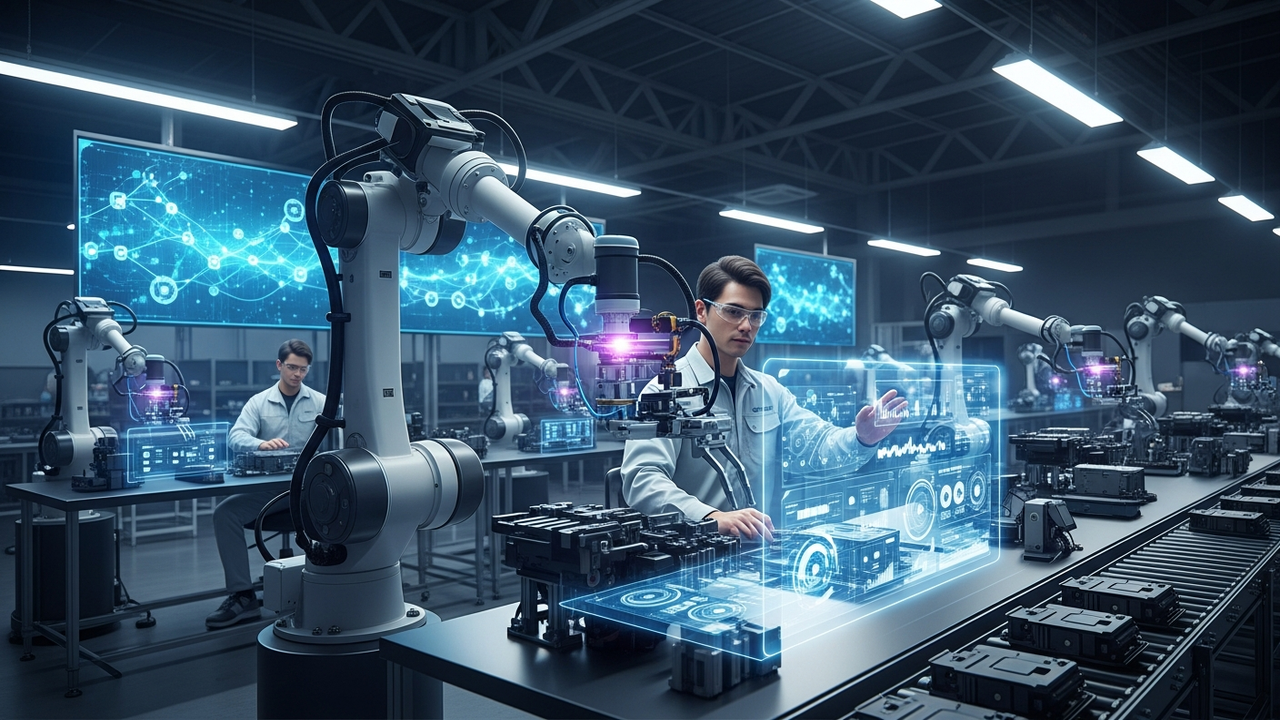
‘Physical AI’ refers to AI systems that act, learn, and make decisions in the physical world, not just computing in data centers. In manufacturing sites, robots collect sensor data (vision, touch, force feedback) in real-time, which AI analyzes to support human tasks or substitute for hazardous ones. For example, AI can learn complex manual tasks from skilled workers, and robots can replicate them, leading to improved quality consistency and productivity. The key to this system is utilizing large amounts of manufacturing data (past production records, defect data, robot operation logs, etc.) for AI model training. Integration with digital twin technology is also crucial, involving an approach where physical factories are replicated in virtual space, and AI learns and optimizes optimal robot movements and production processes through simulation. This allows AI to acquire high-precision prediction and control capabilities, enabling it to address complex challenges in the physical world.
Background & Context
Japan has long been known as a manufacturing powerhouse, but its position has been challenged in recent global digitalization and AI competition. While AI development has tended to be software-centric, Japan aims to leverage its strong hardware technology by fusing it with AI, creating a unique advantage. With a severe labor shortage due to an aging population and declining birthrate, improving productivity in manufacturing sites and optimizing human-robot collaborative work are urgent challenges. Physical AI is expected as a uniquely Japanese solution to this problem, positioned by the government as a core technology for realizing ‘Society 5.0.’
Strategic Significance & Outlook
The advancement of Physical AI will bring significant transformation to Japan’s manufacturing sector. Applications are expected not only in factories but also across a wide range of fields where robots and AI operate in the physical world, such as agriculture, logistics, infrastructure inspection, and healthcare. Particularly, it has the potential to establish Japan’s technological superiority in areas requiring high-precision physical interactions, such as autonomous driving technology, disaster response robots, and precision surgical assistance systems. This initiative is a strategic investment for Japan to overcome the challenges facing its manufacturing industry and achieve sustainable growth, serving as a crucial step for Japan to regain its presence in the global AI competition. In the future, the collaboration between humans and AI is expected to contribute to the realization of a safer, more efficient, and richer society.
Source: https://www.japantimes.co.jp/commentary/2026/06/24/japan/japan-ai-manufacturing-sector/
Get our weekly technology intelligence — free
Receive an infographic that lets you judge at a glance whether each field’s analysis report is worth reading.
Subscribe Free — Weekly Tech Intelligence
By subscribing, you’ll receive Troy-Technical’s weekly technology intelligence newsletter.
- Your email and selected fields are used only to deliver the newsletter.
- We never share your information with third parties.
- You can unsubscribe anytime via the link in each email.
See our Privacy Policy for details.
Takes about a minute · Unsubscribe anytime