Key Findings
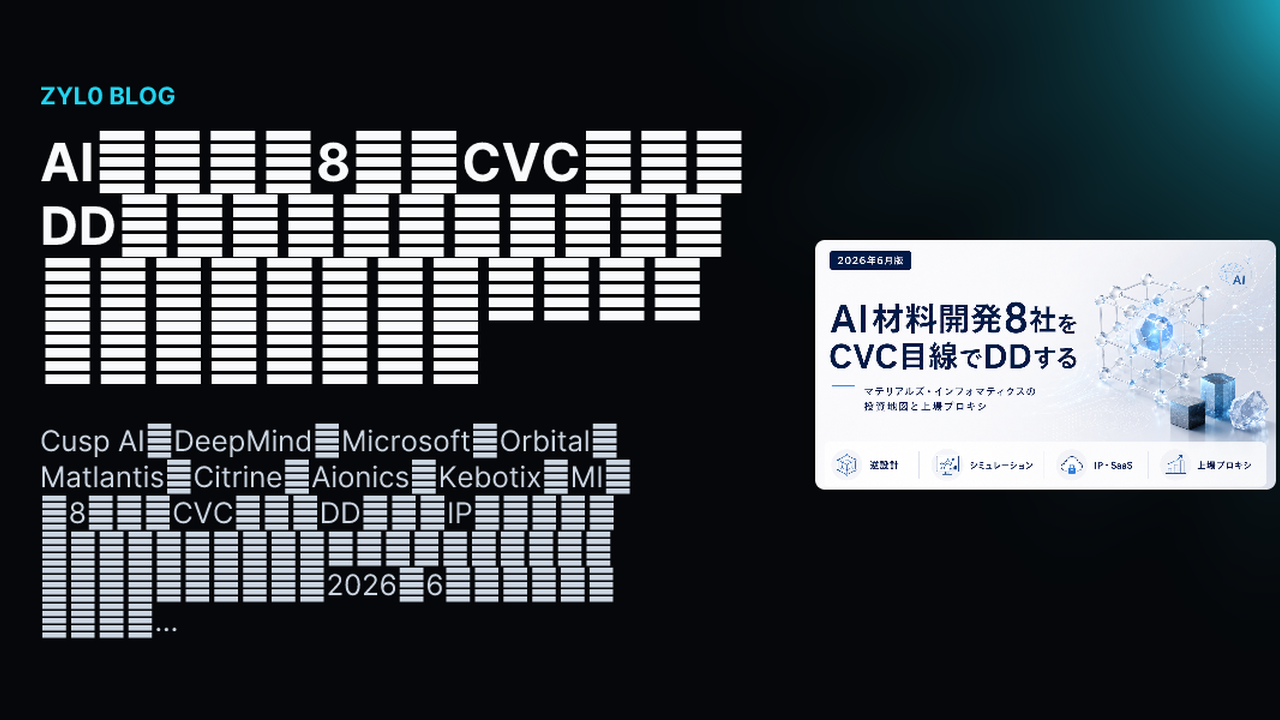
From the perspective of Corporate Venture Capital (CVC), eight leading companies in AI material development—Cusp AI, DeepMind, Microsoft, Orbital, Matlantis, Citrine Informatics, Aionics, and Kebotix—have been analyzed in detail to inform investment decisions. This analysis compares each company’s degree of technological generality versus specialization for specific applications, their current commercialization stage, and their past funding status. It identifies critical factors that CVCs should consider when deciding to invest in this innovative sector.
Technical / Clinical Details
The analyzed AI material development companies employ diverse approaches to address challenges in Materials Informatics (MI):
- Generality vs. Specialization: Some companies (e.g., DeepMind, Microsoft) adopt a broad approach, applying foundation models and general AI frameworks to materials science. In contrast, others (e.g., Matlantis, Citrine Informatics) offer specialized solutions for particular material classes (e.g., polymers, alloys) or specific industries (e.g., batteries, catalysts). CVCs evaluate which type of company is more suitable based on their strategic needs.
- Technology Stack: Each company leverages various AI/ML technologies for materials exploration, design, and process optimization, including machine learning potentials, generative models (e.g., VAE, GAN, LLM), Bayesian optimization, reinforcement learning, and graph neural networks (GNN). Some companies are also strengthening their integration with autonomous experimental systems and robotics to achieve closed-loop material development.
- Commercialization Stage: The companies range from nascent startups to those that have already partnered with major corporations and achieved concrete results. CVCs assess which stage of company to invest in, considering the balance between risk and return.
- Funding Status: Past funding rounds, valuations, and key investors (VCs, other CVCs, etc.) are crucial indicators of a company’s growth potential, market perception, and future fundraising prospects.
This analysis extends beyond mere technical evaluation to include aspects such as business models, market strategy, and competitive advantages.
Background & Context
Materials Informatics (MI), a field leveraging AI and big data to dramatically improve the speed and efficiency of new material development, has seen rapid growth in recent years. Traditional materials development heavily relied on time-consuming and costly trial-and-error experimentation, but MI is transforming this into a data-driven approach. The emergence of such innovative technologies is key to establishing a competitive advantage across diverse industrial sectors, including automotive, electronics, energy, chemicals, and healthcare. CVCs seek synergies with their core businesses and strategically invest in technologies and companies that will be future growth drivers, thereby accelerating innovation and maintaining market leadership.
Strategic Significance & Outlook
CVC investment in AI material development is expected to continue actively. Future trends in this field include the development of more general foundation models for materials science, the creation of fully automated material development pipelines through the integration of AI and autonomous labs, and the acceleration of innovative material design using generative AI. CVCs will capture these trends and strengthen their investments from the following perspectives:
- Companies accelerating the closed-loop ‘Design-Make-Test-Analyze’ cycle.
- Companies with deep expertise specialized in specific industrial challenges (e.g., high-performance batteries, CO2 capture materials).
- Companies possessing technology to evaluate the ‘synthesizability’ of AI-generated material designs.
- Companies with ‘explainable AI’ technology that can articulate AI-discovered material protocols in a human-understandable manner.
Through such strategic investments, CVCs will strengthen their technological portfolios and accelerate the discovery of new materials that contribute to a sustainable society.
Source: https://www.zyl0-lab.com/blogs/31-ai-materials-informatics-cvc-diligence
Get our weekly technology intelligence — free
Receive an infographic that lets you judge at a glance whether each field’s analysis report is worth reading.
Subscribe Free — Weekly Tech Intelligence
By subscribing, you’ll receive Troy-Technical’s weekly technology intelligence newsletter.
- Your email and selected fields are used only to deliver the newsletter.
- We never share your information with third parties.
- You can unsubscribe anytime via the link in each email.
See our Privacy Policy for details.
Takes about a minute · Unsubscribe anytime