Key Findings
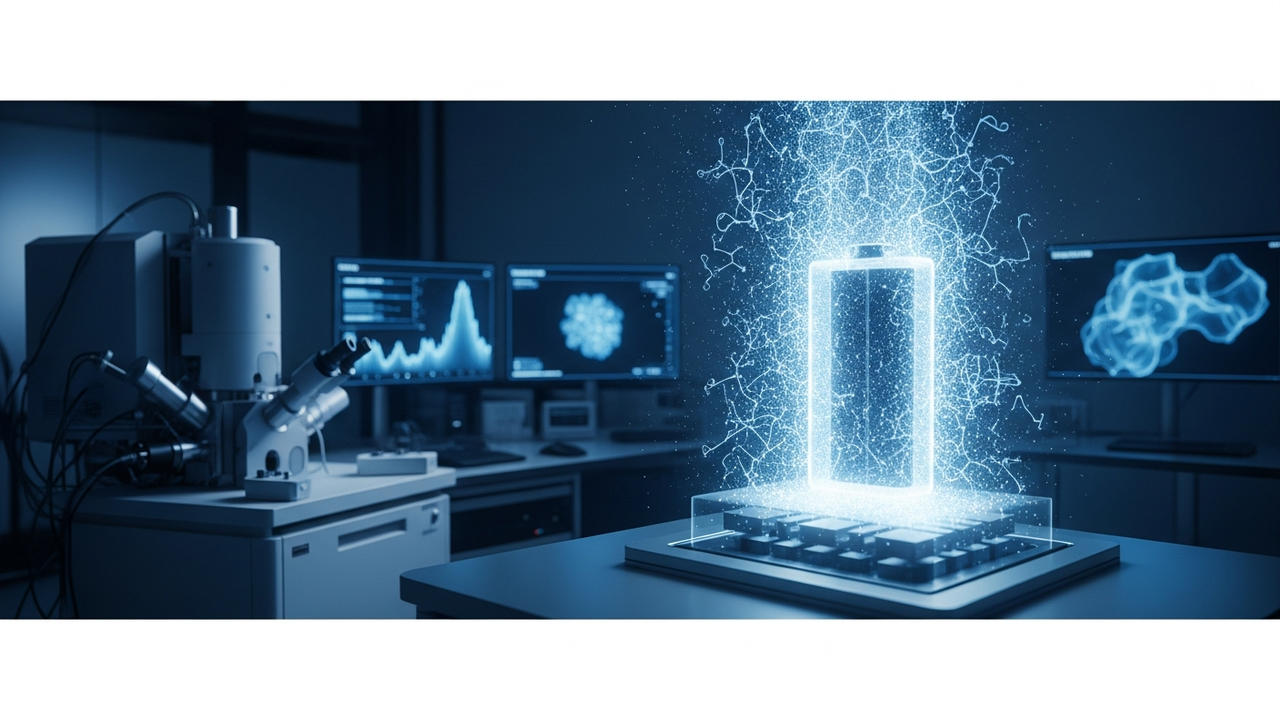
A research team has published groundbreaking findings in Advanced Energy Materials, showcasing a significant breakthrough in anode-free solid-state battery technology. The study demonstrates over 500 stable charge-discharge cycles with minimal capacity fade, even at high current densities. This pivotal advancement stems from a novel interfacial layer design introduced between the lithium metal current collector and the solid electrolyte, which holds the potential to maximize battery energy density while simplifying the manufacturing process of all-solid-state batteries.
Technical and Research Details
Anode-free batteries represent the ultimate configuration for achieving ultra-high energy density, but their primary challenge has been the formation of lithium dendrites (tree-like structures) on the lithium metal anode surface during cycling, leading to short circuits and capacity degradation. The novel interfacial layer developed in this research effectively promotes uniform lithium deposition and dissolution, thereby suppressing dendrite formation. This leads to a substantial improvement in Coulombic efficiency (the ratio of discharged to charged capacity) and dramatically extends the battery’s cycle life. Specifically, overcoming the long-standing instability issues of previous anode-free batteries and achieving over 500 stable cycles marks a significant step towards practical application.
Background and Industry Context
All-solid-state batteries are highly anticipated as a next-generation technology to surpass the limitations of existing lithium-ion batteries in applications such as electric vehicles (EVs), portable electronics, and stationary energy storage. Anode-free designs, by eliminating the need for anode host materials, theoretically maximize battery energy density to the highest levels, simultaneously contributing to cost reduction and simplified manufacturing processes. However, the dendrite problem has been a persistent challenge. This breakthrough offers a practical solution to this formidable barrier, opening new possibilities for enhancing the range and safety of EVs.
Strategic Significance and Outlook
This research outcome significantly propels the commercialization of anode-free solid-state batteries forward. The novel interfacial layer technology enhances battery design flexibility and establishes a crucial foundation for realizing future high-energy-density batteries. Further research and development will be necessary to validate the scalability of this technology and its long-term reliability under various operating conditions. If successful, it could enable lighter and more compact battery packs, substantially extending the range of electric vehicles and contributing to the widespread adoption of more sustainable and safer energy storage solutions.
Source: #
Get our weekly technology intelligence — free
Receive an infographic that lets you judge at a glance whether each field’s analysis report is worth reading.
Subscribe Free — Weekly Tech Intelligence
By subscribing, you’ll receive Troy-Technical’s weekly technology intelligence newsletter.
- Your email and selected fields are used only to deliver the newsletter.
- We never share your information with third parties.
- You can unsubscribe anytime via the link in each email.
See our Privacy Policy for details.
Takes about a minute · Unsubscribe anytime