Key Findings
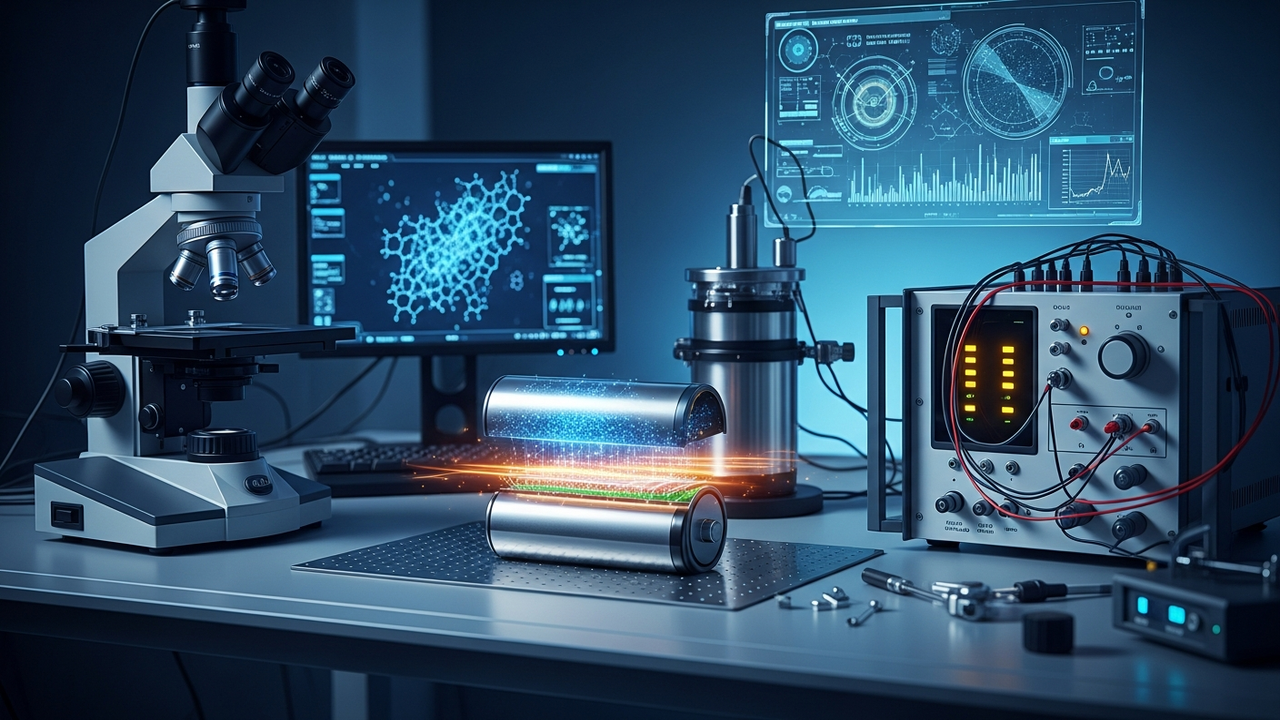
A collaborative research team from Imperial College London and the University of Adelaide has developed a novel battery chemistry, achieving a breakthrough that dramatically reduces the charging time for electric vehicle (EV) batteries. Their announced lithium-ion pouch cell can charge over 85% of its capacity in just 6 minutes while maintaining a high energy density of 240.4 Wh/kg. This rapid charging capability was realized through a technique that utilizes specific interfacial anionic reduction catalysis to form a stable, LiF-rich solid electrolyte interphase (SEI).
Technical Details
In conventional lithium-ion batteries, fast charging often accelerates uneven lithium deposition (dendrite formation) and electrode degradation, compromising safety and lifespan. In this study, based on a new battery chemistry, the researchers introduced interfacial anionic reduction catalysis to form a stable SEI layer rich in lithium fluoride (LiF) on the electrode surface. This LiF-rich SEI layer facilitates uniform lithium-ion migration and suppresses dendrite growth. As a result, the battery can be charged safely and efficiently to over 85% capacity in a short 6-minute period, while successfully maintaining a practical energy density of 240.4 Wh/kg. This performance is superior to many existing high-performance lithium-ion batteries.
Background & Context
For accelerating EV adoption, charging times comparable to gasoline refueling (a few minutes) is one of the most critical demands from consumers. Current EVs often require 20 minutes to an hour even with fast chargers, which is a major barrier to wider EV uptake. The achievement of 85% charge in 6 minutes reported in this study holds immense significance for solving this ‘charging time’ challenge. Furthermore, the formation of a LiF-rich SEI layer may also offer insights into addressing interfacial stability issues in next-generation all-solid-state batteries, contributing to the overall advancement of lithium-ion battery technology.
Strategic Significance & Outlook
This rapid charging technology is expected to have a significant impact on a wide range of applications requiring short charging times, beyond electric vehicles, including drones, robotics, and portable electronic devices. Future research will focus on scaling up this technology and verifying its cost-efficiency and long-term reliability for mass production. If this breakthrough is successfully commercialized, it is anticipated to alleviate the burden on EV charging infrastructure and enhance user experience, thereby significantly accelerating the transition to a sustainable mobility society. Insights into solid electrolyte interface control could also be applied to future all-solid-state battery development.
Source: https://electronics360.globalspec.com/article/23824/faster-charging-for-ev-batteries
Get our weekly technology intelligence — free
Receive an infographic that lets you judge at a glance whether each field’s analysis report is worth reading.
Subscribe Free — Weekly Tech Intelligence
By subscribing, you’ll receive Troy-Technical’s weekly technology intelligence newsletter.
- Your email and selected fields are used only to deliver the newsletter.
- We never share your information with third parties.
- You can unsubscribe anytime via the link in each email.
See our Privacy Policy for details.
Takes about a minute · Unsubscribe anytime








Comments