Key Findings
Samsung Electronics has strategically committed half of its High Bandwidth Memory (HBM) production capacity to the next-generation HBM4, achieving over $1 billion in sales within just four months of its global debut in February 2026. The company projects annual HBM4 sales to reach $10 billion by the end of the year, signaling an aggressive push to reclaim leadership in the burgeoning HBM market. To facilitate this accelerated ramp-up, production of HBM3E, currently experiencing lower demand, has been temporarily halted, with resources reallocated to HBM4.
Technical & Product Details
- HBM4 Focus: Samsung is dedicating approximately 75,000 of its 150,000 monthly HBM DRAM wafer production capacity to HBM4. This significant strategic prioritization directly addresses the critical role HBM4 is expected to play in NVIDIA’s forthcoming next-generation AI platform, ‘Rubin.’
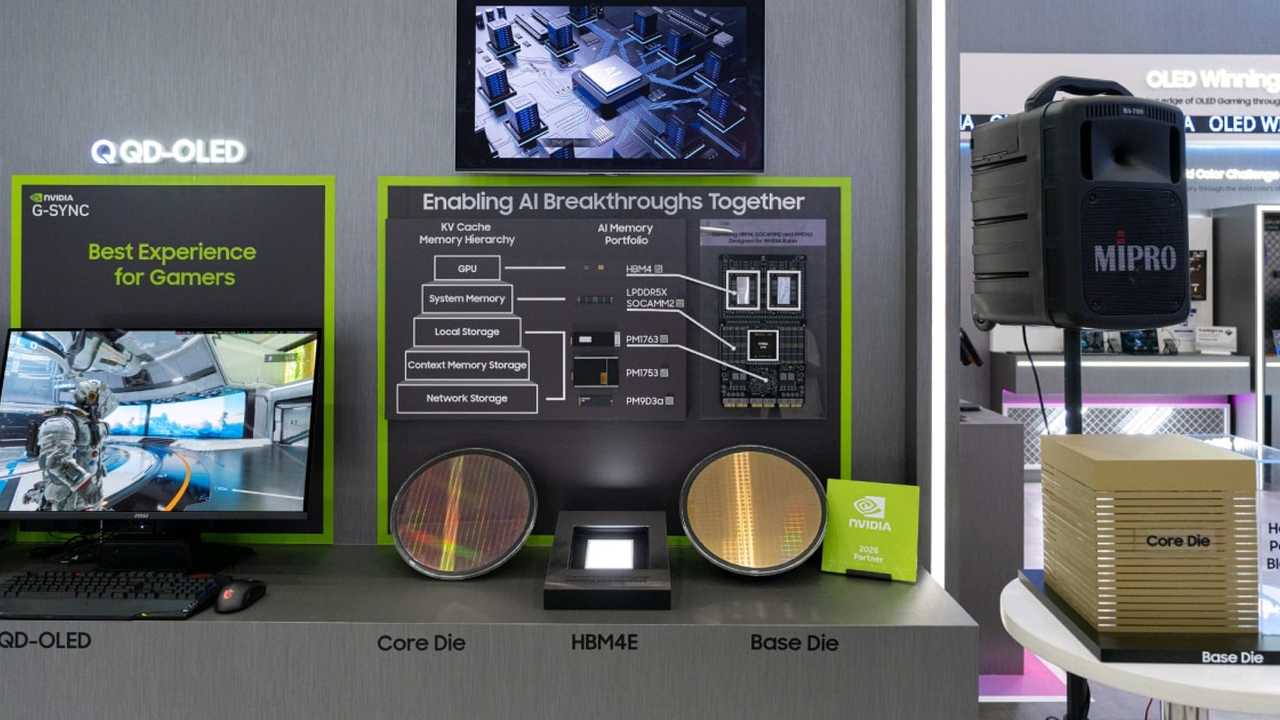
- COMPUTEX 2026 Showcase: At COMPUTEX 2026, Samsung showcased the HBM4E along with its LPDDR5X-based SOCAMM2 server module. The HBM4E features a cutting-edge 1c DRAM-based core die and a base die manufactured using Samsung Foundry’s advanced 4nm process technology. It supports data rates up to 14Gbps per pin, with a clear roadmap for scalability to 16Gbps, enabling aggregate bandwidth exceeding 4TB/s.
- HBM Economics: HBM economics are increasingly critical: HBM stacks represent approximately 34-45% of the total manufacturing cost for AI accelerators, a figure projected to exceed 45% for Blackwell-generation chips. Consequently, HBM yield and rigorous qualification processes are direct determinants of system-level economics. Samsung is reportedly navigating some initial challenges in HBM4 yield and qualification, which it aims to resolve through aggressive investment and optimization.
- Optical HBM Roadmap: Samsung further outlined an ambitious roadmap for mass production of optical HBM, targeting 2028. This innovative approach entails integrating silicon photonics technology directly within HBM stacks and processor packages. The goal is to achieve dramatic improvements in bandwidth and energy efficiency by transcending the inherent limitations of traditional electrical signaling. This push aligns with broader industry trends, including Qualcomm’s High Bandwidth Compute (HBC) concept and NVIDIA’s SOCAMM specification for modularizing LPDDR memory in server CPUs.
Background & Industry Context
The escalating complexity and scale of artificial intelligence models demand immense data processing capabilities and unprecedented memory bandwidth for AI accelerators. Consequently, high-bandwidth memory (HBM) has emerged as a critical bottleneck and a strategic component in the AI chip supply chain. Samsung’s aggressive investment in HBM4 is designed to fortify its competitive position in the high-stakes AI memory market, serving not only a pivotal client like NVIDIA but also major cloud hyperscalers—such as Google, Amazon, and Microsoft—that are increasingly developing their custom AI accelerators.
Strategic Significance & Outlook
Samsung’s aggressive expansion of HBM4 production capacity, coupled with its forward-looking roadmap encompassing HBM4E, SOCAMM2, and especially optical HBM, is poised to significantly strengthen its competitive stance in the burgeoning AI semiconductor market. Optical HBM, in particular, holds transformative potential, capable of revolutionizing AI chip performance by transcending current electrical transmission limitations and marking a crucial milestone for future technological innovation. The consistent supply and continuous performance improvement of HBM are indispensable factors for the sustained evolution and widespread adoption of AI technologies, thereby solidifying Samsung’s critical role as a key enabler of the ongoing AI revolution.
Get our weekly technology intelligence — free
Receive an infographic that lets you judge at a glance whether each field’s analysis report is worth reading.
Subscribe Free — Weekly Tech Intelligence
By subscribing, you’ll receive Troy-Technical’s weekly technology intelligence newsletter.
- Your email and selected fields are used only to deliver the newsletter.
- We never share your information with third parties.
- You can unsubscribe anytime via the link in each email.
See our Privacy Policy for details.
Takes about a minute · Unsubscribe anytime