Key Findings
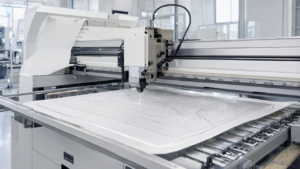
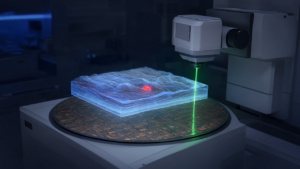
Fraunhofer ILT is advancing research into an innovative “DUV-assisted athermal laser grooving” technology for the microfabrication of low-κ dielectric materials, which are essential for advanced microelectronics packaging. This novel dual-pulse approach allows for high-precision material removal while minimizing thermal damage to the substrate.
Technical Details
- Dual-Pulse Approach: The technology begins with a Deep Ultraviolet (DUV) laser pulse that delivers energy exceeding the bandgap of the low-κ material, temporarily generating free carriers (electrons and holes) within it. This alters the material’s electrical properties, making it absorptive to a subsequent laser pulse, whereas it would normally be transparent.
- Athermal Processing: A second laser pulse, precisely timed after the free carrier generation, selectively removes the modified layer without inducing thermal damage to the underlying substrate. Traditional laser processing often struggles with heat-affected zone damage; this athermal approach ensures high-precision grooving while maintaining the structural integrity of delicate low-κ materials.
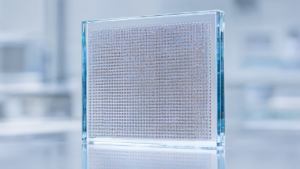
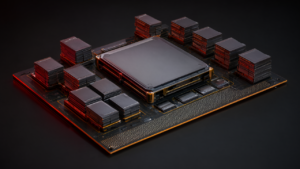
- Importance of Low-κ Materials: Low-κ dielectrics are crucial for reducing signal delay and power loss within microelectronic chips. In advanced packaging, particularly 3D ICs and chiplet integration, the ability to precisely microfabricate these materials without damage directly impacts overall performance and reliability.
Background & Industry Context
The evolution of AI and High-Performance Computing (HPC) has dramatically increased semiconductor chip integration density and operating frequencies. Consequently, interconnect capacitance within chips has become a significant source of signal delay and crosstalk, limiting overall chip performance. Low-κ dielectrics were introduced to mitigate this issue, but their inherent mechanical weakness and thermal fragility have made them extremely challenging to process. Therefore, the development of non-destructive and high-precision fabrication techniques is an urgent industry imperative.
Strategic Significance & Outlook
This DUV-assisted athermal laser grooving technology has the potential to solve long-standing challenges in low-κ material processing, contributing to the realization of next-generation ultra-dense, high-performance semiconductor packaging. By paving the way for smaller, faster, and more power-efficient AI chips and HPC systems, it will drive innovation across a wide range of electronic device sectors. Future research will focus on improving processing speed, scalability, and applicability to various low-κ materials, solidifying its role as a key enabling technology for future microelectronics.
Get our weekly technology intelligence — free
Receive an infographic that lets you judge at a glance whether each field’s analysis report is worth reading.
Subscribe Free — Weekly Tech Intelligence
By subscribing, you’ll receive Troy-Technical’s weekly technology intelligence newsletter.
- Your email and selected fields are used only to deliver the newsletter.
- We never share your information with third parties.
- You can unsubscribe anytime via the link in each email.
See our Privacy Policy for details.
Takes about a minute · Unsubscribe anytime