Key Findings
A groundbreaking research paper published in ACS Applied Materials & Interfaces introduces novel weather-resistant, thermoresponsive, UV-curable smart window composites based on paraffin particles embedded in a polymer matrix. This material demonstrates the ability to autonomously modulate solar transmittance and holds significant promise for advanced thermal management systems and multifunctional window applications in space environments.
Technical & Material Details
- Material Composition: The smart window composite primarily utilizes paraffin particles as the thermoresponsive component, which are uniformly dispersed within a transparent polymer matrix. The polymer matrix is UV-curable, simplifying the manufacturing process and allowing for flexible form factors.
- Thermoresponsive Mechanism: Paraffin undergoes a phase change from solid to liquid within a specific temperature range. This phase transition alters its light-scattering properties: it transmits light when solid and scatters light strongly, reducing transparency and blocking solar radiation, when molten. This reversible phase change enables autonomous adjustment of the window’s transmittance based on external temperature fluctuations.
- Weather Resistance and Flexibility: The developed composite material exhibits excellent weather resistance, maintaining stable performance over repeated cycles. Its mechanical flexibility makes it suitable for application on curved surfaces and complex structures, addressing diverse design requirements.
- Low Cost and Multi-Stimuli Responsiveness: Paraffin is a relatively inexpensive material, contributing to the cost-effectiveness of these smart windows when combined with simplified manufacturing processes. Furthermore, its multi-stimuli responsiveness, reacting not only to heat but also to specific wavelengths of light (UV), offers enhanced control and functionality.
Background & Industry Context
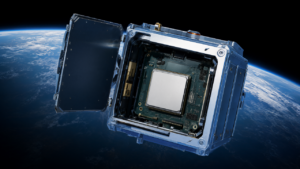
In extreme environments such as spacecraft and lunar bases, external thermal loads are severe, necessitating efficient and reliable thermal management systems. Conventional thermal control systems often rely on complex mechanical components and significant power consumption, leading to increased system mass and power draw. Smart window technology offers a promising solution to these challenges by passively and autonomously regulating thermal loads.
Future Outlook
This weather-resistant thermoresponsive UV-curable smart window composite has the potential to bring significant breakthroughs to thermal management systems in space environments. Potential applications include windows for lunar rovers and habitats, and thermal control blankets for satellites. Beyond space, broad applications are also anticipated in energy-efficient buildings, automotive smart glass, and agricultural greenhouses. Further development of this technology will contribute to both improving habitability in space and advancing sustainable technology development on Earth.
Source: https://pubs.acs.org/doi/abs/10.1021/acsami.6c04877
Get our weekly technology intelligence — free
Receive an infographic that lets you judge at a glance whether each field’s analysis report is worth reading.
Subscribe Free — Weekly Tech Intelligence
By subscribing, you’ll receive Troy-Technical’s weekly technology intelligence newsletter.
- Your email and selected fields are used only to deliver the newsletter.
- We never share your information with third parties.
- You can unsubscribe anytime via the link in each email.
See our Privacy Policy for details.
Takes about a minute · Unsubscribe anytime