Materials Informatics– category –
-

Insilico Medicine and Saudi Aramco Launch ‘sorbaMOF DB’ to Accelerate AI-Driven MOF Discovery, Advancing CO₂ Capture
Insilico Medicine Hong Kong Overview Insilico Medicine and Saudi Aramco have launched 'sorbaMOF DB,' advancing AI-driven MOF (metal-organic framework) discovery. This validated, extensible materials database and benchmarked computational... -
Royal Society of Chemistry Unveils Open-Source Software Platform for Automating Massively Parallel Battery Cycling Experiments
The Royal Society of Chemistry UK Overview The Royal Society of Chemistry has announced a scalable open-source software platform for managing and automating massively parallel battery cycling experiments. This platform accelerates new ma... -
Argonne Lab Advocates Physics-Grounded PhysMat AI to Boost Reliability and Accelerate Materials Discovery
arXiv USA Overview An arXiv paper introduces the concept of Physics-Grounded Materials AI (PhysMat AI) to enhance reliability in materials discovery. PhysMat AI integrates physical knowledge as prior knowledge, descriptors, constraints, ... -
Cornell University’s AI ‘IonNet’ Identifies 63,000 Fast Ion Conductors for Solid-State Batteries, Achieves 0.7V in Low-Voltage Concentration Cells
Fuse Energy USA Overview Cornell University researchers utilized the AI-driven tool 'IonNet' to identify approximately 63,000 promising new materials as fast ion conductors for solid-state batteries. Furthermore, AI insights demonstrated... -
Purdue University Secures $19M NSF Grant to Build AI-Driven Cloud Labs for Semiconductors, Advanced Materials
Purdue University (via Building Indiana) USA Overview Purdue University has received a $19 million grant from the U.S. National Science Foundation (NSF) to establish the 'Intelligent Codesign Cloud Lab (ICoN-PCL)' for semiconductors and ... -
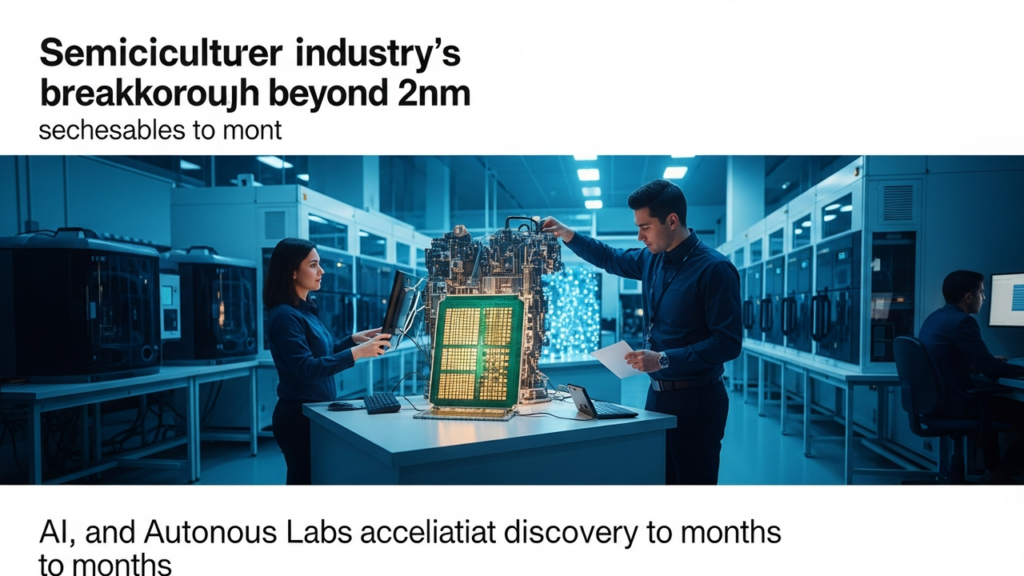
Semiconductor Industry: AI and Self-Driving Labs Accelerate Materials Discovery from Decades to Months to Break 2nm Barrier
Semiconductor Engineering (via Robotics and Automation News) USA Overview Facing physical limits below 2nm, the semiconductor industry is turning to AI and autonomous labs to accelerate new materials discovery. Robotic systems automate s... -
OAE Publishing: Closed-Loop Integration of LLMs and AI Agents Drives Inorganic Materials Discovery, A-Lab Realizes 36 Compounds in 17 Days
OAE Publishing Inc. USA Overview OAE Publishing reports that the integration of large language models (LLMs) and AI agents is shifting inorganic materials discovery from prediction to experimental realization. LLMs orchestrate a closed-l... -
BASF ECMS Deploys Orbital Industries’ AI Materials Discovery Platform ‘CurieOS’ to Accelerate Automotive Catalyst R&D
Just Auto Germany Overview BASF Environmental Catalyst and Metal Solutions (BASF ECMS) has adopted 'CurieOS,' an AI-powered materials discovery platform developed by Orbital Industries, to accelerate research and development of catalysts... -
Chemistry World Reports CuspAI Forms ‘AI Materials Foundry’ with Meta & Nvidia to Accelerate New Functional Material Discovery with AI
Chemistry World UK Overview Chemistry World reports that computational chemistry company CuspAI has formed the "AI Materials Foundry," a network of 45 organizations including Meta and Nvidia, to discover new functional materials using AI... -
Globus Platform to Power NSF-Funded Autonomous Laboratories for AI-Driven Materials Research
Globus / National Science Foundation (NSF) USA Overview The Globus platform will serve as an enabling technology for two new National Science Foundation (NSF) awards focused on creating remotely accessible, AI-driven laboratories for mat...