Materials Informatics– category –
-

SLAC and Penn State Warn: Inter-Lab Data Variations Can Misinform Scientific AI Models
Penn State Altoona USA Overview Researchers from SLAC National Accelerator Laboratory and Penn State University report on the critical importance of reproducible experimental data for building AI models. They emphasize that while AI mode... -
ChemRxiv Unveils ‘CataCon’: A Contrastive Graph Representation Learning Framework for Catalyst Prediction
ChemRxiv International Overview A paper published on ChemRxiv introduces 'CataCon,' a novel contrastive graph representation learning framework for catalyst prediction. Utilizing GraphSAGE, CataCon generates robust molecular graph embedd... -
University of Wisconsin-Madison Secures $25M NSF Grant to Establish ‘Extreme Environment Materials AI Hub’
Facebook USA Overview The University of Wisconsin-Madison has been awarded approximately $25 million from the U.S. National Science Foundation (NSF) to establish the 'NSF Materials AI Hub' for extreme environment materials discovery. Thi... -
Apple Acquires PlasmaSolve s.r.o. to Enhance Advanced Manufacturing and Material Science Capabilities
Signalbase USA Overview Apple has acquired PlasmaSolve s.r.o., a European engineering firm specializing in simulation-based process design and optimization. This acquisition aligns with Apple's strategic commitment to advanced manufactur... -
Frontiers in Education Unveils ‘Curriculum as Code’: A Generative AI Architecture for STEM Instructional Design
Frontiers in Education International Overview A paper in Frontiers in Education introduces 'Curriculum as Code,' an AI-assisted instructional design architecture for STEM education. The system integrates generative AI, specifically OpenA... -
ArXiv Presents ‘ED-CSP’: A Machine Learning Framework for Crystal Structure Prediction from Sparse Electron Diffraction
arXiv International Overview The paper "ED-CSP" introduces a machine learning framework for predicting crystal structures from sparse electron diffraction (ED) observations. This model co-predicts lattice parameters and fractional atomic... -
Applied Materials Partners with UC Berkeley to Accelerate Commercialization of Advanced Semiconductor Materials for AI Chips
Simply Wall St USA Overview Applied Materials announced the University of California, Berkeley's participation as a research collaborator at its Silicon Valley EPIC Center. This partnership is set to accelerate the commercialization of a... -
University of Toronto Discovers Extreme-Condition Metal Alloys Outperforming Inconel 625 Using AI and 3D Printing
Global People Daily News Canada Overview Researchers at the University of Toronto have leveraged AI and robotic-assisted manufacturing to discover novel metal alloys that maintain superior strength under extreme conditions. These new 3D-... -
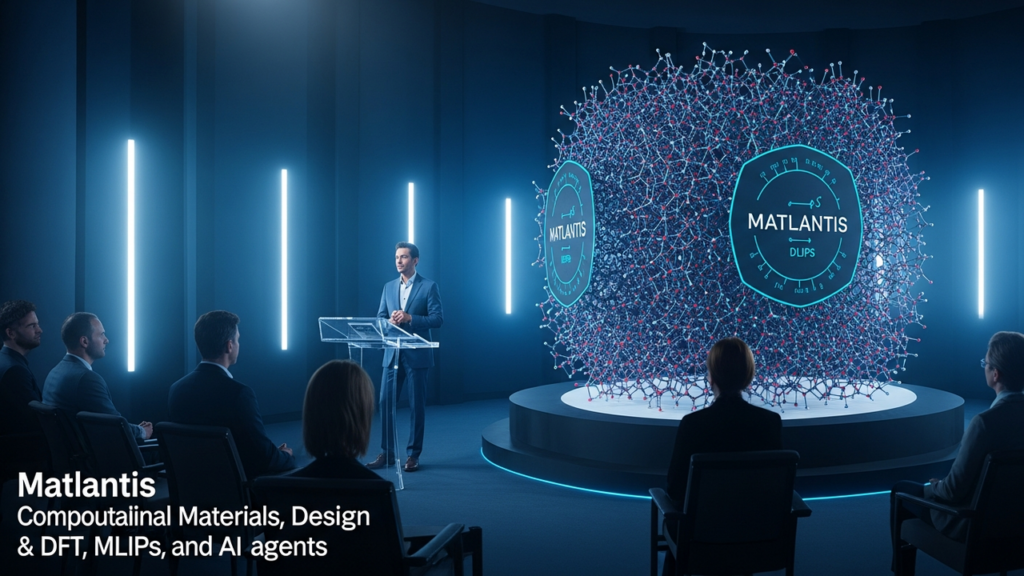
Matlantis Webinar Accelerates Computational Materials Design with Integrated CALPHAD, DFT, MLIPs, and AI Agents
Matlantis Japan Overview Matlantis offers an on-demand webinar accelerating computational materials design by integrating CALPHAD, Density Functional Theory (DFT), Machine Learning Interatomic Potentials (MLIPs), and AI-assisted simulati... -
4th CEMDI-PAIMS Symposium Accelerates Materials Discovery Through Computational Materials Science, AI, Data, Experimental Insights, and International Collaboration
EurekAlert! USA Overview The 4th CEMDI-PAIMS Symposium in Montreal discussed advancements in materials discovery through the fusion of computational materials science, AI, data, experimental insights, and international collaboration. Thi...