
The ‘Network Bottleneck’ Plaguing AI-Era Data Centers
The surge in artificial intelligence (AI) workloads is imposing new challenges on data center design and operation. Particularly in training and inference of large-scale AI models, thousands of GPUs must constantly exchange immense amounts of data at high speeds. This saturates network bandwidth within data centers (dubbed ‘east-west traffic’), leading to a ‘network bottleneck’ where the network, rather than computing power itself, constrains overall system performance. Ultra-low latency, high throughput, and rapid synchronization between systems are crucial for efficient AI cluster operation.
Data Center Infrastructure Redesign and the Rise of Optical Technology
Addressing this network bottleneck requires a fundamental redesign of data center infrastructure. Specifically, the following elements are critical:
- Optimizing Physical Layout: Re-evaluating the placement of server racks and networking equipment to minimize data transfer paths.
- Building Dedicated Network Fabrics: Designing high-bandwidth network topologies specifically for AI workloads.
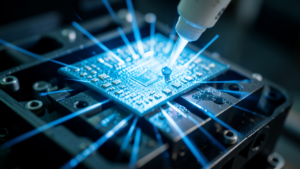
- Implementing High-Speed Optical Interconnects: Traditional copper-based solutions are reaching their physical limits in terms of distance, signal attenuation, power consumption, and bandwidth. In contrast, optical technology offers superior bandwidth, long-distance transmission capability, excellent power efficiency, and high signal integrity, establishing its dominance. Notably, Co-Packaged Optics (CPO) and Near-Packaged Optics (NPO) significantly reduce power and latency by integrating optical engines directly with switch ASICs.
- Advanced Switching Architectures: Architectures capable of efficiently handling AI traffic, including programmable optical switching technologies, are essential.
Industry Impact and Future Outlook
The recognition that AI workload performance is constrained by data movement rather than just computation implies a significant shift in AI infrastructure investment towards optical networking. This accelerates demand for optical components, fiber optics, and optical switching technologies, creating substantial market opportunities for optical device manufacturers and infrastructure providers. However, challenges persist, including operational complexities associated with managing large GPU fabrics, and the need for advanced orchestration, monitoring, and traffic optimization tools. Optical technology will be key to ensuring the scalability and sustainability of AI data centers.





Comments