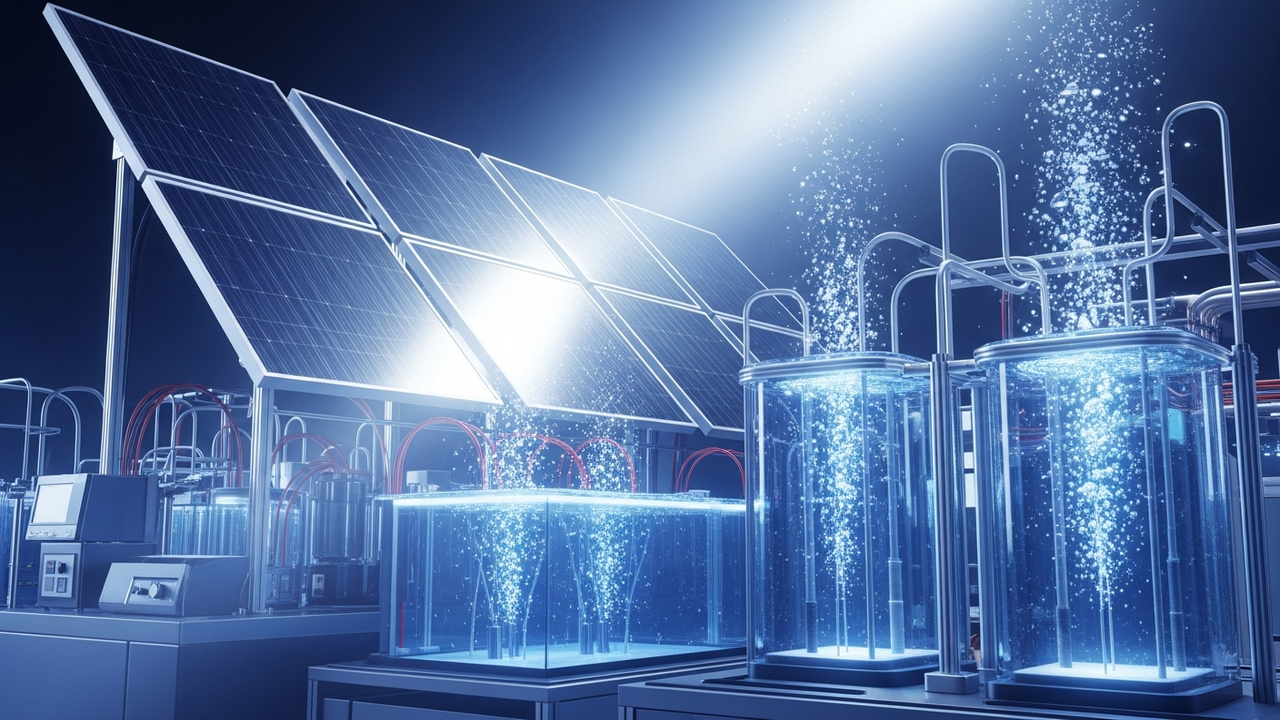
Background: The Dual Challenge of Solar Water Splitting for Green Hydrogen
The global energy transition mandates a shift towards clean, sustainable energy sources, with hydrogen emerging as a leading candidate due to its carbon-free combustion. Among various production methods, solar-driven water splitting, which directly converts sunlight into chemical energy in the form of hydrogen, is highly attractive for its minimal environmental footprint and renewable nature. However, the widespread commercialization of this technology has been significantly hampered by two primary challenges: the relatively low solar-to-hydrogen conversion efficiency and, crucially, the lack of long-term stability in the photocatalytic or photoelectrochemical materials used. Traditional water-splitting catalysts often exhibited a detrimental trade-off, achieving either high efficiency or satisfactory stability, but rarely both simultaneously.
Key Findings / Results: Nanocatalyst Optimization for Unified Performance
Recent research and development efforts have achieved a significant breakthrough in solar-driven hydrogen production, successfully demonstrating a technology that simultaneously ensures both high water-splitting efficiency and remarkable long-term stability. The key to this success lies in the meticulous design and optimization of nanocatalysts and advanced nanomaterials. Researchers have engineered heterostructured nanomaterials comprising multiple functional layers, each optimized for specific roles: light absorption, charge separation, and electrochemical water decomposition reactions. This multi-layered approach involves strategies such as nanostructuring to maximize the surface area of photocatalysts, doping nanoparticles to enhance electron transfer efficiency at reaction active sites, and incorporating protective layers to improve durability and prevent degradation during prolonged operation. These synergistic optimizations have dramatically increased the efficiency of converting solar energy into chemical energy (hydrogen). Concurrently, by mitigating catalyst degradation, the system now enables stable hydrogen generation over extended periods, a critical factor for practical applications. This technology achieves significantly higher overall performance compared to previous solar water-splitting systems, addressing the long-standing efficiency-stability dilemma.
Technical Significance & Outlook: Accelerating the Carbon-Neutral Transition
This advancement in high-efficiency solar-driven hydrogen production carries immense technical significance for the global transition to a carbon-neutral society. The successful unification of efficiency and stability means that the technology is now far more viable for commercial deployment, promising a substantial reduction in hydrogen production costs. This will, in turn, accelerate the widespread adoption of clean hydrogen across various sectors, including fuel cell vehicles (FCVs), grid-scale energy storage for intermittent renewables, and decarbonization of industrial processes. Furthermore, the continuous evolution of nanocatalyst technology could reduce reliance on rare and expensive elements, opening pathways for developing high-performance catalysts from more abundant and cost-effective materials. The immediate outlook focuses on further scaling up this technology and optimizing its cost-effectiveness for industrial-scale hydrogen production plants. This innovation is a potential game-changer, poised to fundamentally transform the global energy supply paradigm, contributing significantly to both environmental protection and economic growth in a sustainable future. It represents a crucial step toward realizing a hydrogen economy where clean, sustainably produced hydrogen powers a significant portion of global energy needs.






Comments