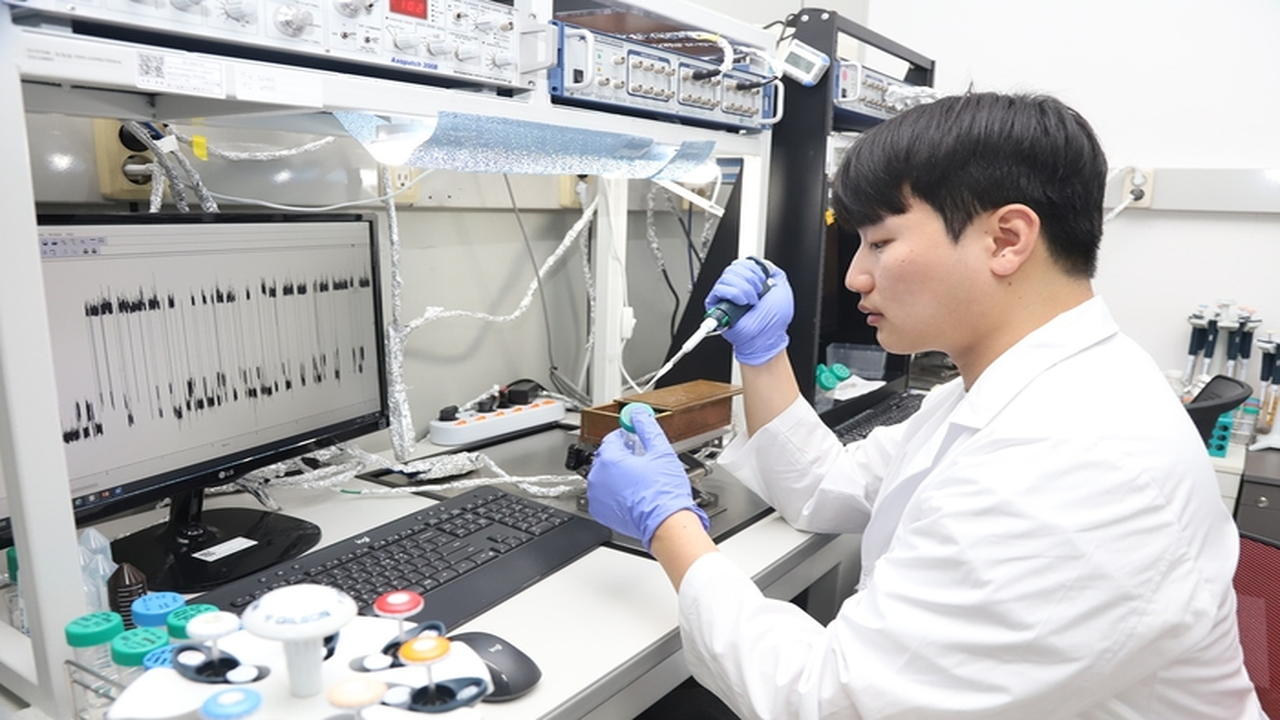
Challenges in Drug Discovery and Precision Medicine
In the drug discovery process, accurately understanding how drug candidates bind to target proteins is paramount. However, existing technologies have struggled to analyze these subtle binding differences in detail at an atomic level, particularly facing limitations in distinguishing highly similar drug molecules with very small mass differences. Consequently, there has been a significant demand for higher-resolution and more sensitive analytical techniques to improve the efficiency of drug screening and the realization of precision medicine.
KRIBB’s Ultra-Precision Nanopore Sensor Technology
A joint research team at the AI Bio-Pharmaceutical Institute of the Korea Research Institute of Bioscience and Biotechnology (KRIBB) has developed a groundbreaking ultra-precision nanopore sensor technology. This technology features:
- Nanopore Sensing: It detects minute changes in electrical signals generated as proteins pass through or reside within nanometer-sized pores (nanopores). These electrical signal changes exhibit unique patterns depending on the type of drug bound to the protein and its binding state.
- Multiparameter Analysis: By comprehensively analyzing changes in the drug molecule’s position, movement, and electrical current signal patterns, the sensor achieves exceptionally high resolution. This was demonstrated in experiments with BRD4 protein and anticancer drugs, successfully distinguishing even highly similar drug molecules with mass differences as small as 2.5 Daltons.
This resolution is dozens of times higher than conventional nanopore technologies and enables rapid, label-free, single-molecule level analysis.
Impact on Healthcare, Industry, and Future Outlook
This ultra-precision nanopore sensor is poised to revolutionize drug discovery in the pharmaceutical industry. It will accelerate high-efficiency screening of new drug candidates, significantly contributing to reduced development times and costs. In precision medicine, it will provide objective data for selecting optimal drugs based on individual patient genetic and biological information, enhancing the accuracy of drug efficacy prediction. In disease diagnostics, it is expected to improve the accuracy of early diagnosis and treatment monitoring through the detection of trace biomarkers and drug metabolites. Future challenges include integrating this technology into large-scale screening systems and further improving reliability and stability for practical implementation.







Comments