Background
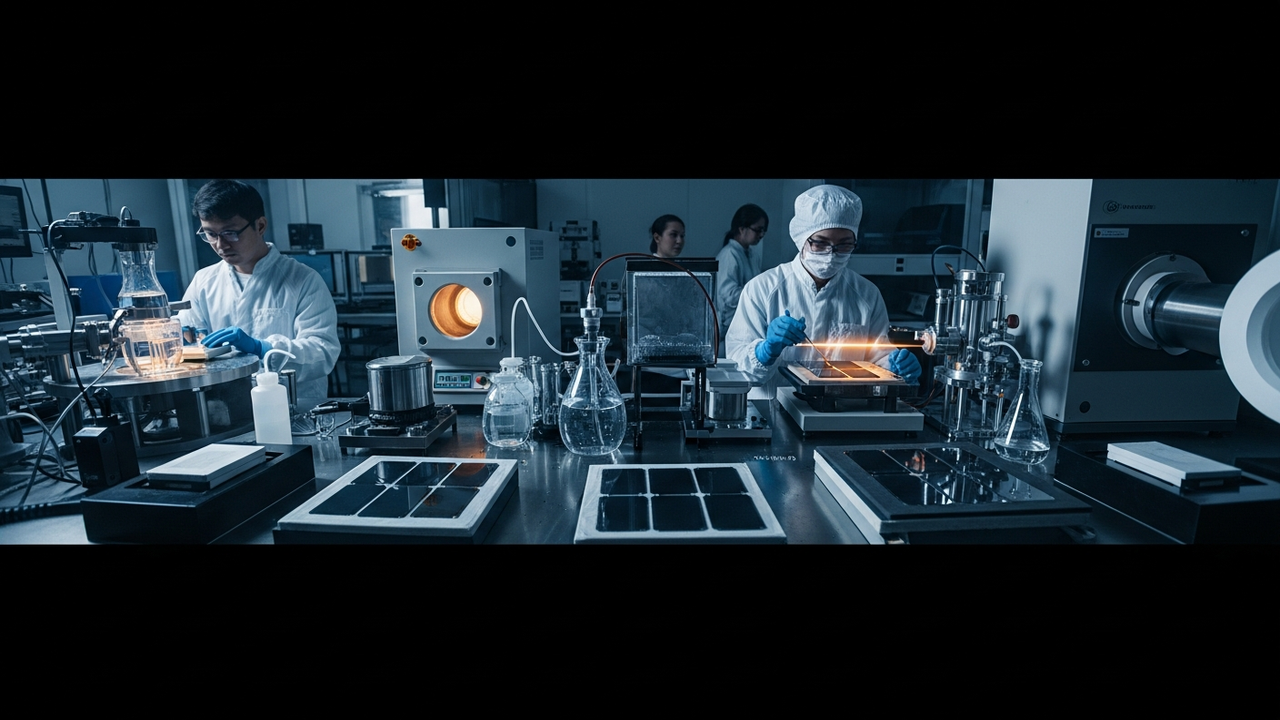
Perovskite solar cells (PSCs) are renowned for their high power conversion efficiency, but the prevalent use of lead raises environmental concerns. Consequently, there is intense research into lead-free perovskite materials, particularly tin (Sn)-based PSCs (TPSCs). However, tin perovskites typically suffer from lower efficiency and stability compared to their lead-based counterparts due to their susceptibility to oxidation. Overcoming this challenge requires not only intrinsic material improvements but also optimization of charge transport layers and interfaces.
Key Findings / Results
A research team from Taiwan’s National Yang Ming Chiao Tung University (NYCU) has developed a novel hole-transporting layer (HTL) technology that significantly enhances the performance of lead-free tin-based perovskite solar cells (TPSCs). They employed a heptacyclic ladder-type triarylamine-functionalized conjugated polymer based on benzodipyrrole (BDP) as the HTL. Critically, by precisely controlling the “stirring time” of the polymer solution, they optimized its aggregation state, leading to the formation of a highly uniform film within the device. This optimized HTL was shown to suppress non-radiative recombination and substantially improve charge extraction efficiency. As a result, the developed inverted TPSCs achieved a high power conversion efficiency (PCE) of 9.1%. Furthermore, the devices demonstrated excellent long-term stability, maintaining 80% of their initial efficiency (T80) after 5000 hours of operation. This represents a major breakthrough in addressing the stability issues of tin perovskites and overcoming existing limitations.
Technical Significance & Outlook
This research outcome marks a significant advance toward the practical application of lead-free perovskite solar cells. It provides a pathway to achieve both practical efficiency and long-term stability while addressing the environmental concerns associated with lead toxicity. The study particularly emphasizes that the design of the hole-transporting layer material and its process control critically influence the overall device performance. The achievement of such substantial performance enhancement through a relatively simple process control like stirring time also holds implications for cost reduction and manufacturing efficiency in future large-scale production. Moving forward, scaling up this technology for large-area modules, further increasing efficiency, and conducting long-term reliability tests to comply with international certification standards will be crucial. NYCU’s achievement highlights Taiwan’s contribution to sustainable energy technology development and represents a vital step in accelerating the adoption of lead-free technologies in the next-generation solar cell market.
Source: https://pubs.acs.org/doi/10.1021/acsenergylett.6c00952






Comments