Background: The Limits of Photonic AI with Electrical Intermediaries
Photonic chips hold immense promise for accelerating AI computing due to light’s inherent speed and bandwidth advantages over electrons. However, current photonic AI architectures often encounter a significant bottleneck: the necessity to convert optical signals to electrical signals for nonlinear processing (e.g., switching, logic operations) and then back to optical. This ‘optical-electrical-optical’ conversion process consumes substantial power and introduces latency, thereby limiting the full potential of photonic AI and hindering its energy efficiency and speed gains compared to purely electronic systems.
Key Findings: Exciton-Polaritons Enable All-Optical Switching
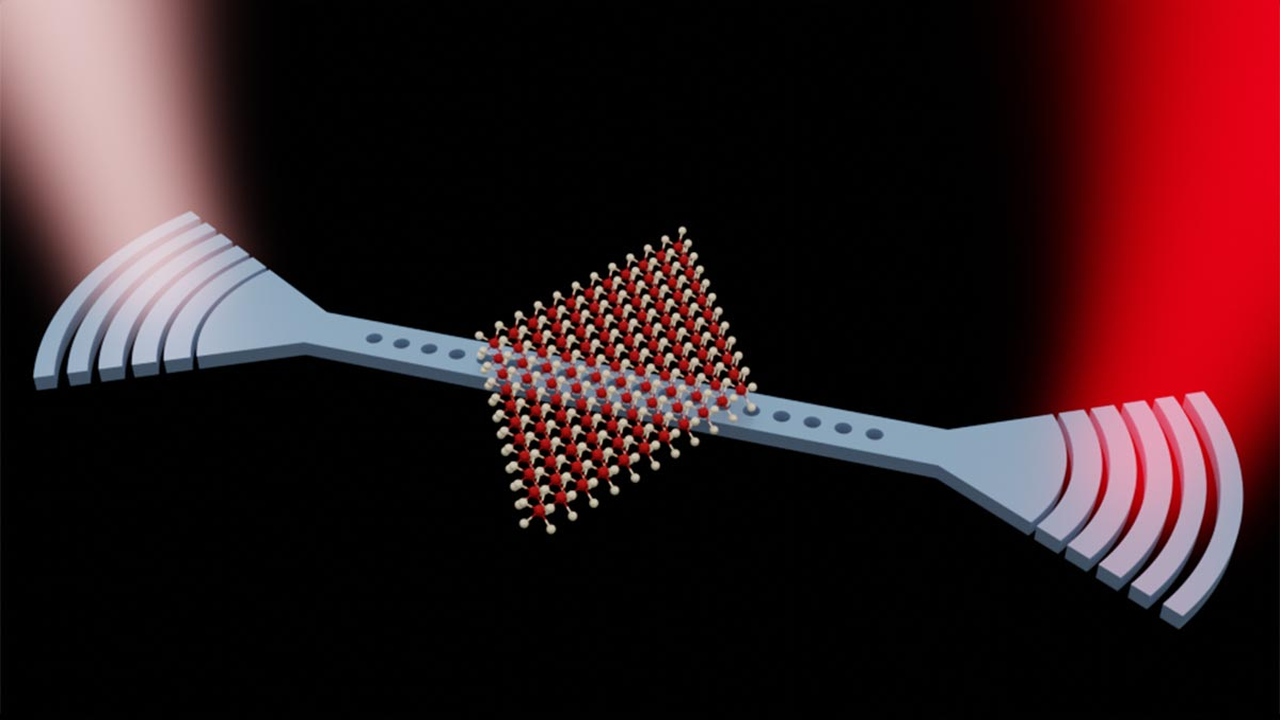
Researchers at the University of Pennsylvania have achieved a breakthrough by leveraging hybrid light-matter particles, known as exciton-polaritons, to enable direct all-light switching. This innovation circumvents the need for electrical intermediaries in photonic AI chips:
- Hybrid Light-Matter Particles: Exciton-polaritons are quasi-particles formed when photons strongly couple with excitons (bound electron-hole pairs) in atomically thin semiconductors. These particles exhibit both light-like and matter-like properties and possess strong optical nonlinearities, meaning their behavior can be significantly altered by very weak light signals.
- Demonstration of All-Light Switching: The team successfully demonstrated an all-light switching mechanism using these exciton-polaritons. By using one light signal to control another, they eliminated the energy-intensive and time-consuming electrical conversion steps. This direct optical control allows for faster and more efficient processing within photonic circuits.
- Ultra-Low Energy Consumption: A key aspect of this demonstration is the significantly low energy consumption achieved during all-light switching. This is crucial for developing energy-efficient AI systems, where power is a major operational cost and environmental concern. The ability to perform operations with minimal energy could enable entirely new classes of low-power AI devices.
- Direct Light Processing & Quantum Computing Potential: This technology opens the door for future photonic chips to directly process light signals originating from sensors like cameras, bypassing the need for initial optical-to-electrical conversion. This could accelerate tasks in computer vision and real-time data analysis. Furthermore, the inherent quantum mechanical properties of exciton-polaritons suggest potential applications in basic quantum computing functions, offering a bridge between classical photonic AI and emerging quantum technologies.
Technical Significance & Outlook: A New Frontier for AI Computing
This research from the University of Pennsylvania is profoundly significant for the future of AI computing. By enabling true all-light switching, it directly tackles the primary limitations of current photonic AI chips:
- Unlocking Speed and Efficiency: Eliminating OEO conversions will drastically improve the speed and energy efficiency of AI model training and inference, allowing for faster processing of complex data with less power.
- Enabling Novel AI Architectures: The ability to process light directly could facilitate the design of entirely new photonic AI architectures, potentially overcoming the architectural constraints imposed by electronic integration.
- Converging AI and Quantum: The dual nature of exciton-polaritons offers a unique platform to explore the convergence of AI with quantum computing, potentially leading to hybrid quantum-photonic AI systems that leverage the strengths of both.
While still in fundamental research stages, the long-term impact of this work is immense. It promises to pave the way for more powerful, energy-efficient, and capable AI systems that can drive advancements in autonomous systems, medical diagnostics, scientific discovery, and beyond, fundamentally reshaping the landscape of intelligent computation.
Source: https://scitechdaily.com/light-matter-particles-could-revolutionize-ai-computing/





Comments