Background: The Urgent Need for Next-Generation Optical Interconnects in AI
Hyperscale AI data centers face unprecedented demands for bandwidth and energy efficiency. As AI workloads become more intensive, the need for faster interconnects between GPUs and AI accelerators is paramount, pushing data rates to 1.6 Terabits per second (1.6T) and beyond. Traditional optical modules often present challenges in terms of power consumption, form factor, and manufacturing complexity. Addressing these issues requires innovative designs that integrate optical components more efficiently.
Key Findings: Gemtek and NewPhotonics’ Integrated 1.6T OSFP Transceiver
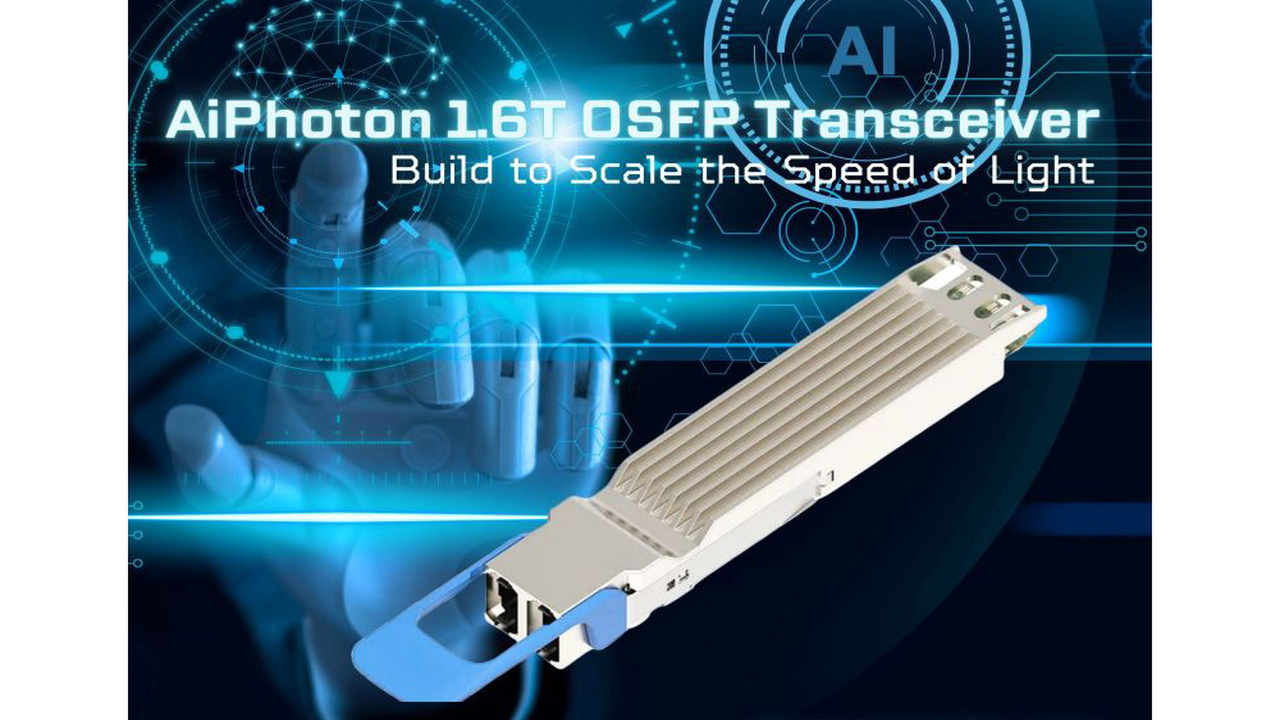
Gemtek, in partnership with NewPhotonics, has unveiled the AiPhoton 1.6T OSFP transceiver, a breakthrough solution specifically engineered for the rigorous demands of hyperscale AI data centers. This module incorporates several key technical advancements:
- Transmitter-on-Chip Design: A core innovation is the use of NewPhotonics’ NPG10204 DR8 Photonic Integrated Circuit (PIC) featuring a transmitter-on-chip design. This integrates the laser and modulator into a single, multi-channel monolithic device. This deep integration offers significant benefits:
- Miniaturization: Combining multiple components onto one chip reduces the overall size of the optical engine.
- Reduced Power Consumption: Shorter electrical paths between the laser, modulator, and driver minimize signal loss and drive power, leading to lower overall module power consumption.
- Improved Signal Integrity: Monolithic integration enhances signal quality by reducing parasitic effects and crosstalk, crucial for high-speed data transmission.
- 200G-per-Channel PAM4 (IMDD) Architecture: The transceiver is designed to support 200 Gbps per channel using PAM4 (Pulse Amplitude Modulation 4-level) signaling over an octal-channel architecture, achieving an aggregate data rate of 1.6T (8 channels x 200 Gbps = 1.6 Tbps). The Intensity Modulated Direct Detection (IMDD) approach is selected for its cost-effectiveness and relatively straightforward implementation at these speeds.
- Highly Integrated Flip-Chip Packaging: To ensure manufacturability and reliability at scale, the companies are employing an advanced flip-chip packaging method. This high-density packaging technique simplifies assembly processes, reduces parasitic electrical effects, and is vital for reliable, high-volume production of complex integrated optical modules.
Technical Significance & Outlook: Accelerating AI Infrastructure
The introduction of the AiPhoton 1.6T OSFP transceiver with its integrated laser and transmitter-on-chip design represents a significant step forward for AI data center interconnects. This technology provides the necessary bandwidth, power efficiency, and signal integrity required to support the next generation of AI workloads. The focus on integration and advanced packaging is crucial for overcoming the physical and electrical limitations of traditional modules, paving the way for more compact, lower-power, and higher-performing networks. This product not only addresses current AI demands but also sets a precedent for future optical integration trends, potentially influencing the evolution towards Co-Packaged Optics (CPO) and other advanced architectures. By offering a high-performance pluggable solution, Gemtek and NewPhotonics are contributing to the acceleration and efficiency of AI infrastructure, enabling faster model training, more complex AI applications, and ultimately, advancing the capabilities of artificial intelligence globally.







Comments