Background: The AI-Driven Interconnect Challenge
The relentless growth of AI, particularly in GPU-accelerated computing, has created an urgent need for highly efficient and scalable data interconnects. Traditional methods of connecting optical components to electronic circuits often involve complex, expensive, and labor-intensive alignment processes, which limit bandwidth density, increase latency, and consume significant power. As AI clusters expand, these challenges become major bottlenecks, impeding further performance gains and escalating operational costs.
Key Findings: POET Technologies’ Optical Interposer Innovation
POET Technologies is addressing these critical interconnect challenges with its innovative Optical Interposer platform. This silicon-based technology represents a significant leap forward in photonic integration:
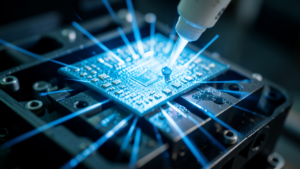
- Wafer-Level Integration: The core innovation lies in its ability to integrate photonic components (such as lasers, modulators, and detectors) directly with electronic circuits at the wafer level. This deep integration eliminates the need for expensive and error-prone active alignment steps typically required when coupling discrete optical components, drastically reducing manufacturing complexity and cost.
- Proximity to Compute: By bringing optics much closer to the compute links within the package, the Optical Interposer minimizes the length of electrical traces. This directly translates to significant reductions in signal loss, latency, and power consumption, which are paramount for high-performance AI applications where data must move rapidly between GPUs.
- Scalable Bandwidth: The platform is designed to scale bandwidth efficiently, addressing the insatiable demand for data throughput in large GPU clusters. Its integrated approach allows for higher density optical channels, crucial for future generations of AI accelerators.
- Strategic Partnership and Production Roadmap: POET Technologies is collaborating with Lite-On Technology to co-develop these advanced optical modules. The partnership has a clear roadmap, targeting prototypes for late 2026 and aiming for high-volume production by 2027. This demonstrates a strong commitment to bringing the technology to market rapidly.
Technical Significance & Outlook: Revolutionizing AI Semiconductor Infrastructure
POET Technologies’ Optical Interposer holds the potential to unlock a staggering $146 billion opportunity in the AI semiconductor market. By fundamentally rethinking optical-electronic integration, the technology offers a pathway to:
- Lower Cost and Higher Yield: Eliminating complex alignment steps can dramatically reduce manufacturing costs and improve production yields, making high-performance optical interconnects more accessible.
- Enhanced AI Performance: The combination of lower latency, reduced power consumption, and increased bandwidth density will allow AI chips to operate at their full potential, enabling faster training of larger models and more efficient inference.
- Driving Next-Generation Architectures: This approach aligns with and could accelerate the adoption of advanced interconnect paradigms like Co-Packaged Optics (CPO) and Near-Packaged Optics (NPO), as it provides a robust and scalable method for integrating optical components.
The success of POET’s Optical Interposer could be a game-changer for the entire AI infrastructure, providing a more efficient, scalable, and cost-effective foundation for the future of artificial intelligence. Its progress towards prototyping and mass production will be a key indicator of its transformative impact.
Source: https://www.fool.com/investing/2026/05/19/this-artificial-intelligence-ai-semiconductor-comp/



Comments