Background: Challenges in Drug Delivery for Cancer Treatment
Cancer remains a formidable global health challenge. Conventional chemotherapy often suffers from non-selectivity, affecting healthy cells and leading to severe systemic side effects. While the advent of targeted molecular therapies and gene therapies offers more specific approaches, the in vivo stability, efficient delivery to tumor tissues, and cellular uptake of these potent agents remain significant hurdles. In this context, nanotechnology-enabled drug delivery systems (DDS) are actively being researched to improve therapeutic outcomes and minimize adverse effects.
Key Findings / Results: Translational Advances in Lipid Nanoparticle Systems
This review focuses on the translational advancements of lipid nanoparticle (LNP)-based drug delivery systems for cancer therapy. LNPs have gained widespread recognition for their efficacy, notably highlighted by their success in mRNA vaccine platforms, and their potential in oncology is now being vigorously explored. The primary advantages and progress in LNP technology include:
- Structural Flexibility: LNPs can be precisely engineered by adjusting lipid composition and structure, allowing for efficient encapsulation of a diverse range of therapeutics, including small molecules, nucleic acids (siRNA, mRNA, plasmid DNA), and proteins. This modularity enables custom tailoring for specific drug cargo.
- Biocompatibility and Safety: Derived from natural lipid components, LNPs generally exhibit high biocompatibility and a relatively low immunogenicity and toxicity profile, which is crucial for repeated systemic administration.
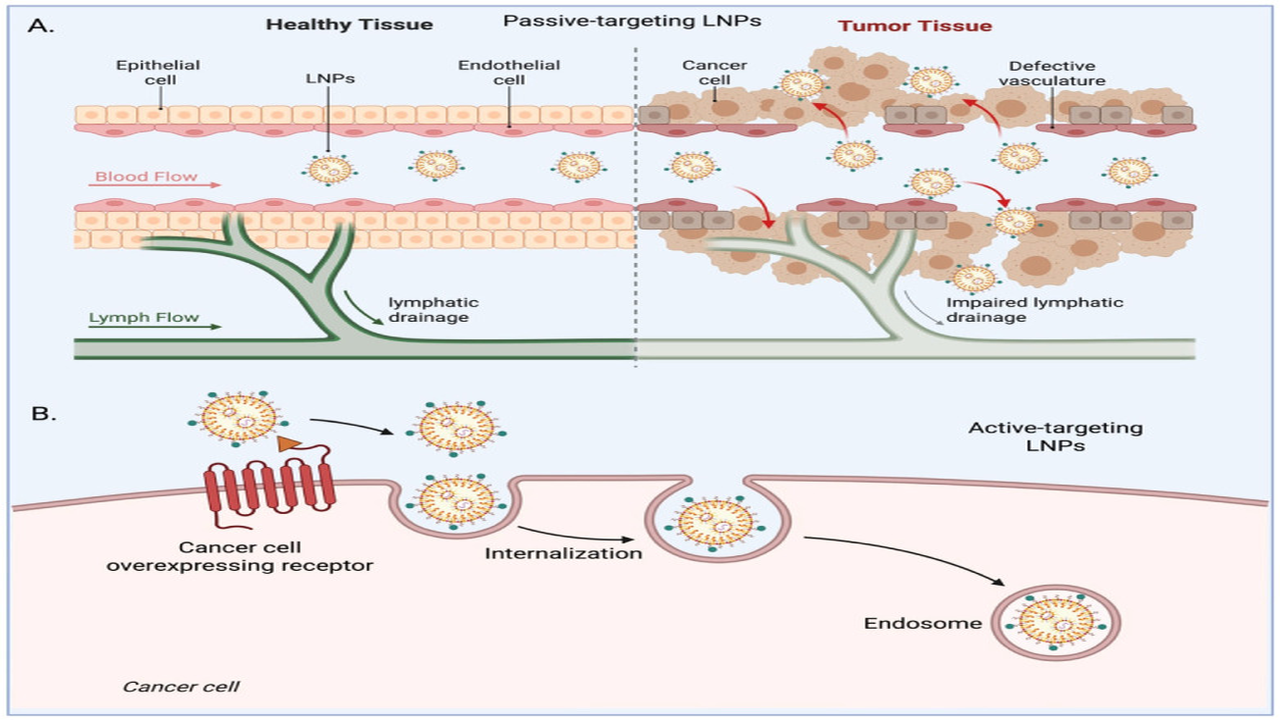
- Enhanced Targeted Delivery: Surface modification of LNPs with specific ligands (e.g., antibodies, peptides, aptamers) enables active targeting to cancer cells, increasing drug accumulation within tumors while reducing off-target effects. This can lead to a 5-10 fold increase in tumor-to-normal tissue drug ratio compared to untargeted formulations.
- Responsive Release Systems: Advanced LNPs are being developed to release their therapeutic payload in response to specific external or internal stimuli, such as pH changes, temperature fluctuations, enzymatic activity, or light. This ‘on-demand’ release mechanism can maximize drug concentration specifically within the tumor microenvironment.
- Multifunctional LNPs (Theranostics): Research is progressing on theranostic LNPs that integrate both diagnostic capabilities (e.g., encapsulating imaging agents) and therapeutic functions. These systems facilitate real-time monitoring of treatment efficacy and enable personalized medicine strategies.
The review emphasizes that these LNP formulations have demonstrated excellent preclinical results, with several platforms advancing into clinical trials for applications such as siRNA and mRNA gene therapy, and targeted delivery of small-molecule chemotherapeutics. Notably, Onpattro, an LNP-siRNA drug, has been approved for a non-cancer indication, validating the platform’s clinical viability.
Technical Significance & Outlook: Shaping the Future of Cancer Treatment
Lipid nanoparticles hold immense potential to revolutionize drug delivery paradigms in cancer treatment. Their key advantages lie in improving drug stability, optimizing biodistribution, and enabling highly specific tumor targeting, thereby maximizing therapeutic efficacy and minimizing systemic toxicity. The success of LNPs in delivering genetic material (siRNA and mRNA) strongly suggests their central role in the future of cancer immunotherapy and personalized oncology.
Future directions include further optimization of LNP formulations, overcoming challenges in large-scale manufacturing and quality control, and expanding their clinical application across various cancer types. Furthermore, the integration of artificial intelligence (AI) for LNP design and the development of hybrid LNP-nanomaterial systems could lead to even more sophisticated and highly functional drug delivery platforms. Ultimately, LNPs are expected to serve as a foundational technology for next-generation cancer treatment strategies, significantly improving patient outcomes and quality of life by providing precise, potent, and safer therapeutic options.








Comments