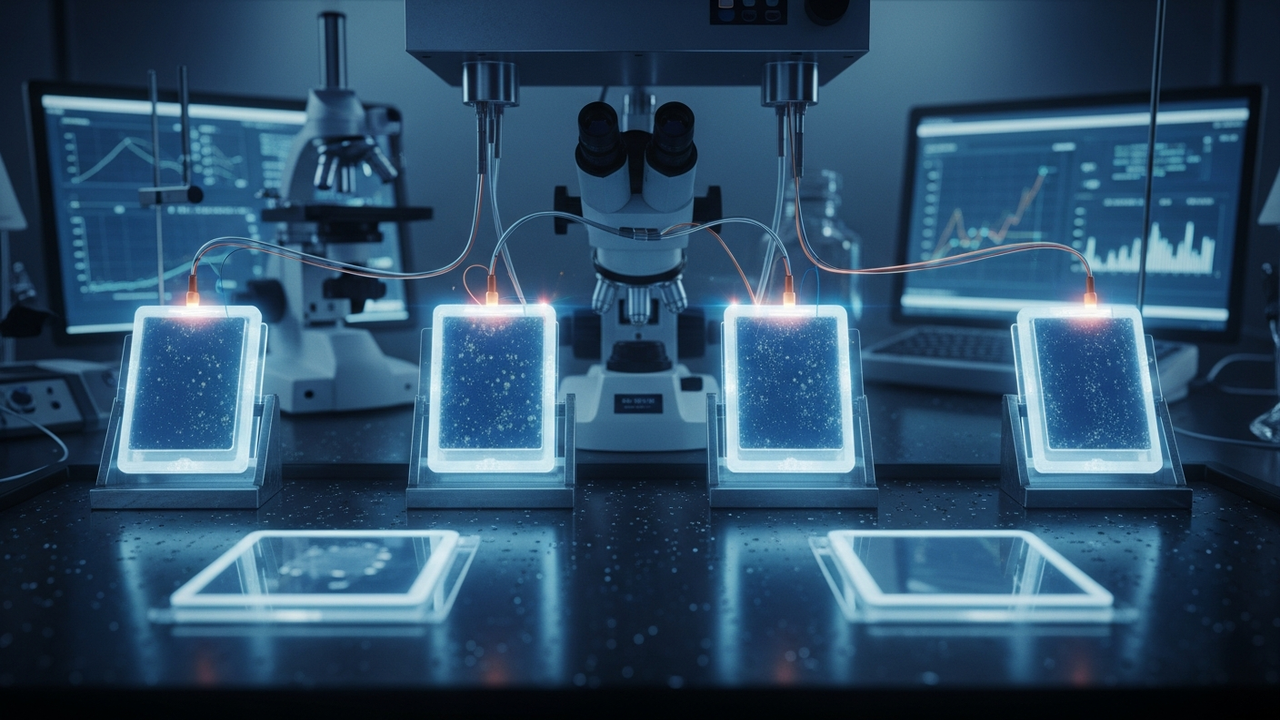
The Challenge of Potential-Induced Degradation (PID) in Perovskite Solar Cells
Despite rapid technological advancements in perovskite solar cells, long-term reliability and durability remain critical concerns, with Potential-Induced Degradation (PID) being one of the primary culprits. PID is triggered by a combination of voltage bias across the solar module and environmental factors (e.g., temperature, humidity), which can lead to power loss and premature failure. While also observed in conventional silicon solar cells, perovskites’ inherent ionic migration properties have made them particularly vulnerable to PID.
Positive-Voltage System Strategy for PID Mitigation
This research experimentally demonstrated that PID in perovskite solar cells can be effectively mitigated by implementing positive-voltage systems—i.e., systems designed such that the overall module voltage bias with respect to ground is positive. The study specifically focused on encapsulated inverted (p-i-n structure) perovskite solar cells, yielding significant insights and results:
- Understanding the Mechanism: It is hypothesized that when a positive voltage is applied, the accumulation of charges at defect states within the perovskite layer and interfaces is suppressed, stabilizing ion migration. This mechanism delays or halts the progression of degradation reactions.
- Superior Stability Demonstrated: The research team continuously tested encapsulated perovskite solar cells under positive voltage conditions for 168 hours. During this period, the devices maintained over 95% of their initial power output, showing minimal degradation. This performance aligns with the stringent certification standards for PID resistance that commercial solar modules must meet.
- Impact on Practical Applications: This finding strongly suggests that PID is manageable not only at the material level of the cell or module but also through system-level design and operation. This increases the flexibility in installation design for perovskite solar cells, enabling broader applications.
Technical Significance and Future Outlook
This research represents a crucial breakthrough for improving the long-term reliability of perovskite solar cells, significantly accelerating their path to commercialization. By demonstrating that PID can be overcome through optimized system design, it potentially relaxes some stringent constraints on the chemical composition and device structure of perovskite materials themselves. Future research will focus on verifying applicability to various types of perovskite solar cell modules, long-term field testing under different environmental conditions, and evaluating PID behavior in actual grid-connected systems. This technology is indispensable for establishing the reliability needed for perovskite solar cells to become a widely adopted primary renewable energy source.
Source: https://pubs.acs.org/doi/10.1021/acsenergylett.6c00520




Comments