
Background
Solid-State Lighting (SSL) using Light Emitting Diodes (LEDs) has revolutionized illumination due to its high energy efficiency and longevity. However, conventional white LEDs, which typically combine a blue LED with a yellow phosphor, often exhibit limitations in color rendering, spectral gaps, and potential flicker. Quantum Dots (QDs), with their narrow emission spectra and high quantum efficiency, offer a promising pathway to achieve superior color reproduction and energy efficiency. Nevertheless, many high-performance QDs currently contain cadmium, a toxic heavy metal, raising environmental and regulatory concerns. The demand for high-quality, cadmium-free alternatives is therefore paramount for sustainable and safe SSL.
Key Findings / Results
The project, supported by the U.S. Department of Energy (DOE), is focused on the critical task of developing stable, cadmium-free quantum dot (QD) optical down-converters for solid-state lighting applications. The primary objectives are to engineer QD materials composed of non-toxic elements that can:
- Eliminate Cadmium: Transition away from cadmium-containing QDs (e.g., CdSe) to environmentally benign compositions, such as indium phosphide (InP)-based QDs, to meet growing environmental regulations and safety standards.
- Ensure High-Flux and High-Temperature Stability: Develop QDs that maintain their luminous performance and color stability under the demanding conditions of high-power LED operation, specifically at elevated light intensities and temperatures up to 150°C. The target is for these QDs to exhibit no significant degradation over the typical lifetime of an LED luminaire.
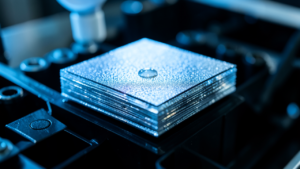
- Achieve Efficient Light Down-Conversion: The QDs must efficiently convert blue light emitted by primary LEDs into precise green and red wavelengths, enabling a broad color gamut and high-quality white light output with superior color rendering index (CRI) and tunable correlated color temperature (CCT).
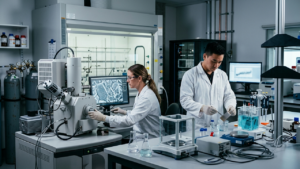
This endeavor leverages the deep expertise of Nanosys, a global leader in quantum dot synthesis and manufacturing, for advanced material creation. Concurrently, the University of California, Merced, contributes its specialized knowledge in QD characterization and materials science to rigorously evaluate the optical, thermal, and long-term stability performance of the synthesized cadmium-free QDs. The collaborative effort aims to optimize the synthesis pathways for materials like InP QDs to achieve the required quantum efficiency and spectral purity.
Technical Significance & Outlook
The development of stable, cadmium-free QD optical down-converters is technically highly significant, poised to redefine the landscape of the solid-state lighting industry. Successful implementation of this technology will enable the widespread adoption of environmentally friendly LED products that deliver superior light quality without the health and environmental risks associated with toxic heavy metals. For consumers, this translates to more vibrant, natural-looking light, improved visual comfort, and potentially flicker-free illumination. For the industry, it opens new avenues for creating high-value, differentiated lighting products that comply with stringent environmental regulations and meet sustainability expectations. Future work will focus on further improving the cost-effectiveness of QD synthesis, enhancing durability and long-term reliability under various operating conditions, and optimizing the integration of QD components into existing LED manufacturing processes. This initiative represents a crucial step towards advancing clean energy technologies and will continue to drive innovation in the lighting sector, contributing to a more sustainable and brighter future.



Comments