Key Findings
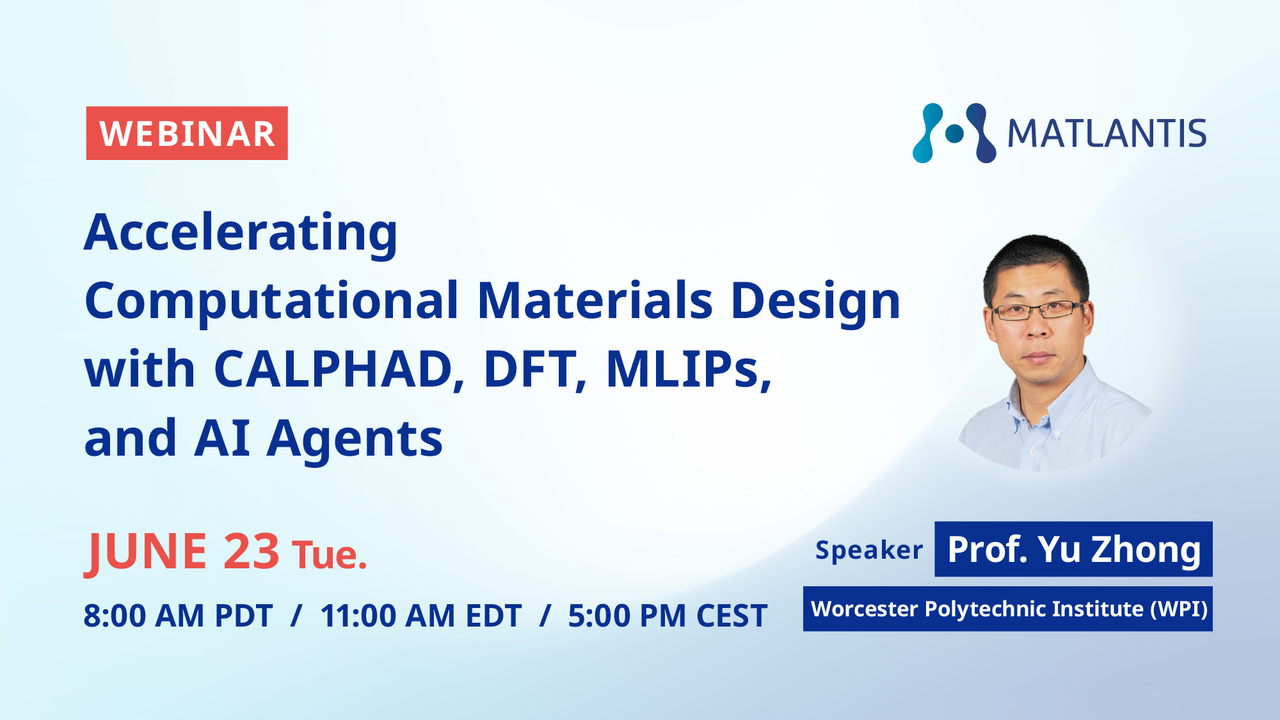
During an ASM International webinar, recent advancements in dramatically accelerating computational materials design were highlighted, achieved through the integration of CALPHAD, Density Functional Theory (DFT), Machine Learning Interatomic Potentials (MLIPs), and AI-assisted simulation workflows. Specifically, the integration of AI-assisted workflows via the ‘Masgent’ simulation agent on the Matlantis platform has demonstrated that autonomous or semi-autonomous simulation pipelines can significantly reduce the cost and complexity of large-scale computational campaigns. These integrated technologies are opening up new applications in critical areas such as battery materials and structural alloys.
Technical / Clinical Details
- CALPHAD (Computational Thermodynamics): Predicts thermodynamic properties and phase equilibria of materials, optimizing composition-temperature relationships in the early stages of alloy design.
- DFT (Density Functional Theory): Based on quantum mechanics, DFT meticulously calculates the electronic structure and atomic-level interactions of materials, predicting accurate physical properties. However, it faces challenges due to high computational costs.
- MLIPs (Machine Learning Interatomic Potentials): By learning from vast quantities of DFT calculation results, MLIPs enable atomic interactions to be simulated much faster while maintaining accuracy comparable to DFT. This permits molecular dynamics simulations of larger systems and over longer timescales. The Matlantis platform provides the infrastructure for efficient utilization of such MLIPs.
- AI-Assisted Simulation Workflows and Masgent Agent: The AI agent ‘Masgent’ integrates tools like CALPHAD, DFT, and MLIPs to autonomously manage and optimize the entire simulation process. This frees researchers from the burden of manual simulation setup and data analysis, dramatically boosting the efficiency of computational materials design. The agent adapts simulation strategies through learning to converge on optimal results.
- Applications: These technologies are being applied to the design of battery materials (e.g., high-performance cathodes, solid-state electrolytes) and structural alloys (e.g., high-strength, lightweight alloys).
Background & Context
Modern materials science demands the development of new materials at an unprecedented pace to meet requirements for sustainability, energy efficiency, and enhanced performance. However, traditional experimental-based materials development has been a time-consuming and costly bottleneck. Computational materials science offers a powerful means to overcome this challenge, but individual methods have limitations in computational cost and applicability. The integration of CALPHAD, DFT, MLIPs, and AI agents promises to fundamentally transform the material development process by combining and complementing the strengths of these cutting-edge computational methods.
Strategic Significance & Outlook
This integrated approach will significantly reduce material discovery lead times and development costs, accelerating industrial innovation. Applications are particularly expected in fields where high-performance materials are indispensable, such as electric vehicles, aerospace, and renewable energy storage systems. In the future, as AI agents become more sophisticated, autonomous design and optimization of more complex material systems and manufacturing processes will be possible, allowing researchers and engineers to focus on more creative challenges. Platforms like Matlantis contribute to the democratization and widespread adoption of such computational materials design.