Key Findings
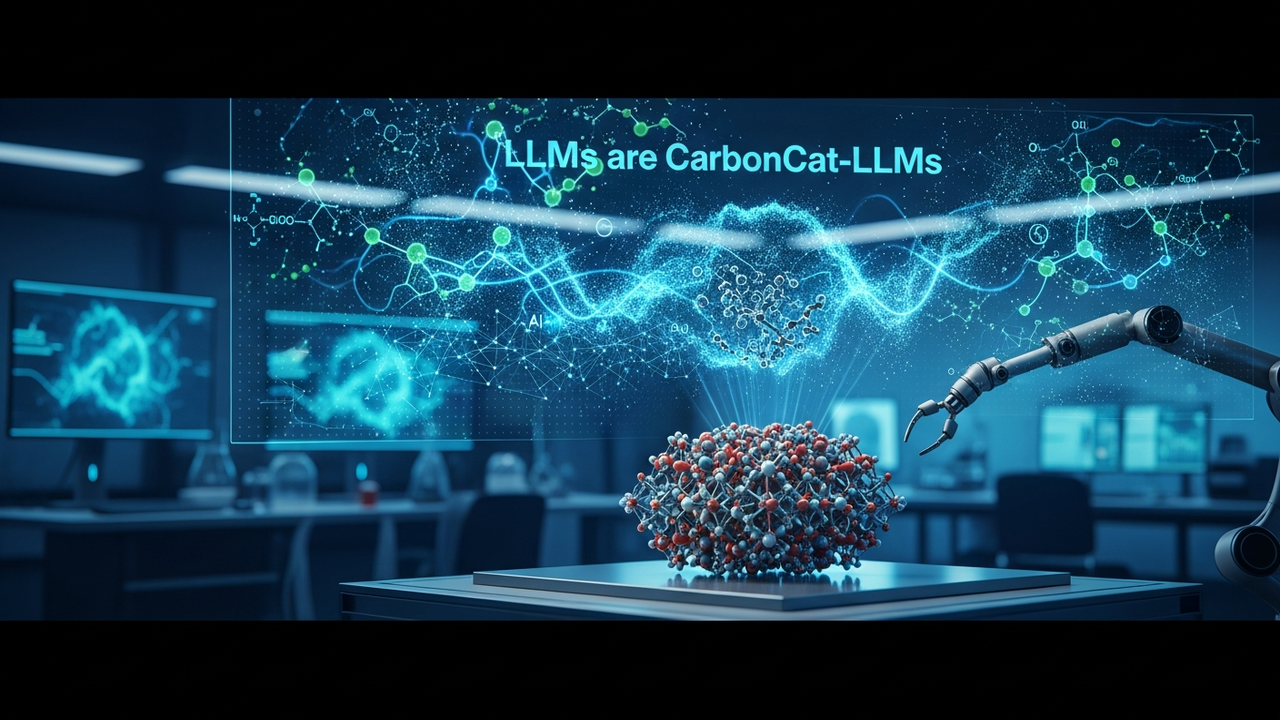
Scientists have developed ‘CarbonCat-LLMs,’ a groundbreaking framework that leverages large language models (LLMs) to dramatically accelerate the rational design of carbon-supported high-entropy alloy (HEA) electrocatalysts for hydrogen evolution reactions (HER). This AI-driven approach systematically extracts and analyzes knowledge from vast scientific literature, enabling the efficient prioritization of compatible multi-element HEA compositions and carbon supports, thereby significantly shrinking the immense materials search space. As a compelling proof of concept, CarbonCat-LLMs successfully identified high-performing catalyst configurations years before their experimental discovery, achieving state-of-the-art predictive capabilities.
Technical / Clinical Details
- High-Entropy Alloy (HEA) Catalysts: HEAs are a class of novel materials composed of five or more metallic elements in near-equimolar ratios, offering unique crystal structures and often superior catalytic properties. The vast combinatorial space of HEA compositions makes their discovery through traditional means exceptionally challenging.
- Hydrogen Evolution Reaction (HER): HER is a critical electrochemical process for green hydrogen production via water electrolysis. Developing highly efficient, stable, and cost-effective electrocatalysts for HER is essential for a sustainable energy future.
- LLM Integration: CarbonCat-LLMs is built upon LLMs trained on millions of scientific publications, patents, and databases in chemistry, materials science, and physics. These LLMs are capable of extracting unstructured information—such as catalyst composition, synthesis conditions, performance data, and structural insights—and constructing comprehensive knowledge graphs.
- Search Space Reduction: By combining the LLMs’ extensive chemical knowledge and inferential capabilities, the framework can understand complex interactions between HEA components and carbon supports. This allows it to identify highly promising combinations, drastically reducing the search space for experimental synthesis and high-fidelity computational simulations.
- Predictive Performance: The proof-of-concept demonstrations showed that CarbonCat-LLMs could predict HEA catalyst compositions with HER performance comparable to or better than those reported experimentally, even years before their actual publication. This highlights AI’s potential to revolutionize material design at a pace and scale beyond human expert capabilities.
Background & Context
The discovery of new materials is fundamental to addressing global challenges in clean energy, electronics, and medicine. However, the development of complex, multi-component materials like HEAs faces significant limitations with traditional experimental or even first-principles computational approaches due to the sheer number of possible combinations. The advent of AI, particularly advanced LLMs, offers a transformative solution to this “materials discovery bottleneck.”
Strategic Significance & Outlook
AI-driven catalyst design frameworks like CarbonCat-LLMs are poised to revolutionize materials research and development. The methodology is readily adaptable to other electrochemical reactions (e.g., CO2 reduction, oxygen reduction reaction), promising to dramatically shorten the time from material discovery to commercialization. This technology will accelerate the development of high-performance, low-cost catalysts that can replace expensive precious metal alternatives, playing a crucial role in the global energy transition, environmental protection, and the realization of sustainable chemical industries. The synergy between AI and materials science is expected to be a dominant trend in scientific and technological advancement for decades to come, offering a powerful tool for rational material design and innovation.







Comments