Key Findings
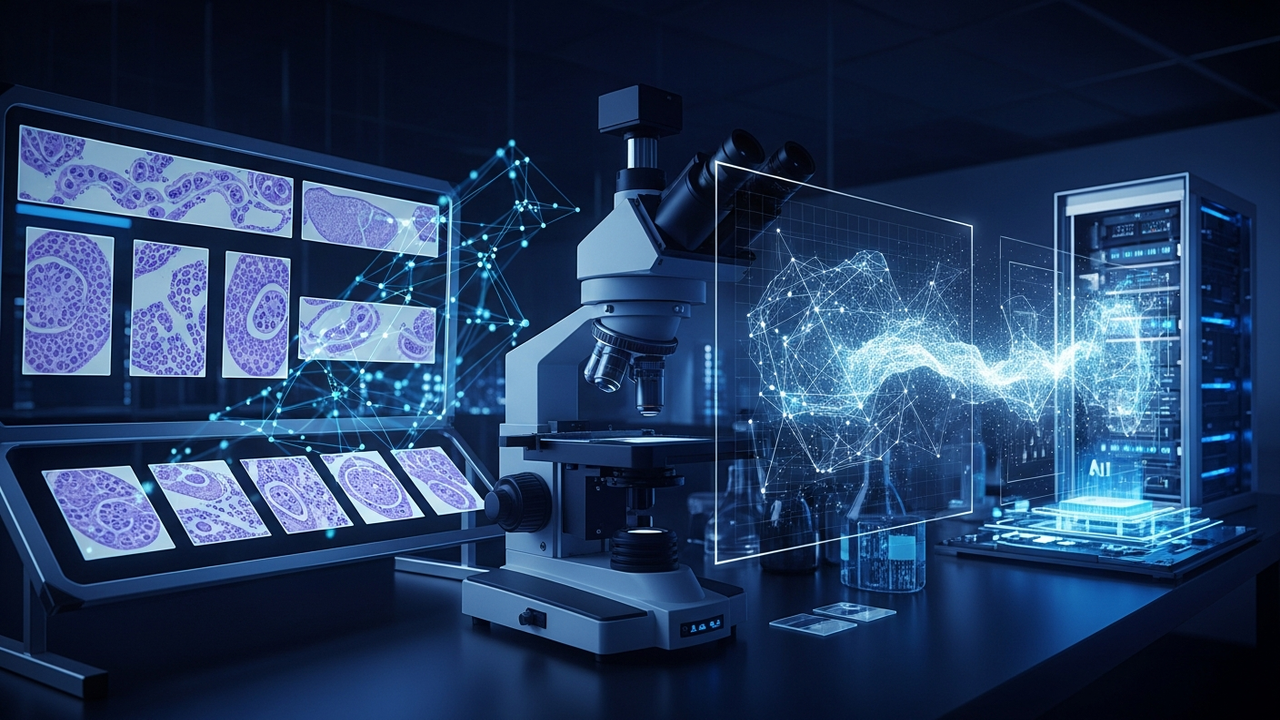
Researchers have developed SQUALL, a pioneering multimodal foundation model that integrates histology with spatial molecular programs. This innovation aims to address the limitations in mechanistic interpretation of histopathological assessment, which has traditionally lacked direct molecular context. SQUALL was pre-trained on histMol, an unprecedented large-scale corpus consisting of 1.76 billion paired histology-spatial transcriptomics spots. This extensive training enables transcriptome-wide virtual biomarker profiling and has demonstrated significantly improved outcome prediction in cancer, promising a new era for precision diagnostics.
Technical / Clinical Details
The core innovation of SQUALL lies in its ability to seamlessly fuse information from two distinct data modalities: the morphological features from histology images and the gene expression profiles from spatial molecular programs. Pathologists traditionally rely on visual examination of tissue morphology for diagnosis, often without direct insight into underlying cellular molecular dynamics. SQUALL utilizes advanced deep learning and transformer architectures to learn complex spatial and molecular patterns from the vast histMol dataset. This allows it to accurately predict gene expression profiles from histology images alone, effectively providing ‘virtual’ molecular information that previously required invasive biopsies. Such capabilities are poised to enhance cancer diagnostic accuracy, identify novel therapeutic targets, and enable more personalized prognostic predictions.
Background & Context
Conventional histopathology, while foundational, often suffers from subjectivity and a lack of detailed molecular insights. While spatial transcriptomics technologies have advanced, integrating this molecular data directly with high-resolution pathology images for clinical application has remained a significant challenge. SQUALL bridges this information gap, accelerating the convergence of molecular pathology and digital pathology. The emergence of such multimodal AI models is set to bring about a paradigm shift not only in cancer research but also in the diagnosis and treatment strategies for a wide range of diseases, including inflammatory and neurodegenerative conditions. It represents a move beyond purely descriptive pathology to a more predictive and mechanistic understanding of disease.
Strategic Significance & Outlook
Multimodal foundation models like SQUALL are critical for realizing the full potential of personalized medicine. Clinicians will be empowered with more comprehensive molecular-level information to select optimal, patient-specific therapies, potentially avoiding ineffective treatments and maximizing therapeutic efficacy. Going forward, SQUALL will require further validation on larger and more diverse datasets and evaluation of its clinical utility across various cancer types. For pharmaceutical companies, SQUALL is also expected to accelerate the discovery of new drug targets and the development of companion diagnostics, positioning it as a pivotal tool to drive a new era of medical innovation and significantly improve patient outcomes globally.
Source: https://www.biorxiv.org/content/10.64898/2026.06.01.729028v1









Comments