Key Findings
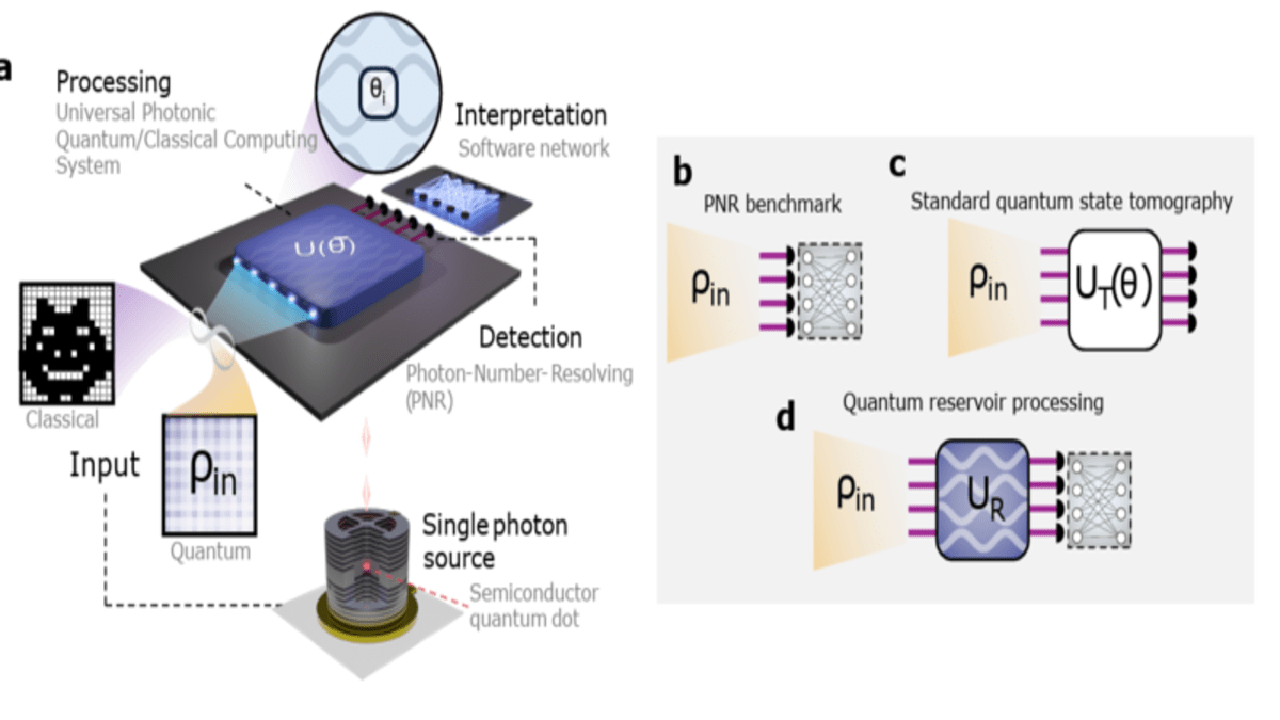
Quandela, a leader in photonic quantum computing, has achieved a significant milestone in advancing photonic quantum machine learning (QML) by demonstrating a quantum reservoir computing device on a programmable chip, leveraging silicon photonics technology. This research showcases Quandela’s Quantum Processing Unit (QPU) capable of executing both quantum information processing and classical machine learning tasks within a single experimental platform. This advancement substantially enhances the feasibility of hybrid quantum-classical learning approaches and opens new avenues for practical QML applications.
Technical / Clinical Details
- QML with Silicon Photonics: Quandela employs silicon photonics, compatible with existing semiconductor manufacturing processes, for its photonic quantum computing approach, where photons serve as qubits. Silicon photonics enables large-scale integration of optical circuits, contributing to the realization of low-cost, scalable quantum hardware.
- Demonstration of Quantum Reservoir Computing: The core of the research lies in the successful construction and demonstration of a quantum reservoir computing device on a programmable chip. Reservoir computing is a machine learning technique particularly effective for modeling time-series data and complex non-linear systems. Achieving this in the quantum domain promises performance benefits beyond classical reservoir computing.
- Collaboration with QUONDENSATE Consortium: This achievement was made possible through collaboration with the QUONDENSATE consortium, supported by the European Union. Such international partnerships are crucial for advancing complex quantum technology R&D efforts.
- Hybrid Quantum-Classical Learning: Quandela’s QPU provides both quantum information processing and classical machine learning capabilities on the same platform. This hybrid approach is central to overcoming the limitations of current NISQ (Noisy Intermediate-Scale Quantum) devices, combining the strengths of classical and quantum computers to build more powerful learning models.
Background & Context
Quantum Machine Learning (QML) is a burgeoning field at the intersection of AI and quantum computing, expected to drive innovations across data analysis, pattern recognition, and optimization. Photonic quantum computing, in particular, is considered a promising platform for QML due to its high speed, potential for room-temperature operation, and compatibility with existing optical communication infrastructures. The successful demonstration of quantum reservoir computing on a programmable chip marks a significant increase in the technological maturity of this field and a major step towards the commercialization of quantum AI applications. The development of such hybrid systems is indispensable for realizing practical quantum computers.
Strategic Significance & Outlook
Quandela’s achievement is poised to accelerate the development of scalable and practical photonic QML hardware, further propelling the convergence of quantum computing and AI. Quantum reservoir computing on programmable chips holds the potential to deliver breakthroughs in diverse areas, including financial time-series forecasting, modeling complex physical systems, and predicting new material properties. In the future, this technology is expected to be leveraged for processing larger quantum datasets and training complex AI models, ultimately establishing a “quantum advantage” over existing classical machine learning. Quandela is positioned to continue leading innovation at the forefront of this field.
Source: https://www.quandela.com/resources/blog/photonic-quantum-machine-learning/






Comments