Key Findings
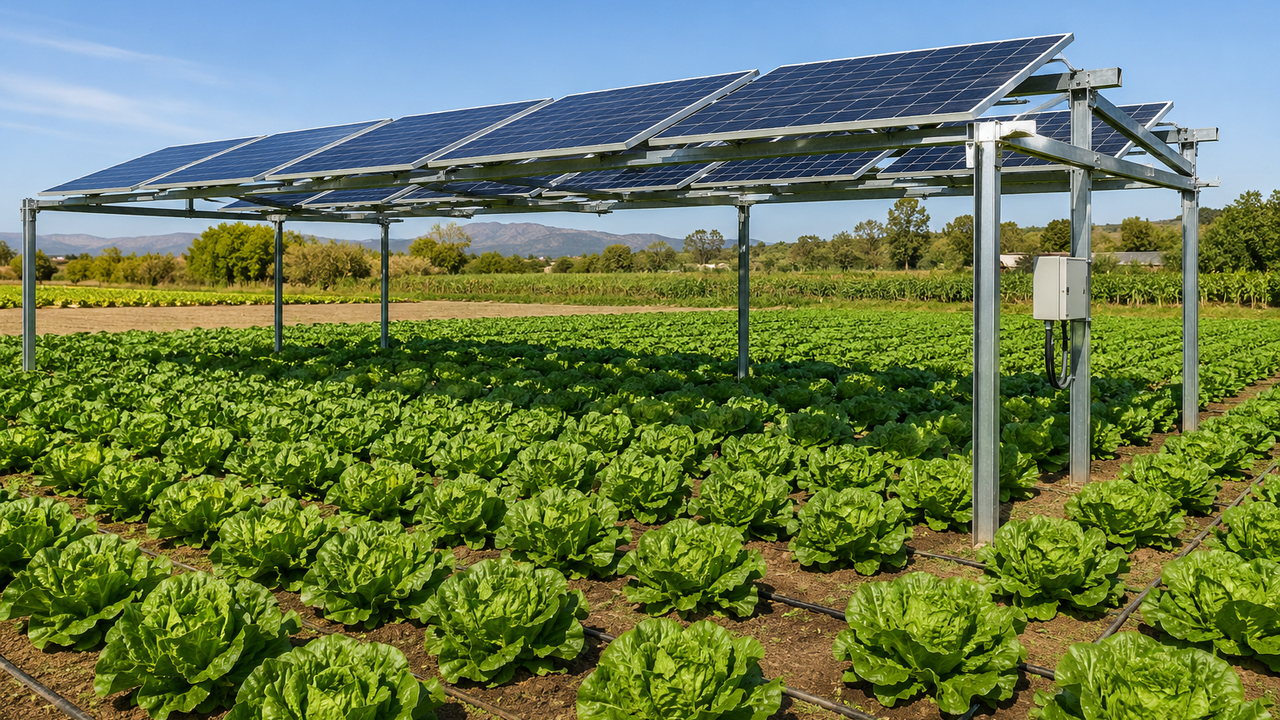
Researchers at Cornell University have evaluated the sustainability potential of integrating perovskite tandem PV (both perovskite-silicon and perovskite-perovskite configurations) into agrivoltaics lettuce production in the United States. This comprehensive “farm-to-fork” life cycle assessment (LCA) revealed that the coexistence of advanced tandem solar cells with agriculture can significantly reduce irrigation demand and substantially cut greenhouse gas emissions. Under favorable conditions, the study projects a potential annual offset of up to 30.9 million tons of CO₂ emissions and savings of approximately 8.4 billion m³ of water.
Technical & Environmental Details
The study focused on integrating perovskite tandem PV, including both perovskite-silicon and perovskite-perovskite configurations, into agrivoltaics systems for lettuce production across the U.S. The methodology employed a “farm-to-fork” life cycle assessment to comprehensively quantify environmental impacts. The integration demonstrated dual environmental benefits: a reduction in irrigation demand due to shading from the solar panels, which minimizes soil moisture evaporation and thus the water required for lettuce cultivation, and a significant reduction in Greenhouse Gas (GHG) emissions. The GHG reduction comes not only from direct electricity generation displacing fossil fuels but also from reduced energy consumption associated with water transportation and pumping, thanks to water savings. Quantitatively, under optimal conditions, the system could offset up to 30.9 million tons of CO₂ emissions and save approximately 8.4 billion m³ of water annually. This research underscores how perovskite tandem PV, with its ability to utilize a broader light spectrum more efficiently, combined with agrivoltaics’ environmental merits, can offer an innovative solution to the triple nexus challenge of food, energy, and water resources.
Background & Context
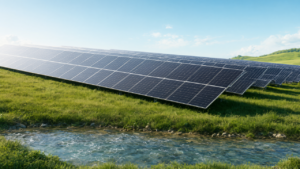
Agrivoltaics, the sustainable practice of co-locating solar power generation with agriculture, is gaining global attention as an efficient way to maximize limited land resources for both food and energy production. In the U.S., its adoption is particularly anticipated given vast agricultural areas and rising energy demands. Perovskite tandem solar cells are especially suited for agrivoltaics due to their high conversion efficiency and their ability to absorb a wider range of the solar spectrum than conventional silicon cells. This allows for module designs with specific light transmittance optimized for plant growth, potentially minimizing negative impacts on crop yields while maximizing energy output. Cornell University’s practical sustainability assessment plays a crucial role in facilitating technology adoption and clearly demonstrating the benefits to policymakers, farmers, and energy operators. This integrated approach is particularly vital amidst escalating global warming and water scarcity, as it addresses multiple environmental challenges simultaneously.
Strategic Significance & Outlook
The findings from Cornell University’s study highlight the immense potential of perovskite tandem PV in agrivoltaics. The projected annual CO₂ reductions of tens of millions of tons and water savings of billions of cubic meters could have a profound impact on both climate change mitigation and water resource conservation. If this research leads to further demonstration projects and policy support, agrivoltaics could become a leading strategy for achieving both renewable energy targets and food security. Investors should view this sector through an Environmental, Social, and Governance (ESG) lens, recognizing the potential for sustainable growth. Engineers will be crucial in developing new designs and deployment methods to optimize perovskite tandem PV for agricultural environments, ensuring both energy yield and crop vitality. This study illuminates a future where energy and food systems are more integrated and sustainable.
Source: https://www.pv-magazine.com/2026/06/17/perovskite-tandem-pv-for-agrivoltaics/
Get our weekly technology intelligence — free
Receive an infographic that lets you judge at a glance whether each field’s analysis report is worth reading.
Subscribe Free — Weekly Tech Intelligence
By subscribing, you’ll receive Troy-Technical’s weekly technology intelligence newsletter.
- Your email and selected fields are used only to deliver the newsletter.
- We never share your information with third parties.
- You can unsubscribe anytime via the link in each email.
See our Privacy Policy for details.
Takes about a minute · Unsubscribe anytime