Key Findings
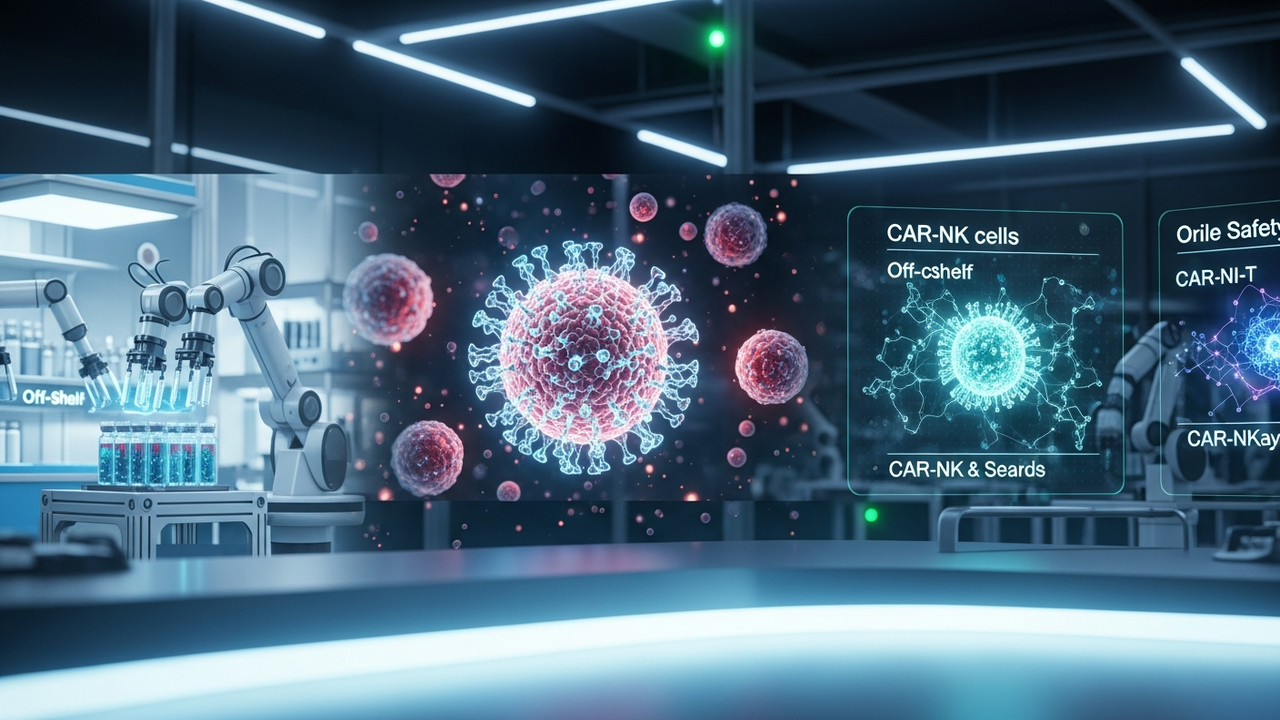
Chimeric Antigen Receptor (CAR)-modified Natural Killer (NK) cells are emerging as a promising immunotherapy strategy for solid tumor treatment, offering superior safety and the potential for off-the-shelf manufacturing compared to CAR-T cell therapies. A recent review comprehensively analyzes the current landscape and future directions of CAR-NK cell therapy in solid tumors.
Technical / Clinical Details
CAR-NK cells are engineered to express CARs, similar to CAR-T cells, enabling them to target specific cancer cell antigens. However, unlike CAR-T cells, CAR-NK cells do not require Major Histocompatibility Complex (MHC) compatibility, significantly reducing the risk of graft-versus-host disease (GVHD) in recipients. NK cells also possess intrinsic cytotoxic mechanisms (perforin/granzyme pathway, ADCC, etc.), allowing for non-specific killing of cancer cells in addition to CAR-mediated antigen recognition. The solid tumor microenvironment (TME) remains a significant challenge for CAR-NK cell therapy, as it is rich in immunosuppressive factors (e.g., TGF-β, PGE2) that hinder NK cell homing, infiltration, persistence, and activity within the tumor. Nevertheless, recent preclinical studies have demonstrated strategies to overcome these challenges, such as NK cell activation with cytokines like IL-15, improved homing through overexpression of chemokine receptors, or combination with immune checkpoint inhibitors. Early clinical trials have reported favorable safety profiles and limited but promising anti-tumor activity of CAR-NK cells in some solid tumors.
Background & Context
While CAR T-cell therapy has achieved remarkable success in hematological malignancies, its efficacy in solid tumors has been limited, and it carries the risk of severe side effects such as cytokine release syndrome (CRS) and neurotoxicity (ICANS). Furthermore, autologous CAR T-cell therapy is complex and expensive to manufacture, posing accessibility challenges for many patients. CAR-NK cell therapy has gained attention as a compelling alternative to address these issues. The use of iPSC (induced pluripotent stem cell)-derived NK cells offers the potential for large-scale, cost-effective manufacturing of quality-controlled, off-the-shelf allogeneic CAR-NK cell products, representing a groundbreaking step towards broader patient access. The development of CAR-NK cell therapy for solid tumors is positioned as the next frontier in cancer immunotherapy.
Strategic Significance & Outlook
Research into CAR-NK cell therapy for solid tumors is rapidly progressing. Future developments are expected to focus on novel molecular engineering strategies to further overcome NK cell dysfunction in the TME, such as dual CAR designs or ‘armored’ CAR-NK cells engineered for cytokine production. Combination therapies with other modalities (radiotherapy, chemotherapy, targeted agents, immune checkpoint inhibitors) could also generate synergistic effects and enhance anti-tumor efficacy. The next critical step involves establishing long-term safety, efficacy, and treatment durability through larger-scale human clinical trials. As CAR-NK cell therapy becomes part of standard solid tumor treatment, it promises to bring new hope to a significant number of cancer patients.
Source: https://pubmed.ncbi.nlm.nih.gov/42349415/
Get our weekly technology intelligence — free
Receive an infographic that lets you judge at a glance whether each field’s analysis report is worth reading.
Subscribe Free — Weekly Tech Intelligence
By subscribing, you’ll receive Troy-Technical’s weekly technology intelligence newsletter.
- Your email and selected fields are used only to deliver the newsletter.
- We never share your information with third parties.
- You can unsubscribe anytime via the link in each email.
See our Privacy Policy for details.
Takes about a minute · Unsubscribe anytime