Key Findings
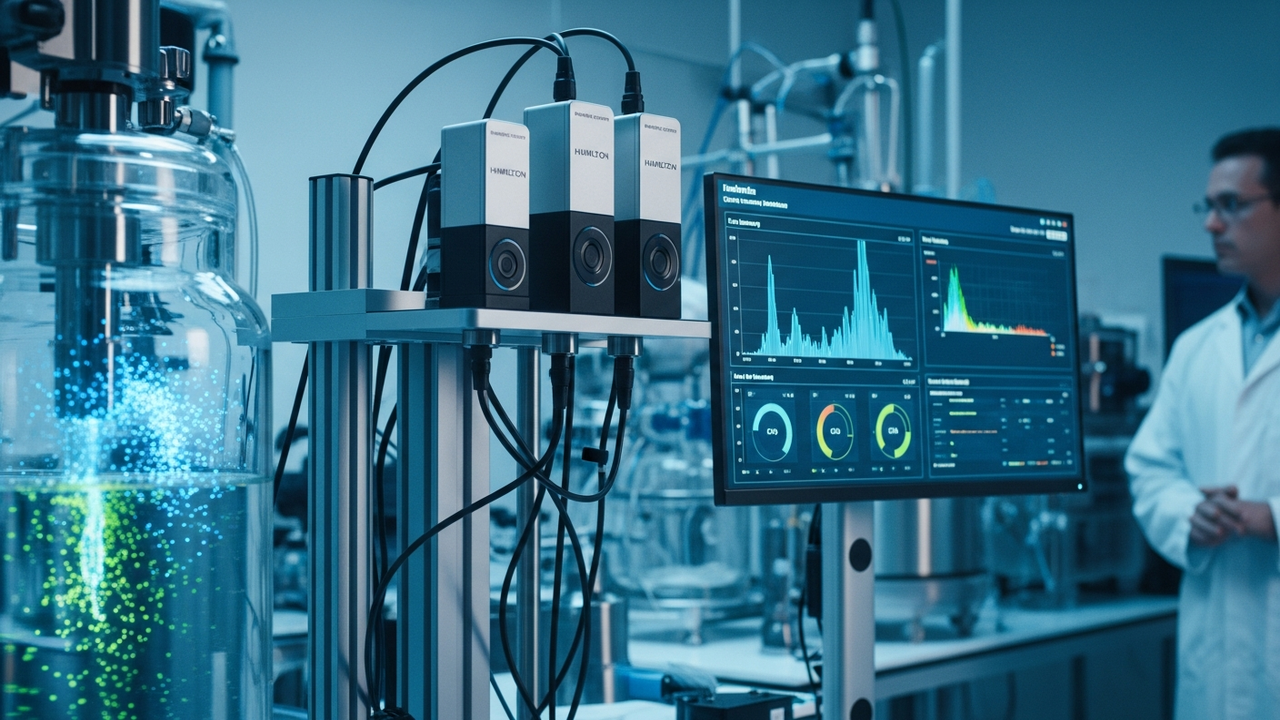
Hamilton has unveiled innovative in-line sensors for bioprocess monitoring at Interphex. These sensors are designed to dramatically enhance the understanding and control of biomanufacturing processes by offering continuous, real-time measurement capabilities for live cell density, total cell density, and dissolved CO2.
Technical/Clinical Details
The key products announced include:
- Incyte Arc: This advanced sensor measures live cell density, enabling non-invasive, real-time assessment of cell growth status in cell culture processes. This contributes to optimizing timing for cell harvest and nutrient feeding strategies.
- Dencytee Arc: An optical density-based total cell density sensor specifically designed for fermentation processes, providing accurate and continuous measurement of biomass in microbial cultures. Real-time insights into process progression support decisions on harvest timing and process adjustments.
- CO₂NTROL: A maintenance-free, in-line dissolved CO2 measurement system tailored for mammalian cell culture. By accurately monitoring CO2 concentrations, which directly reflect cellular respiration activity, it helps maintain environmental stability and promotes healthy cell growth. A key feature is the significant reduction in maintenance compared to traditional systems.
These sensors collectively facilitate data-driven decision-making, improve process consistency, and reduce batch-to-batch variability.
Background & Context
In the biomanufacturing industry, efficient and reliable control of complex biological processes has always been a challenge. Particularly for producing high-quality biopharmaceuticals and bioproducts, detailed real-time process information is indispensable. Traditional offline analyses are time-consuming and often fail to capture the full dynamics of the process. Hamilton’s new in-line sensors address these challenges and accelerate the industry’s trend toward digitalization and automation.
Strategic Significance & Outlook
These new sensor technologies from Hamilton are expected to play a crucial role in optimizing biomanufacturing processes and enhancing scalability. By combining real-time data with advanced process control strategies, improvements in productivity, cost reduction, and shorter time-to-market are anticipated. In the future, these sensors are likely to be integrated with AI and machine learning platforms, enabling more sophisticated predictive analytics and autonomous process control, thereby paving the way for next-generation smart biofactories.
Get our weekly technology intelligence — free
Receive an infographic that lets you judge at a glance whether each field’s analysis report is worth reading.
Subscribe Free — Weekly Tech Intelligence
By subscribing, you’ll receive Troy-Technical’s weekly technology intelligence newsletter.
- Your email and selected fields are used only to deliver the newsletter.
- We never share your information with third parties.
- You can unsubscribe anytime via the link in each email.
See our Privacy Policy for details.
Takes about a minute · Unsubscribe anytime