Key Findings
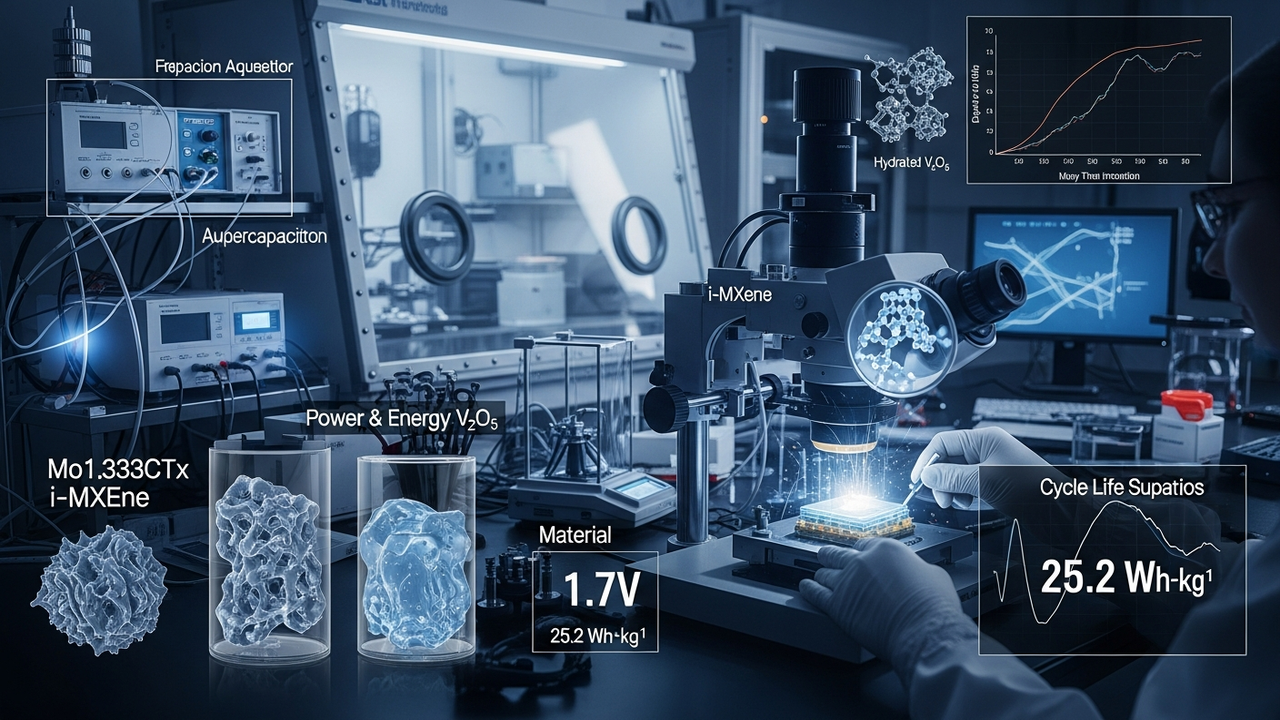
A research paper published in MDPI reports the development of a groundbreaking aqueous asymmetric supercapacitor using an ordered-vacancy Mo1.33CTx i-MXene/carbon nanotube (CNT) negative electrode and a hydrated V2O5·nH2O/CNT positive electrode. This device achieved a high stable operating voltage of 1.7 V, an impressive specific capacitance of 61 F·g−1 at 1 A·g−1, and an energy density of 25.2 Wh·kg−1, demonstrating remarkable cycling stability with 86% capacitance retention after 10,000 cycles.
Technical / Clinical Details
The design of this supercapacitor is based on the precise selection and optimization of electrode materials to achieve both high voltage and high energy density. The negative electrode employs a composite of ordered-vacancy (i-MXene) Mo1.33CTx MXene and CNTs. MXene, with its excellent conductivity and large specific surface area, enables rapid ion adsorption and charge storage. The ordered vacancies, in particular, contribute to improved ion transport pathways and increased capacity. The positive electrode utilizes a composite of hydrated V2O5·nH2O (vanadium pentoxide hydrate) and CNTs. Hydrated V2O5 is a redox-active material with a wide potential window and high capacity, with CNTs reinforcing its conductivity. By using a LiCl electrolyte, a high operating voltage of 1.7 V was achieved with an aqueous electrolyte, which is a significant advancement in achieving energy densities comparable to conventional organic electrolyte systems while maintaining inherent safety. The 86% capacitance retention after 10,000 cycles highlights the long-term reliability and significant potential for practical application of this device.
Background & Context
Supercapacitors are gaining attention as energy storage devices that bridge the gap between batteries and conventional capacitors, offering rapid charge/discharge rates, high power density, and long cycle life. Aqueous electrolyte-based supercapacitors, in particular, possess excellent safety and low cost, making their potential market very large. However, they traditionally suffered from low operating voltages and lower energy densities compared to organic electrolyte systems. MXene, a family of two-dimensional transition metal carbides, nitrides, or carbonitrides, has been highly anticipated as a next-generation supercapacitor electrode material due to its outstanding conductivity and ion transport properties. This research successfully leveraged the unique properties of MXene to dramatically enhance the performance of aqueous supercapacitors.
Strategic Significance & Outlook
The development of this high-voltage aqueous asymmetric supercapacitor has the potential to significantly impact various application fields, including electric vehicles, renewable energy storage systems, and portable electronic devices. Its high energy density and excellent cycling stability make it particularly suitable for regenerative braking systems in hybrid vehicles, stabilization of wind and solar power generation, and as auxiliary power for electrical grids. Future research and development will focus on large-scale production and cost reduction of this technology. This breakthrough is expected to accelerate the adoption of safe and high-performance next-generation energy storage devices, contributing significantly to the realization of a sustainable society.
Source: https://www.mdpi.com/2313-0105/12/7/231
Get our weekly technology intelligence — free
Receive an infographic that lets you judge at a glance whether each field’s analysis report is worth reading.
Subscribe Free — Weekly Tech Intelligence
By subscribing, you’ll receive Troy-Technical’s weekly technology intelligence newsletter.
- Your email and selected fields are used only to deliver the newsletter.
- We never share your information with third parties.
- You can unsubscribe anytime via the link in each email.
See our Privacy Policy for details.
Takes about a minute · Unsubscribe anytime