Key Findings
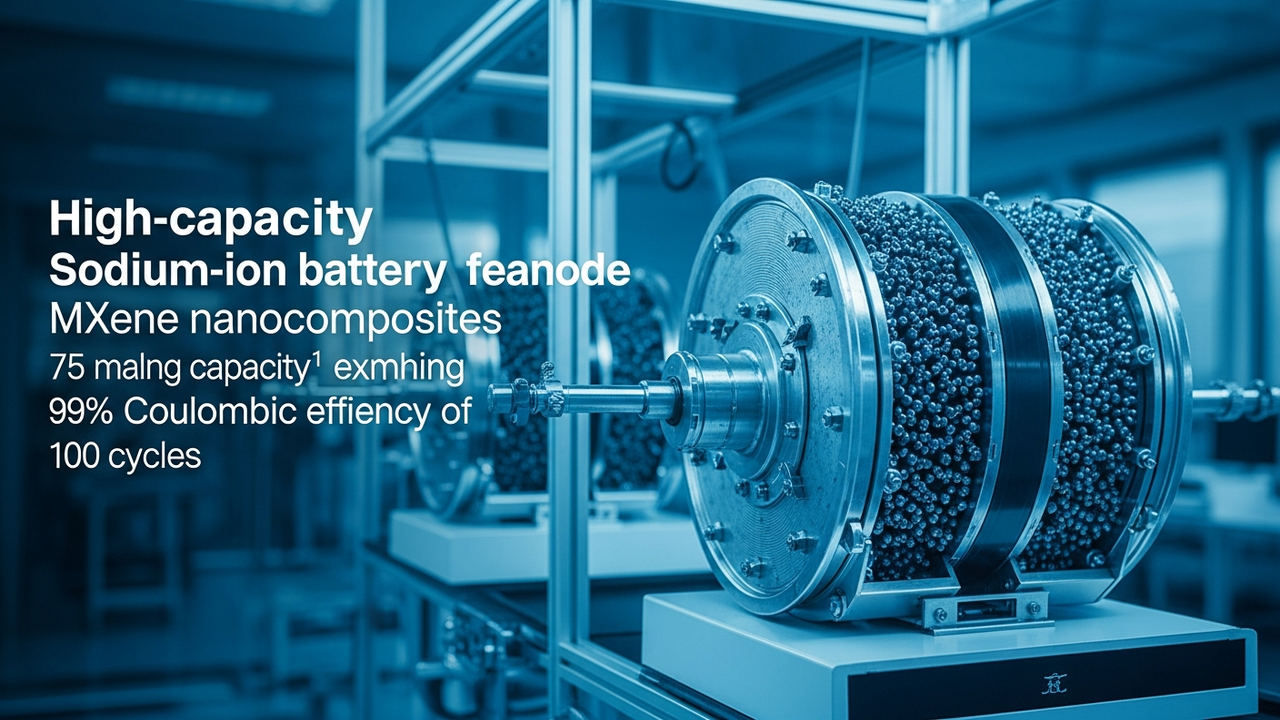
A novel Zn2GeO4/MXene nanocomposite has been successfully developed and demonstrated as a high-performance anode for sodium-ion batteries (SIBs), exhibiting remarkably enhanced electrochemical properties. This advanced material achieved a sustained reversible specific capacity of 75 mAh g-1 after 100 cycles at a current density of 100 mA g-1, alongside outstanding cycling stability and a Coulombic efficiency exceeding 99%.
Technical / Clinical Details
The innovative nanocomposite integrates high-capacity Zn2GeO4 with highly conductive MXene. While Zn2GeO4 offers a high theoretical capacity, it suffers from significant volume expansion during cycling, which typically degrades performance. The two-dimensional structure of MXene effectively encapsulates the Zn2GeO4 nanoparticles, mitigating volume changes and significantly enhancing the structural stability of the electrode. Furthermore, the layered architecture of MXene facilitates rapid insertion and de-insertion of sodium ions, enabling faster charge-discharge kinetics. This synergistic combination results in exceptional stability, maintaining most of its initial capacity over 100 cycles at low current densities and achieving near-100% Coulombic efficiency. This performance is a direct result of the high electrical conductivity provided by the MXene network and the precise morphological control achieved at the nanoscale.
Background & Context
Lithium-ion batteries (LIBs) dominate the current energy storage market, but concerns regarding the uneven distribution and high cost of lithium resources necessitate the exploration of sustainable alternatives. Sodium, being abundant and chemically similar to lithium, makes SIBs a highly promising candidate for next-generation, low-cost, and high-performance energy storage systems. However, a key challenge for SIB commercialization has been the development of anode materials that can match LIBs in terms of energy density and cycle life. Traditional carbonaceous anode materials struggle with the larger sodium ion size, which hinders efficient insertion and extraction, leading to lower capacity and stability issues.
Strategic Significance & Outlook
The successful development of the Zn2GeO4/MXene nanocomposite represents a significant leap forward for the practical realization of high-performance SIBs. This material design strategy is highly adaptable and can potentially be applied to other metal oxide and alloy-based anode materials, paving the way for further improvements in SIB energy density and longevity. Future research will focus on scaling up the synthesis of this material and optimizing its integration into commercial battery prototypes. The widespread adoption of SIBs could dramatically reduce energy storage costs across various applications, including renewable energy grids, smart grids, and electric vehicles, thereby making a substantial contribution to achieving a sustainable future. This breakthrough has the potential to redefine the landscape of energy storage technology.
Get our weekly technology intelligence — free
Receive an infographic that lets you judge at a glance whether each field’s analysis report is worth reading.
Subscribe Free — Weekly Tech Intelligence
By subscribing, you’ll receive Troy-Technical’s weekly technology intelligence newsletter.
- Your email and selected fields are used only to deliver the newsletter.
- We never share your information with third parties.
- You can unsubscribe anytime via the link in each email.
See our Privacy Policy for details.
Takes about a minute · Unsubscribe anytime