Key Findings
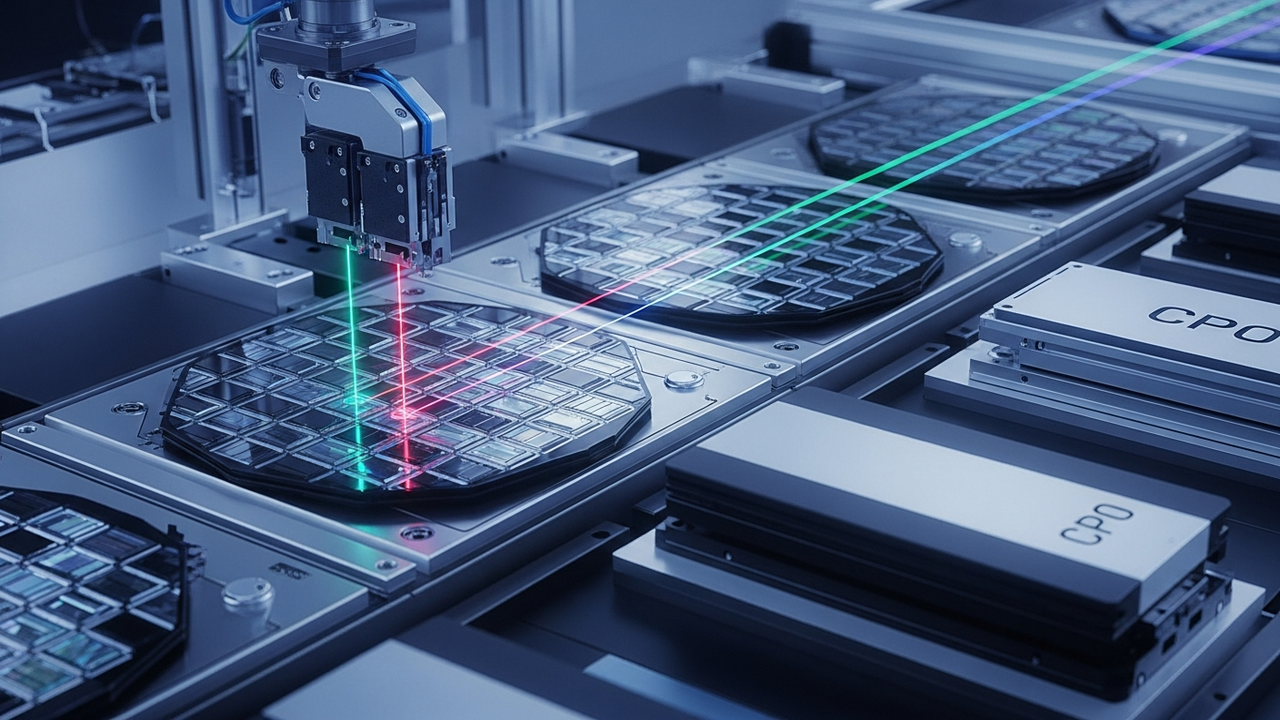
Leading AI chip developer Nvidia and communication semiconductor powerhouse Broadcom have fully embraced Co-Packaged Optics (CPO) and silicon photonics technologies, pushing their associated supply chain ecosystems into the volume production phase. This strategic move is intended to dramatically enhance data transfer capabilities and efficiency within AI data centers, promising to usher in a significant transformation across the industry.
Technical / Clinical Details
CPO technology involves integrating optical interconnects directly within the same package as processors or switching chips. This significantly reduces the electrical trace length between the chip and the optical module, leading to decreased signal loss, lower power consumption, and improved transmission latency. Silicon photonics, the foundational technology for CPO, enables the generation, modulation, transmission, and detection of optical signals on a silicon chip. The full-scale volume production by industry titans like Nvidia and Broadcom signifies that CPO has transcended research and development, entering a phase of widespread commercial application. This advancement will lead to a dramatic increase in data bandwidth between AI accelerators, ensuring the scalability of next-generation AI models and High-Performance Computing (HPC) systems.
Background & Context
As the scale and complexity of AI models continue to grow, the volume of data movement within AI data centers has exploded. Traditional copper-based electrical interconnects have struggled to keep pace with this enormous data traffic, leading to escalating power consumption and severe bandwidth bottlenecks. CPO and silicon photonics have emerged as the most promising technologies to address these challenges, garnering significant industry attention for their practical implementation. The comprehensive adoption and transition to volume production by industry giants such as Nvidia and Broadcom strongly pave the way for CPO to become a standard technology in AI infrastructure. This move is expected to create new business opportunities and profitability for various companies across the CPO supply chain, including optical module manufacturers, silicon photonics foundries, and advanced packaging providers.
Strategic Significance & Outlook
The entry of the CPO ecosystem into volume production marks a paradigm shift in the design and operation of AI data centers. This will further push the performance boundaries of AI computing, enabling the efficient processing of larger and more complex AI workloads. The widespread adoption of CPO technology will not only accelerate the growth of the optical communication components market but also profoundly impact related fields such as semiconductor manufacturing, packaging, and testing. In the future, CPO adoption is expected to expand beyond AI chips to include general-purpose CPUs and other high-performance processors, potentially evolving the entire data center architecture toward an optical-centric model. This technological innovation is set to further accelerate the application of AI in diverse fields such as autonomous driving, drug discovery, and climate simulation, serving as a powerful catalyst for digital transformation globally.
Source: https://finance.biggo.com/news/18d4225c-e1a8-4df5-9217-be8dc0929a91
Get our weekly technology intelligence — free
Receive an infographic that lets you judge at a glance whether each field’s analysis report is worth reading.
Subscribe Free — Weekly Tech Intelligence
By subscribing, you’ll receive Troy-Technical’s weekly technology intelligence newsletter.
- Your email and selected fields are used only to deliver the newsletter.
- We never share your information with third parties.
- You can unsubscribe anytime via the link in each email.
See our Privacy Policy for details.
Takes about a minute · Unsubscribe anytime








Comments