Key Findings
ACS Material’s recent expert article underscores a critical insight into Thermal Interface Material (TIM) performance evaluation: the total thermal resistance of a TIM joint is composed of the thermal resistance of the bond line itself and the contact resistance at the interfaces between the TIM and the contacting surfaces. This highlights that relying solely on a single bulk thermal conductivity value from a datasheet is insufficient for accurately predicting the real-world thermal performance of an assembled device stack, particularly in thin bond line applications where contact resistance can become dominant.
Technical Details
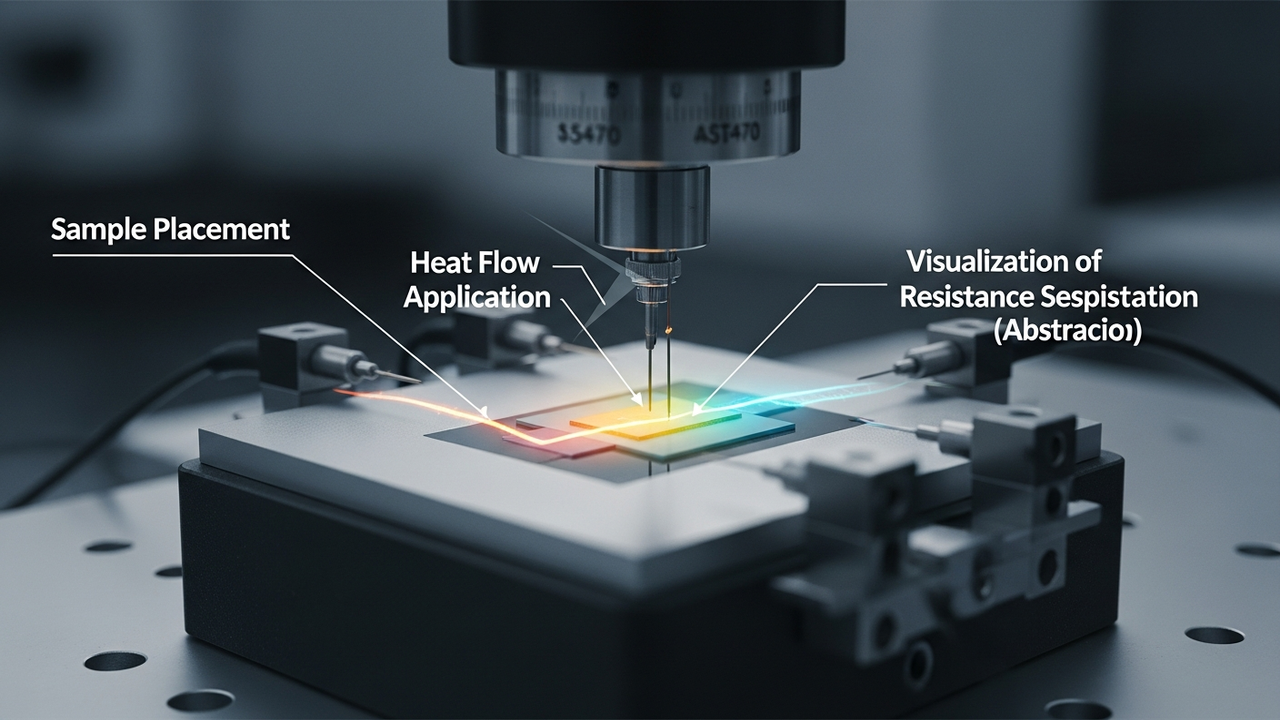
The article elaborates on the limitations of traditional TIM performance assessment. Often, thermal conductivity values provided by manufacturers represent the bulk properties of the material, which may not accurately reflect the thermal performance in an actual assembled stack. This discrepancy is particularly pronounced when bond line thicknesses are very small (e.g., below tens of micrometers) or when the TIM does not achieve perfect wetting and adhesion to the heat source and heatsink surfaces, in which cases interfacial contact resistance can account for a significant portion of the total thermal resistance. To address this, the article strongly recommends utilizing the ASTM D5470 standard’s thickness-series testing method. This technique involves measuring the thermal resistance of TIM samples at various thicknesses. By performing a linear regression analysis on these results, it is possible to independently quantify both the bond line’s thermal conductivity (representing the material’s intrinsic bulk thermal conductivity) and the interfacial contact thermal resistance. This approach allows engineers to gain a far more accurate understanding of a TIM’s true performance in a specific application, facilitating optimal material selection.
Background & Context
Modern electronic devices, including high-performance computing (HPC), AI chips, power electronics, and LED lighting, face increasingly high heat flux densities. Efficient thermal management is a decisive factor for ensuring device performance, reliability, and longevity. TIMs play an essential role in creating an effective thermal pathway from the heat source to the heatsink. However, an overestimation of TIM performance can lead to inadequate thermal designs, risking thermal runaway and premature device failure. Therefore, establishing accurate and comprehensive TIM evaluation methodologies is crucial for enhancing overall industry reliability.
Strategic Significance & Outlook
The widespread adoption of standardized testing methods like ASTM D5470 will streamline the TIM selection and design process, significantly improving the accuracy of thermal performance predictions for electronic products. Going forward, the industry will focus on developing new TIM materials that achieve even thinner bond lines and lower contact resistance, alongside the evolution of evaluation techniques that more faithfully replicate real operating environments. This precise evaluation framework is indispensable for solving complex thermal management challenges in next-generation devices such as AI processors and high-speed memory, thereby accelerating the further advancement of high-performance electronics. Investors and researchers should note the increasing importance of TIM evaluation technology as a foundational element supporting the growth of the high-performance device market.
Source: https://www.acsmaterial.com/blog-detail/thermal-interface-material-measurement.html
Get our weekly technology intelligence — free
Receive an infographic that lets you judge at a glance whether each field’s analysis report is worth reading.
Subscribe Free — Weekly Tech Intelligence
By subscribing, you’ll receive Troy-Technical’s weekly technology intelligence newsletter.
- Your email and selected fields are used only to deliver the newsletter.
- We never share your information with third parties.
- You can unsubscribe anytime via the link in each email.
See our Privacy Policy for details.
Takes about a minute · Unsubscribe anytime